

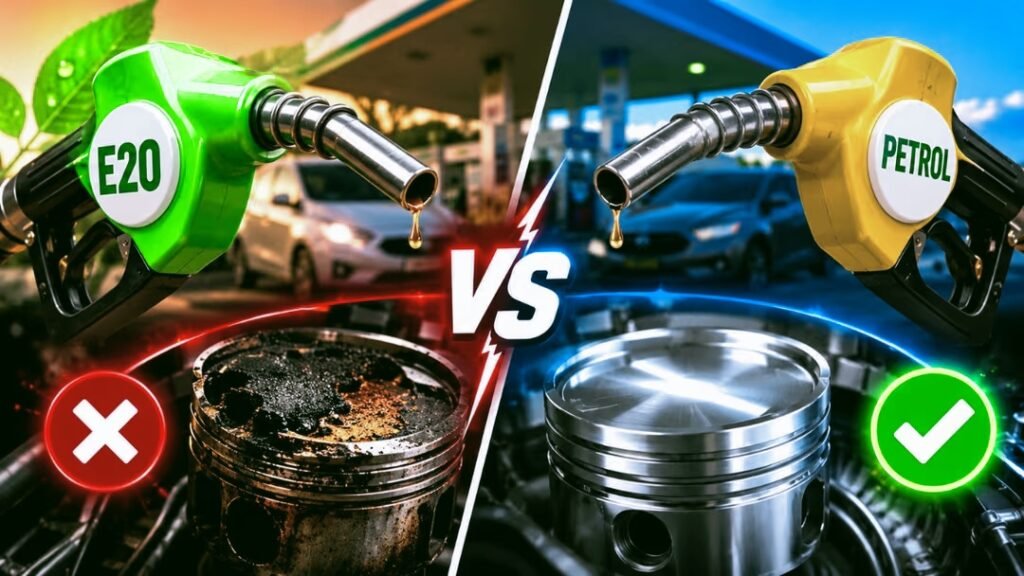

New Delhi, India | Since April 1, 2026, E20 petrol—a blend of 20% ethanol and 80% gasoline—has become the standard fuel available at petrol stations across India. While the move is a major step toward reducing the country’s dependence on imported crude oil and lowering emissions, it has also raised concerns among millions of vehicle owners about reduced fuel efficiency, higher running costs, and possible engine damage, especially in older vehicles.
Here’s a detailed look at how E20 compares with normal petrol, what experts say, and what it means for motorists in 2026.
What Is E20 Fuel?
E20 fuel is a blend containing 20% ethanol and 80% petrol. Ethanol is a renewable biofuel produced primarily from sugarcane, corn (maize), and other agricultural crops. It offers a higher octane rating, which helps improve combustion and reduce engine knocking. However, ethanol contains 27–30% less energy than pure gasoline, making it less fuel-efficient on a per-liter basis.
E20 vs. Normal Petrol: Key Differences
Compared to traditional petrol, E20 generally delivers 2–7% lower fuel economy in newer vehicles that are specifically designed for ethanol-blended fuel. In older vehicles, especially those manufactured before 2023, some drivers have reported 10–20% or even greater mileage loss.
On the positive side, E20 significantly lowers greenhouse gas emissions, reduces India’s dependence on imported crude oil, and creates new income opportunities for farmers by increasing demand for ethanol-producing crops.
Major Benefits of E20 Petrol
The Indian government’s nationwide transition to E20 fuel is aimed at achieving multiple long-term goals.
One of the biggest advantages is energy security. By replacing a portion of imported crude oil with domestically produced ethanol, India has already substituted more than 245 lakh metric tonnes of crude oil, resulting in foreign exchange savings exceeding ₹1.44 lakh crore.
The shift also benefits the environment, as ethanol burns cleaner than conventional petrol, reducing carbon dioxide emissions and other harmful pollutants.
In addition, the policy supports Indian farmers, particularly those growing sugarcane and maize, by creating a stable market for ethanol production and generating an estimated ₹40,000 crore in additional annual farm income.
For vehicles specifically designed to run on E20, the fuel’s higher octane rating may also improve engine performance and provide smoother acceleration under city driving conditions.
Consumer Concerns and Reported Problems
Despite its environmental benefits, fuel efficiency remains the biggest concern among vehicle owners.
Many drivers have reported a noticeable drop in mileage, particularly in vehicles that were not originally engineered for E20 fuel. Surveys suggest that while modern BS6-compliant vehicles experience only a modest reduction, older cars and motorcycles may suffer significantly larger losses.
Another issue involves engine components. Because ethanol absorbs moisture and has corrosive properties, it may accelerate wear in older rubber seals, fuel hoses, and fuel pumps that were not designed for higher ethanol concentrations.
As a result, some motorists say they are spending more on fuel, even though the price per liter remains similar to conventional petrol.
A LocalCircles survey found that nearly half of owners of older vehicles reported a noticeable decline in fuel economy after switching to E20.
Government and Industry Response
The Indian government maintains that all petrol vehicles manufactured after April 2023 are E20-compatible and should operate without major issues.
Officials have also emphasized that reports claiming 50% or greater mileage loss are not supported by controlled scientific studies.
Manufacturers recommend regular maintenance, periodic inspection of the fuel system, and following the vehicle’s maintenance schedule to ensure reliable operation.
Meanwhile, India is already preparing for higher ethanol blends, including E22, E30, E85, and E100, along with the introduction of more flex-fuel vehicles in the coming years.
Who Should Use E20?
Owners of newer cars and motorcycles manufactured after 2023 can generally use E20 fuel without concern, as these vehicles were designed to handle higher ethanol blends.
Drivers of older vehicles should consult their owner’s manual or visit an authorized service center to verify compatibility. Regular maintenance becomes especially important to minimize potential long-term wear.
Motorists whose primary concern is maximum fuel economy may notice a slight increase in monthly fuel expenses due to the lower energy content of ethanol.
Future Outlook
India’s ethanol blending program is expected to expand even further, with the government targeting higher ethanol blends and wider adoption of flex-fuel technology by 2030. The initiative forms a key part of the country’s long-term strategy to strengthen energy independence, reduce carbon emissions, and support sustainable agriculture.
Conclusion
The nationwide rollout of E20 petrol represents a significant milestone in India’s clean energy transition. While the fuel delivers substantial benefits for the environment, farmers, and national energy security, it also presents practical challenges for some vehicle owners, particularly those driving older models.
For most new-generation vehicles, E20 is expected to function normally with only a minor reduction in fuel economy. However, owners of older vehicles should remain attentive to maintenance requirements and manufacturer recommendations.
Ultimately, experts advise motorists to follow the vehicle manufacturer’s guidance, maintain their engines properly, and monitor real-world mileage to determine how E20 performs in their individual vehicles.