


ISRO Scientists Highlight Gaganyaan Mission, Human Spaceflight Programme and India’s Long-Term Plans for Bharatiya Antariksh Station
Raipur : The National Institute of Technology (NIT) Raipur celebrated National Space Day with a series of technical interactions, expert sessions and an innovation challenge focused on India’s expanding space programme.
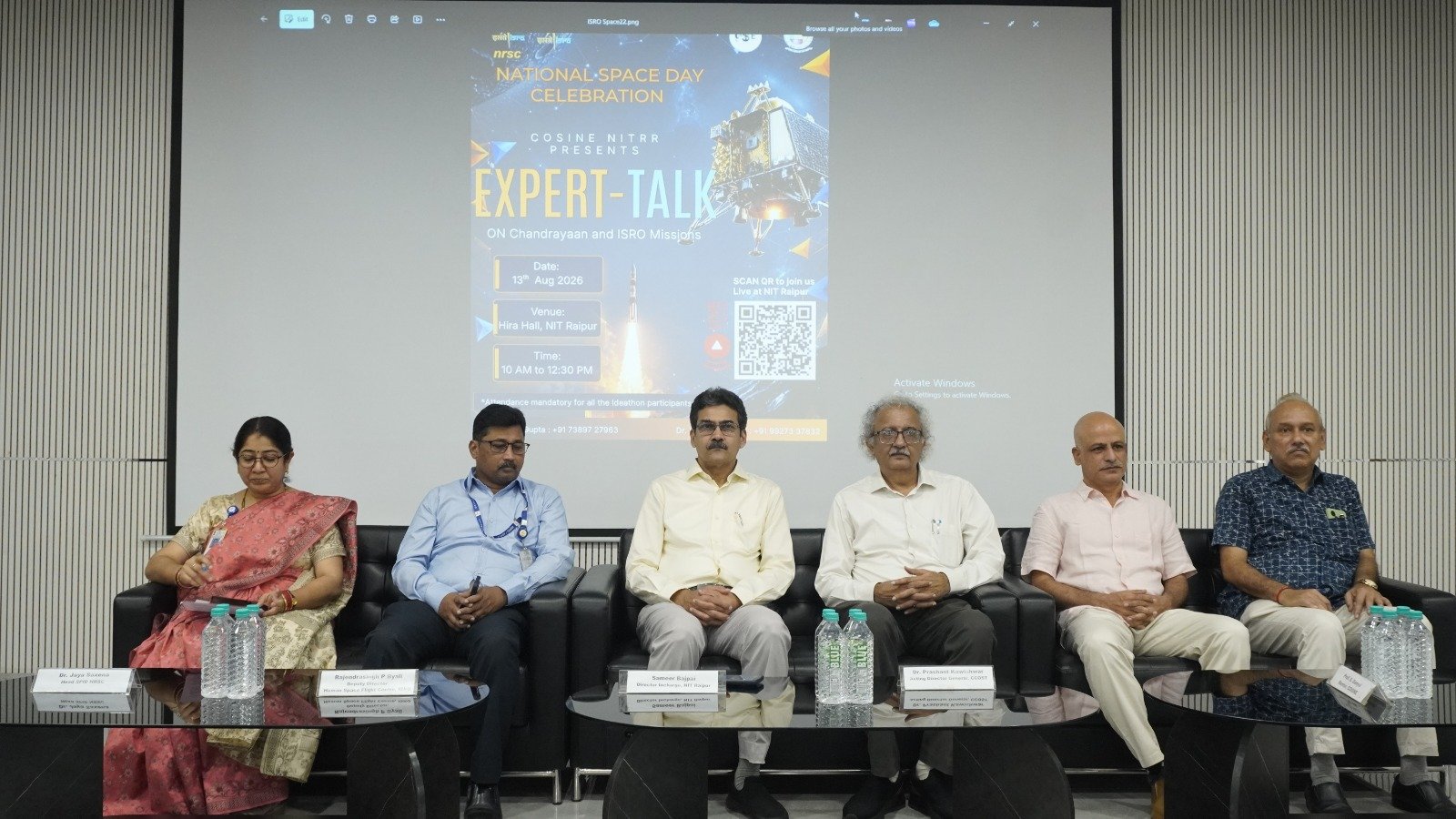
The event was organised by the institute’s Centre of Space & Interplanetary Exploration (COSINE) in association with the National Remote Sensing Centre (NRSC), ISRO, and featured detailed discussions on India’s achievements in space exploration, the Gaganyaan Mission, the Human Space Flight Programme and emerging applications of space and geospatial technologies.
The programme was followed by a SpaceTech Ideathon Challenge, providing students and young innovators an opportunity to develop technology-driven solutions to real-world societal challenges.
ISRO Scientists and Senior Officials Attend Event
The event was attended by senior officials, scientists, faculty members, students and young innovators.
The key participants included:
- Shri Prashant Kavishwar, Acting Director General, Chhattisgarh Council of Science and Technology (CCOST) — Chief Guest
- Shri Rajendrasingh P. Byali, Deputy Director, Human Space Flight Centre (HSFC), ISRO — Guest of Honour
- Dr. BHM Darukesha, Group Head, HSFC, ISRO
- Prof. Samir Bajpai, Director In-Charge, NIT Raipur
- Prof. S. Sanyal, Mentor, COSINE
- Faculty members, ISRO scientists, students and young innovators
The programme was organised under the guidance of Dr. Saurabh Gupta, Head, COSINE; Dr. Jaya Saxena, NRSC, ISRO; Dr. Himanshu Govil, Member, COSINE; and Dr. Kapil Soni, Member, COSINE.
National Space Day Highlights India’s Space Achievements
Addressing the gathering, Dr. Jaya Saxena highlighted the significance of National Space Day and India’s historic achievement in space exploration through the soft landing of the Vikram lander during the Chandrayaan-3 mission.
She emphasised the importance of encouraging students to pursue scientific research and innovation and noted the enthusiastic participation of students from across Chhattisgarh.
The focus, she said, should be on transforming young students into future innovators, researchers and technology developers.
Space Technology Should Reach Society: CCOST
Chief Guest Shri Prashant Kavishwar, Acting Director General of CCOST, stressed the importance of making space technology more accessible and relevant to ordinary citizens.
He emphasised that developments in the space sector should ultimately contribute to solving problems faced by society.
Drawing an analogy from E = MC², he linked energy with the potential of young minds and highlighted the role of students in driving innovation.
He encouraged young participants to use their scientific knowledge and creativity to contribute to India’s technological progress.
NIT Raipur Highlights ISRO’s Technological Achievements
Prof. Samir Bajpai, Director In-Charge of NIT Raipur, described ISRO’s achievements as a matter of national pride.
He highlighted space technology as a strong example of the integration of multiple engineering and technological disciplines.
According to him, the space sector brings together expertise from areas such as:
Mechanical Engineering + Electronics + Computer Science + Artificial Intelligence + Biomedical Engineering + Robotics + Remote Sensing
He encouraged students to pursue innovative projects in space technology and extended his best wishes for India’s upcoming space programmes.
Gaganyaan Mission: ISRO Explains India’s Human Spaceflight Programme
One of the major highlights of the event was the technical session by Shri Rajendrasingh P. Byali, Deputy Director at the Human Space Flight Centre (HSFC), ISRO.
He provided detailed insights into India’s Human Space Flight Programme and the Gaganyaan Mission.
He explained how India’s human spaceflight programme has developed since its announcement in 2018, involving extensive work in several critical areas.
These include:
- Human-rating of launch systems
- Astronaut selection and training
- Crew safety
- Microgravity experiments
- Mission operations
- Recovery operations
He also highlighted the involvement of the Indian Air Force in astronaut selection and training.
India’s Long-Term Goal: Bharatiya Antariksh Station
The ISRO official also discussed India’s long-term ambitions in human spaceflight.
One of the major goals is the development of the Bharatiya Antariksh Station, India’s planned space station.
The programme represents a broader transition in India’s space activities—from robotic exploration and satellite missions towards sustained human presence and research in space.
Byali emphasised that Gaganyaan is a national endeavour requiring contributions from institutions across the country.
He also encouraged NIT Raipur to contribute to the human spaceflight programme by developing compact, low-power microgravity experiments that can potentially be adapted for space missions.
Human Spaceflight Involves Complex Engineering
Dr. BHM Darukesha, Group Head at HSFC, provided another detailed technical perspective on India’s human spaceflight ambitions.
He highlighted the historic significance of Chandrayaan-3’s soft landing and encouraged students to participate actively in India’s growing space ecosystem.
His session covered several critical aspects of human spaceflight, including:
Human-Rated Launch Vehicles
Launch vehicles carrying astronauts require additional safety and reliability standards compared with conventional satellite-launch missions.
Crew Escape Systems
Crew escape systems are designed to provide astronauts with a means of escaping the spacecraft in the event of a serious launch emergency.
Environmental Control and Life Support Systems
These systems maintain essential conditions inside the spacecraft, including oxygen, temperature, pressure and other environmental parameters required for crew survival.
Orbital Operations and Re-entry
The session also covered orbital operations, deboosting, parachute deployment and crew recovery following the mission.
Biomedical Engineering Will Play a Critical Role
A major focus of the discussion was the importance of Biomedical Engineering in human spaceflight.
Space missions expose astronauts to environmental conditions that are very different from those on Earth.
Biomedical research can contribute to:
- Crew health monitoring
- Human performance
- Biomedical research
- Life-support systems
- Astronaut training
- Understanding the effects of microgravity
One major challenge discussed was loss of bone density during prolonged exposure to microgravity.
Researchers therefore need to develop effective countermeasures that can help maintain astronaut health during extended space missions.
Microgravity Research Can Create New Technologies
The experts also discussed the potential of conducting experiments under microgravity conditions.
Areas highlighted included:
- Crystallisation
- Combustion
- Biomedical research
- Human physiology
- Materials research
Dr. Darukesha encouraged students to move beyond theoretical ideas and convert scientific problems into practical, compact payloads that could potentially be tested in space.
This approach can help bridge the gap between academic research and real-world space applications.
Students Interact Directly With ISRO Scientists
The expert sessions were followed by an interactive question-and-answer session.
Students and participants raised questions related to:
- Human spaceflight
- Astronaut safety
- Biomedical research
- Microgravity experiments
- Space-ready payload development
- Future opportunities in the space sector
The interaction demonstrated the increasingly interdisciplinary nature of India’s space programme.
Modern space missions require expertise across engineering, biomedical sciences, artificial intelligence, remote sensing, robotics and other emerging technologies.
The first half of the programme concluded with a vote of thanks by Dr. S. Sanyal.
SpaceTech Ideathon Focuses on Societal Problems
The second half of the programme featured the SpaceTech Ideathon Challenge along with a workshop titled:
“Deep Tech with Geospatial Technology to Solve Societal Problems”
The initiative provided students, researchers and young innovators with a platform to develop and present technology-driven solutions to real-world challenges.
The focus on geospatial technology reflects the growing role of satellite data, remote sensing and location-based intelligence in sectors such as:
Agriculture, disaster management, urban planning, infrastructure, environment and public services.
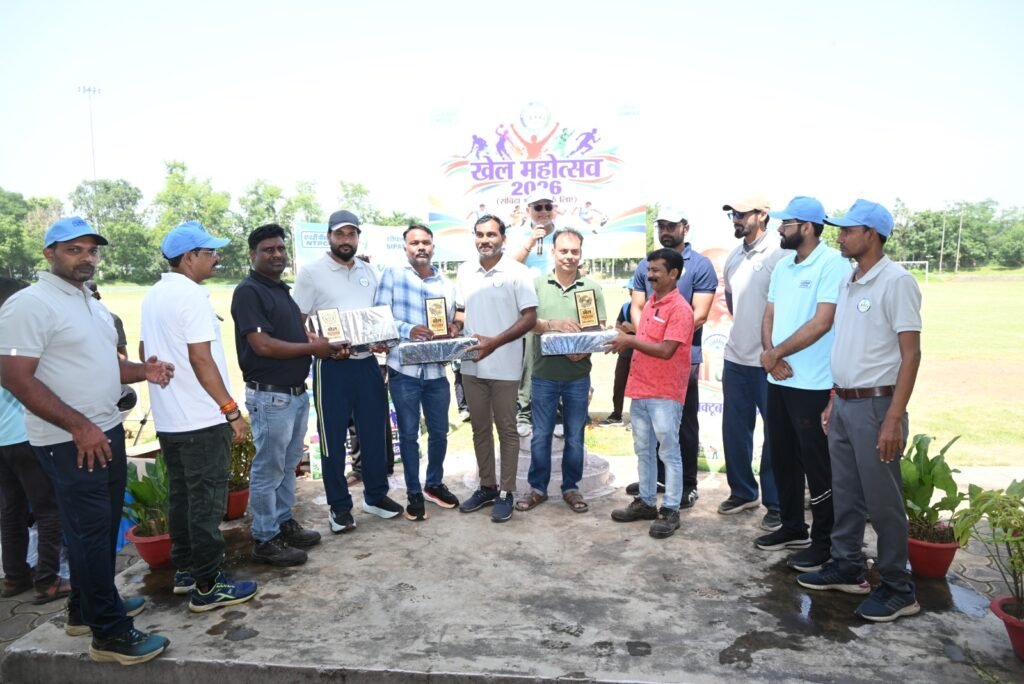
Team Sanjeevani Wins the Ideathon
The competition saw participation from teams representing various educational institutions.
The final results were:
🏆 First Position
Team Sanjeevani — SSIPMT, Raipur
🥈 Second Position
Team Sail IGKV — IGKV, Raipur
🥉 Third Position
Team Fuego — CSVTU
First Consolation Prize
Team Pookie Rangers — NIT Raipur
Second Consolation Prize
Team Bio Extreme
The results highlighted the growing interest among students in combining space technology, deep-tech and geospatial applications to address societal challenges.
Why Events Like This Matter for India’s Space Sector
India’s space programme is entering a phase in which the role of students, universities, startups and private-sector innovators is becoming increasingly important.
Programmes such as the Gaganyaan Mission and India’s long-term plans for a Bharatiya Antariksh Station require a large ecosystem of scientists, engineers, medical researchers, software developers and technology entrepreneurs.
Academic institutions such as NIT Raipur can play an important role by providing:
- Research and development
- Student innovation
- Space-ready experiments
- Deep-tech startups
- Skilled manpower
- Interdisciplinary research
The National Space Day programme therefore served not only as a celebration of India’s achievements but also as a platform to connect students and researchers with India’s future space missions.
Conclusion
The National Space Day celebration at NIT Raipur brought together ISRO scientists, academic leaders, students and young innovators to discuss India’s rapidly expanding space capabilities.
The technical sessions provided detailed insights into the Gaganyaan Mission, human spaceflight, astronaut safety, biomedical engineering and microgravity research, while the SpaceTech Ideathon encouraged participants to develop practical solutions using deep-tech and geospatial technologies.
With India’s ambitions expanding from lunar exploration to human spaceflight and the Bharatiya Antariksh Station, the event highlighted the crucial role that young scientists, universities and innovators can play in shaping the country’s next phase of space exploration.
Source: NIT Raipur / event information provided for publication.