

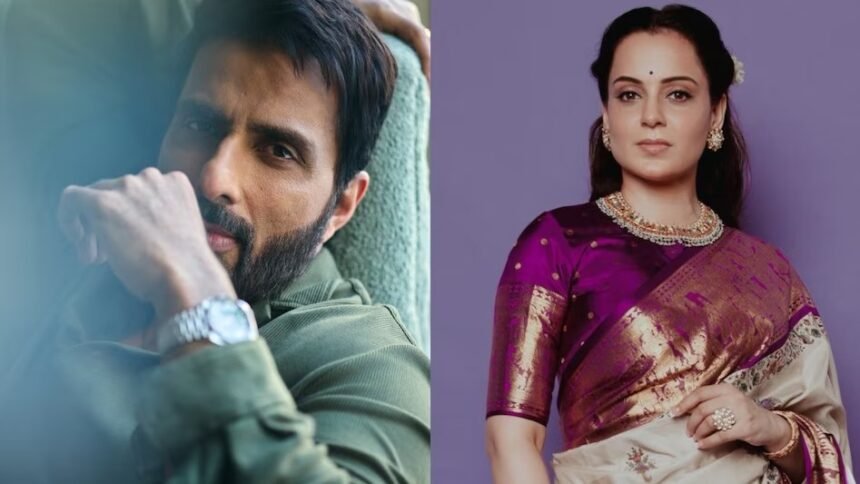

Mumbai | Bollywood actress and BJP Member of Parliament Kangana Ranaut has once again found herself at the center of a public controversy after her alleged use of the phrase “gutter generation” while referring to certain youths during a student protest at Jantar Mantar. The remark has triggered widespread criticism on social media and drawn reactions from several public figures, including actor Sonu Sood, who described such language as “shameful” if it was indeed used.
As the controversy intensified, Kangana Ranaut issued a clarification, stating that her comments were not directed at an entire generation of young people, but were instead aimed at what she described as inappropriate behavior in public spaces.
Sonu Sood Urges Public Figures to Choose Their Words Carefully
Speaking to the media, Sonu Sood expressed concern over the reported remark and emphasized the importance of responsible communication by public personalities.
He said that if such words had been used, they were inappropriate, adding that the well-known principle of “Think before you speak” applies to everyone in public life.
According to Sood, young people and the public are the foundation of every artist’s success and recognition, and therefore deserve to be addressed with respect and dignity.
He further noted that whether someone is an actor, doctor, or professional in any field, their achievements ultimately depend on the trust and support of the people. Without public confidence, he said, even significant accomplishments lose their value.
Kangana Ranaut Clarifies Her Statement
Responding to the growing criticism, Kangana Ranaut released a clarification through social media and interactions with the press.
In a video shared on the occasion of Guru Purnima, she explained that her remarks were made in the context of the Jantar Mantar protest related to the NEET-UG 2026 paper leak controversy.
According to Ranaut, her comments were specifically directed at alleged indecent language and inappropriate conduct displayed by certain individuals during the protest, rather than the youth community as a whole.
She maintained that public spaces should uphold standards of civility, particularly when children, women, and elderly citizens are present.
Concern Over Public Conduct
During her interaction with journalists, Kangana stated that her objection was to activities she considered against public decency and social values.
She argued that society should not normalize behavior that, in her view, could negatively influence young people or undermine public decorum.
Her clarification sought to distinguish criticism of specific conduct from criticism of an entire generation.
Social Media Divided
The controversy has generated extensive discussion across social media platforms, where opinions remain sharply divided.
Supporters of Kangana Ranaut argue that she was highlighting concerns about public behavior and discipline, while critics contend that the phrase attributed to her was disrespectful toward young people and could be interpreted as a sweeping generalization.
The debate has reignited broader conversations about:
- Freedom of expression
- Responsible public communication
- Respectful political discourse
- The influence of celebrities and elected representatives on public opinion
Background
The controversy emerged following demonstrations at Jantar Mantar, where students protested issues related to the NEET-UG 2026 paper leak. During discussions surrounding the protest, Kangana Ranaut allegedly used the phrase that has since become the focus of public debate.
While her critics viewed the remark as offensive to the younger generation, Kangana has maintained that her comments were misinterpreted and were intended only to criticize specific instances of alleged inappropriate behavior.
Ongoing Public Debate
The incident has once again highlighted the intense scrutiny faced by public figures, particularly when commenting on sensitive social and political issues. As discussions continue online and in the media, the controversy underscores the importance of carefully chosen language, especially by individuals in influential public positions.
With differing interpretations of Kangana Ranaut’s remarks continuing to circulate, the issue remains a topic of public discussion, reflecting broader debates over free speech, accountability, and respectful public dialogue in contemporary India.