

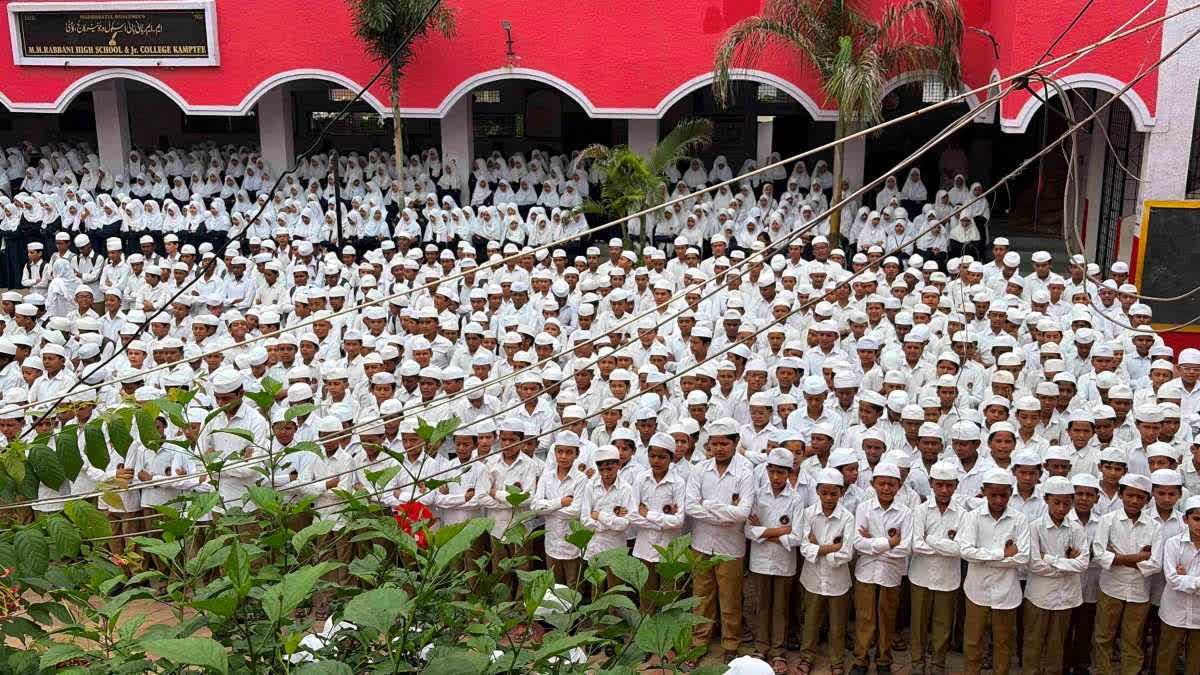

M.M. Rabbani School in Kamptee has preserved the tradition of students wearing the iconic Gandhi cap for 94 years, connecting its young generation with the values of Mahatma Gandhi and India’s freedom movement.
Nagpur (Maharashtra): The Gandhi cap, once a powerful symbol of India’s freedom struggle and closely associated with Mahatma Gandhi, may have largely disappeared from everyday life in modern India. However, a school in Kamptee, Nagpur district, has kept this historic tradition alive for nearly a century.
At M.M. Rabbani School, students have been wearing the white Gandhi cap as part of their school uniform for the past 94 years. The tradition, which began when the school was established in 1932, continues to this day.
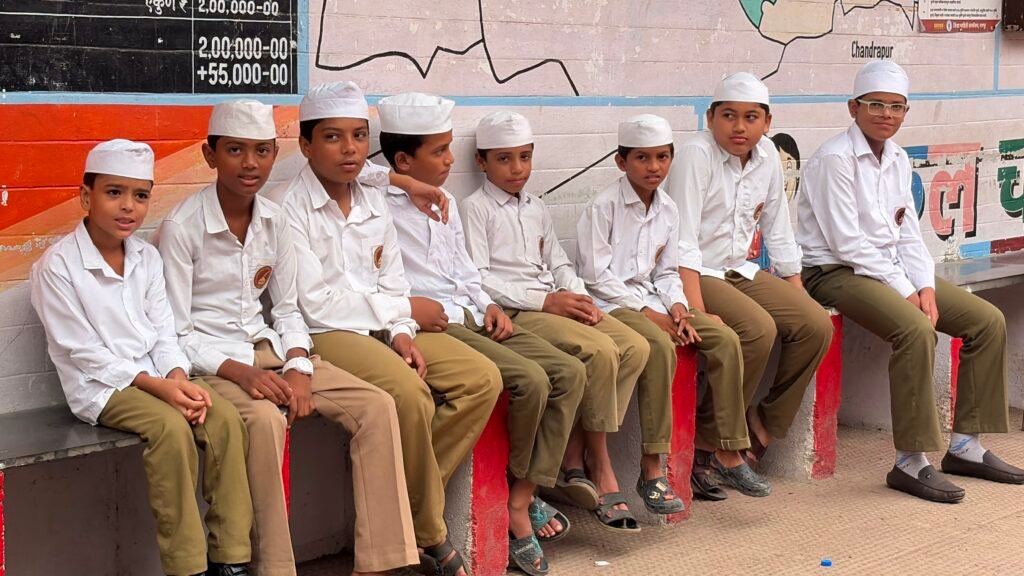
The practice has turned the Gandhi cap into more than just an item of clothing. For the students, it represents self-respect, dignity, simplicity, national unity and the ideals associated with Mahatma Gandhi.
A 94-Year-Old Tradition
M.M. Rabbani School was established in 1932 by M.M. Rabbani to provide education to children from the Muslim community.
It was a period when India’s freedom movement was gaining momentum and Mahatma Gandhi’s campaigns were inspiring people across the country.
Over the decades, the institution expanded and eventually included a secondary school section as well as a junior college.
Despite the passage of time, one distinctive tradition has remained unchanged — students wearing the Gandhi cap.
Today, the school has more than 470 students, while the broader institution is described as having around 2,000 Muslim students. The Gandhi cap remains an important part of the school’s identity.
Students Wear the Cap Throughout the School Day
At the school, students arrive wearing a white Gandhi cap and are expected to keep it on throughout the school day.
The cap is generally removed only when students return home after school.
For many students, wearing the cap is not simply about following a uniform rule. They see it as a symbol of pride and dignity and as a way of maintaining a tradition that has been passed down through generations.
Students can also be seen wearing the distinctive caps while walking through the streets of Kamptee, meaning the tradition has become recognizable beyond the school campus.
Why Did the Gandhi Cap Become a Symbol?
During India’s freedom struggle, khadi clothing and the Gandhi cap became closely associated with the Swadeshi movement, non-cooperation and resistance to British rule.
The simple white cap became particularly associated with freedom fighters, satyagraha movements and leaders influenced by Gandhian thought.
For many people at the time, wearing khadi and the Gandhi cap was seen as a public expression of support for Gandhian principles and India’s independence movement.
Following Independence, however, the use of the Gandhi cap gradually declined.
While it continued to be worn by some political leaders and people in rural areas, it became much less common among younger generations.
A Different Meaning at M.M. Rabbani School
The tradition at M.M. Rabbani School is particularly notable because the institution has a predominantly Muslim student community.
For Muslim communities, covering the head can have religious and cultural significance, particularly during prayer and other religious occasions.
School Headmaster Iftikhar Ahmed explained that this cultural practice provided one of the reasons behind continuing the Gandhi cap tradition.
The thinking was simple: if students are going to cover their heads, why not use a Gandhi cap that also connects them with India’s freedom struggle?
This has created a unique combination of religious tradition, cultural identity and national history.
More Than a Religious or Uniform Symbol
For students at the school, the Gandhi cap represents something broader than religious identity.
It connects them with:
- India’s freedom struggle
- Mahatma Gandhi’s ideals
- National unity
- Simplicity
- Truth and non-violence
- Swadeshi
- Self-reliance
- Patriotism
The school has therefore transformed an old freedom-era symbol into a part of everyday student life.
Keeping Gandhi’s Ideals Alive
The Gandhi cap was historically associated with several principles promoted during India’s freedom movement.
Among them were Ahimsa (non-violence), truth, Swadeshi, self-reliance, simplicity and patriotism.
At a time when many physical symbols of the freedom struggle are becoming less familiar to younger generations, M.M. Rabbani School’s tradition gives students a direct connection with that history.
Instead of learning about the Gandhi cap only through textbooks or history lessons, students encounter it every day as part of their school uniform.
A Tradition That Survived Generations
The most remarkable aspect of the tradition is its longevity.
For 94 years, generations of students at M.M. Rabbani School have continued to wear the Gandhi cap.
What began in the era of India’s freedom movement has survived through Independence, social change, modernization and the digital age.
The tradition has also become part of the cultural landscape of Kamptee, where students wearing white Gandhi caps can still be seen outside the school.
Religious Tradition Meets National Heritage
The story of M.M. Rabbani School presents an unusual connection between religious practice and India’s national heritage.
For Muslim students, covering the head can carry religious and cultural importance. At the same time, the choice of the Gandhi cap connects that practice with the country’s history of independence and the values associated with Mahatma Gandhi.
As a result, the cap has acquired a meaning that goes beyond its appearance.
It represents identity, history, discipline, pride and national unity.
Key Highlights
| Particular | Details |
|---|---|
| School | M.M. Rabbani School |
| Location | Kamptee, Nagpur, Maharashtra |
| Tradition | Students wear the Gandhi cap |
| Tradition Since | 1932 |
| Age of Tradition | 94 years |
| Cap Colour | White |
| Founder | M.M. Rabbani |
| Institutional Community | Predominantly Muslim students |
| Associated Values | Truth, non-violence, simplicity, Swadeshi and patriotism |
A Living Symbol of India’s History
The Gandhi cap may no longer be a common sight across India’s cities, but the tradition at M.M. Rabbani School demonstrates how historical symbols can survive when they become part of everyday life.
For the students of this Kamptee institution, the cap is not merely an old-fashioned piece of clothing. It is a living connection to India’s freedom movement and Mahatma Gandhi’s values.
After 94 years, the white Gandhi cap continues to sit proudly on the heads of students — preserving a small but powerful chapter of India’s history for a new generation.