

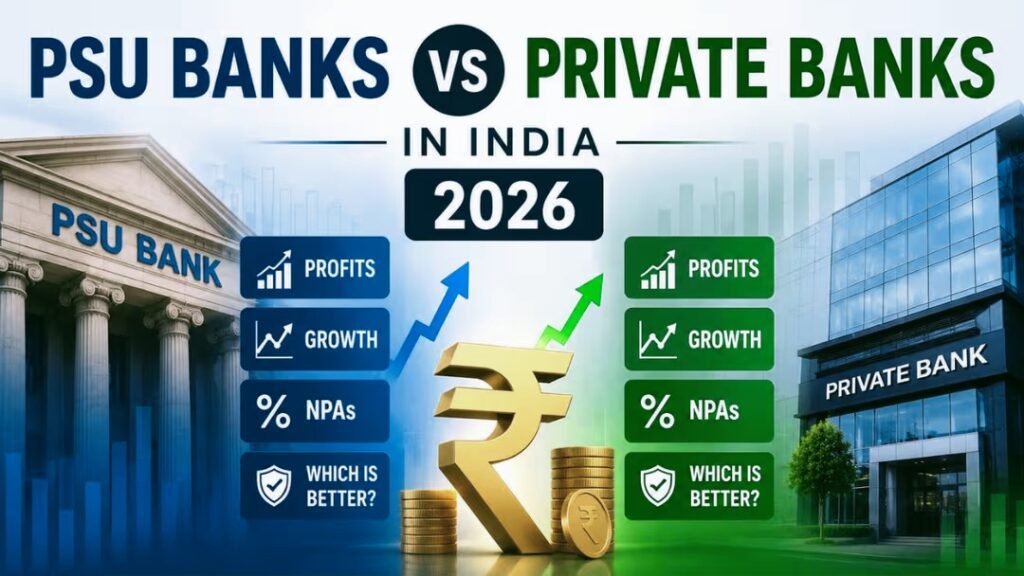
India’s Banking Landscape Shifts as PSU Banks Regain Momentum in FY26
Mumbai, India — India’s banking sector is witnessing a major transformation in 2026 as Public Sector Banks (PSU Banks) regain market dominance, outperforming many private lenders in loan growth, profitability, and balance sheet improvement.
For years, private banks led the industry in growth, technology, and profitability. However, the latest FY26 data from the Reserve Bank of India (RBI), the Finance Ministry, and industry analysts show PSU banks making a remarkable comeback.
State-owned lenders such as State Bank of India, Bank of Baroda, Punjab National Bank, and Canara Bank have posted record profits, lower bad loans, and strong credit growth during FY26.
Meanwhile, leading private sector lenders including HDFC Bank, ICICI Bank, Axis Bank, and Kotak Mahindra Bank continue to dominate urban retail banking and digital innovation.
PSU Banks Gain Market Share in Loans
According to recent banking industry estimates:
- PSU Banks now hold approximately 54.4% market share in loans
- Private Banks account for around 40.6%
- The remaining share belongs to foreign and small finance banks
This marks the first major reversal in years, as PSU banks have overtaken private banks in overall loan growth.
Analysts say aggressive corporate lending, infrastructure financing, government-backed projects, and improved asset quality have fueled PSU banks’ resurgence.
Profitability Improves Sharply for PSU Banks
One of the biggest highlights of FY26 is the dramatic rise in profitability among government-owned banks.
Several PSU lenders reported:
- Record annual net profits
- Lower provisioning costs
- Strong treasury income
- Better recovery from stressed assets
State Bank of India remained India’s most profitable bank, benefiting from strong credit demand, improved net interest margins, and lower non-performing assets.
Banking experts note that PSU banks have significantly strengthened their balance sheets after years of cleanup under the Insolvency and Bankruptcy Code (IBC) framework.
NPAs Continue to Decline Across the Banking Sector
India’s banking sector has seen a sharp improvement in asset quality over the past few years.
Gross NPA Trends in FY26
- PSU Banks: Gross NPAs have fallen substantially compared to previous years
- Private Banks: Continue to maintain relatively lower NPA ratios overall
Although private banks still enjoy an advantage in asset quality, the gap has narrowed considerably.
Government reforms, stronger recovery mechanisms, and disciplined lending practices have helped PSU banks reduce stress levels.
Loan Growth: PSU Banks Outperform
PSU banks recorded stronger loan growth in several key sectors:
Major Drivers of PSU Bank Growth
- Infrastructure financing
- Renewable energy projects
- MSME lending
- Agriculture loans
- Corporate credit expansion
Private banks, meanwhile, remained dominant in:
- Retail loans
- Credit cards
- Personal banking
- Wealth management
- Digital financial services
Industry analysts say PSU banks benefited from increased government capital expenditure and strong demand for industrial financing.
Interest Rates and RBI Rate Transmission
PSU banks are also seeing an advantage from faster transmission of RBI rate cuts.
Because many PSU lenders still maintain a higher share of loans linked to the Marginal Cost of Funds-based Lending Rate (MCLR), borrowers may benefit more quickly when interest rates decline.
Private banks, however, continue to focus heavily on repo-linked and floating-rate products, especially in retail segments.
Technology & Customer Experience
Private banks still lead the industry in:
- Digital banking innovation
- Mobile banking apps
- Customer service quality
- Faster loan approvals
- AI-based financial services
Banks such as HDFC Bank and ICICI Bank continue investing heavily in fintech partnerships and advanced digital ecosystems.
PSU banks have improved considerably in technology adoption but still lag behind private competitors in customer experience and service speed.
Rural Reach Gives PSU Banks a Strong Edge
One of the biggest strengths of PSU banks remains their nationwide physical presence.
State-owned banks continue to dominate:
- Rural banking
- Financial inclusion programs
- Government subsidy distribution
- Agricultural lending
- Jan Dhan accounts
Their extensive branch and ATM network gives them a significant advantage in underserved and semi-urban regions.
PSU Banks vs Private Banks: Key Comparison in FY26
Category PSU Banks Private Banks Market Share Higher Lower Loan Growth Strong in FY26 Moderate Profitability Rapidly improving Consistently strong NPAs Improving sharply Lower overall Technology Improving Industry leader Rural Presence Very strong Limited compared to PSU banks Customer Service Moderate Strong Government Backing Yes No Digital Banking Catching up Advanced
Which Is Better for Customers in 2026?
The answer largely depends on customer priorities.
PSU Banks May Be Better For:
- Rural banking customers
- Government-related services
- Lower-fee banking
- Trust and stability
- Corporate and infrastructure financing
Private Banks May Be Better For:
- Faster customer service
- Premium banking
- Digital-first users
- Quick loan approvals
- Wealth management services
Financial experts believe both banking segments will continue to play critical roles in India’s economic growth.
Outlook for India’s Banking Sector
India’s banking industry is expected to remain one of the fastest-growing in the world as economic activity, infrastructure investment, and retail credit demand continue expanding.
Analysts expect:
- Continued reduction in NPAs
- Stronger credit growth
- Increased digital transformation
- Greater competition between PSU and private banks
The revival of PSU banks is now being viewed as one of the most significant developments in India’s financial sector over the past decade.
With stronger balance sheets, rising profits, and renewed investor confidence, PSU banks appear well-positioned to challenge private lenders more aggressively in the coming years.