
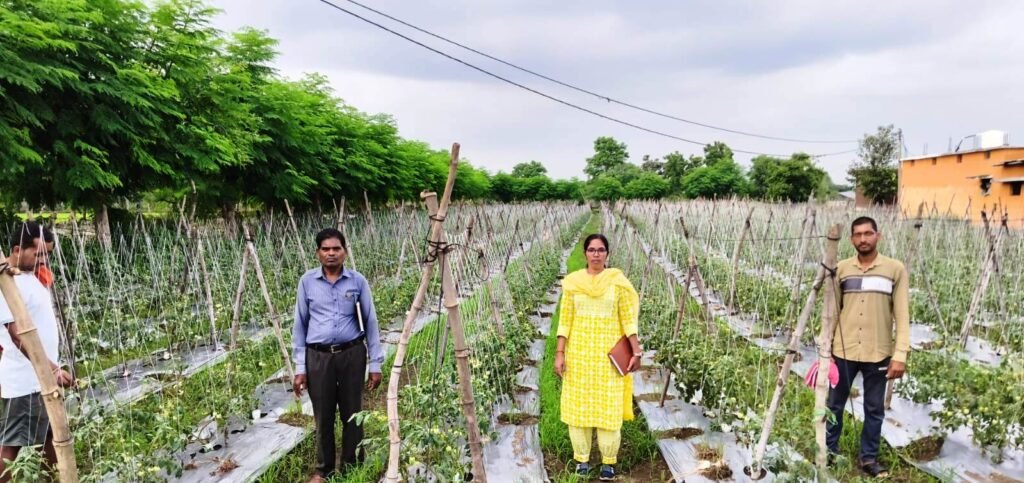
Mungeli, India — In a notable example of how small-scale farmers can significantly boost their income through modern agricultural practices, a farmer from the central Indian state of Chhattisgarh has earned nearly ₹290,000 (approximately $3,500 USD) in net profit from tomato cultivation.
Eshwari Prasad, a resident of Kalarjeva village in the Patharia block of Mungeli district, adopted advanced farming techniques under the Rashtriya Krishi Vikas Yojana (RKVY) for the 2025–26 season. Despite having limited resources and owning just 1.20 hectares (about 3 acres) of land, Prasad dedicated one acre to cultivating an improved variety of tomato known locally as “Saho.”
By implementing drip irrigation and plastic mulching—methods known for conserving water and improving crop quality—he achieved an impressive yield of approximately 150 quintals (15,000 kilograms) per acre.
Prasad sold his produce at wholesale market prices ranging between ₹25 and ₹30 per kilogram, generating total revenue of about ₹375,000 (roughly $4,500 USD). After accounting for cultivation costs of around ₹85,000, his net profit stood at approximately ₹290,000. Financial assistance from the state’s horticulture department, including a subsidy of ₹30,000, further helped reduce his overall expenses.
Speaking about his success, Prasad emphasized the importance of adopting modern agricultural techniques and effectively utilizing government support programs. “Even with limited land, farmers can achieve higher productivity and better income if they use the right technology and guidance,” he said.
Officials from the district public relations office noted that Prasad’s achievement is inspiring other farmers in the region to explore scientific farming methods and government-backed schemes to improve their livelihoods.
This success story highlights the growing impact of targeted agricultural initiatives in India, especially in empowering small and marginal farmers to become more self-reliant and economically stable.