


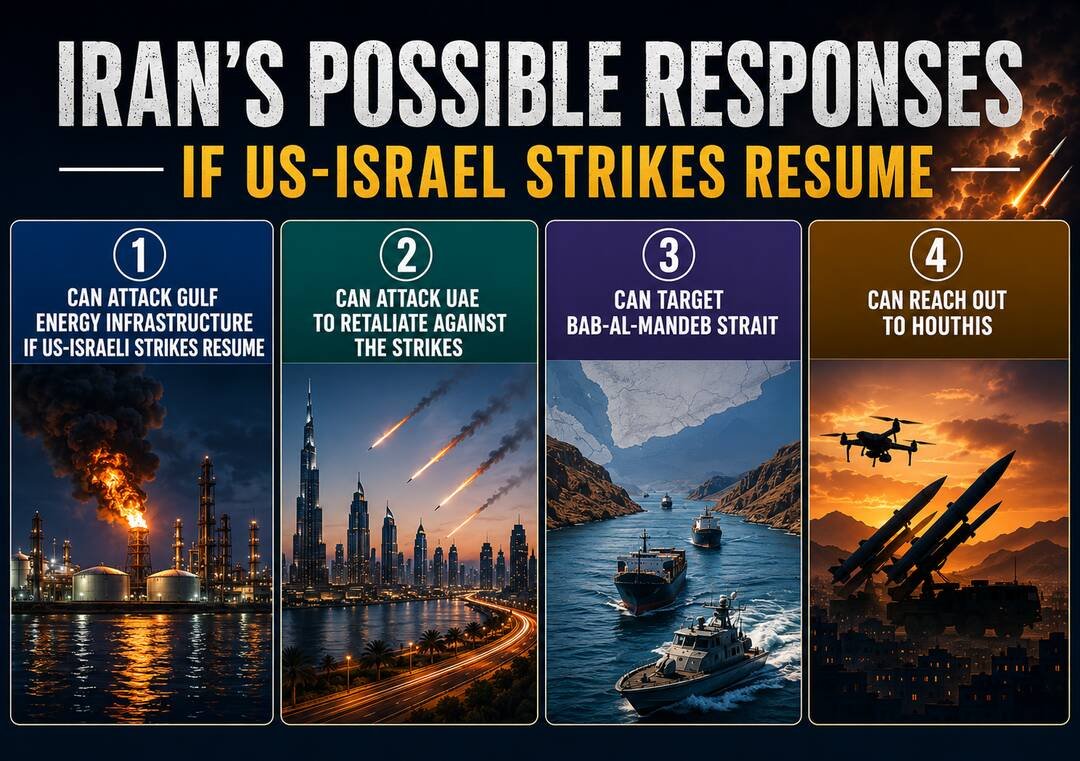

Middle East tensions could sharply escalate if military strikes by the United States and Israel against Iran or Iranian-linked targets resume, according to regional security analysts and former military officials. Experts believe Tehran has several strategic options that could impact energy markets, international shipping routes, and regional stability across the Gulf and Red Sea.
Iran has repeatedly warned that any large-scale military action against its territory, nuclear facilities, or allied groups would trigger a “proportional and decisive response.” While the exact nature of Tehran’s retaliation would depend on the scale of the strikes, analysts say Iran possesses both direct and indirect methods to pressure Washington and its allies.
Possible Attacks on Gulf Energy Infrastructure
One of the most immediate concerns is the potential targeting of Gulf energy infrastructure. Iran has previously been accused by Western and Gulf nations of being linked to attacks on oil facilities in the region, allegations Tehran has denied.
Security experts say strategic targets could include:
- oil refineries,
- export terminals,
- offshore energy facilities, and
- pipelines in Gulf countries.
Any disruption to energy production or shipping in the region could send global oil prices sharply higher, given that the Gulf remains one of the world’s most important energy-exporting regions.
Countries such as:
- Saudi Arabia,
- United Arab Emirates, and
- Qatar
could face heightened security risks if regional conflict expands.
Risk of Escalation Involving the UAE
Analysts also warn that Iran could target strategic or economic interests in the UAE if Tehran believes Gulf nations are assisting American or Israeli military operations.
The UAE hosts major international business hubs, ports, and logistics infrastructure that are considered critical to regional trade. Although diplomatic relations between Iran and the UAE have improved in recent years, tensions could quickly rise during a wider regional conflict.
Military analysts note that Iran’s missile and drone capabilities have significantly expanded over the last decade, giving Tehran the ability to project power across the Gulf.
Threat to Key Maritime Routes
Another major concern is the possibility of disruption in critical maritime chokepoints.
Iran could attempt to increase pressure on the international community by threatening shipping lanes connected to:
- the Bab-el-Mandeb Strait, which links the Red Sea to the Gulf of Aden, and
- the Strait of Hormuz, one of the world’s most important oil transit routes.
The Bab-el-Mandeb Strait is particularly sensitive because a large percentage of global trade and energy shipments pass through the corridor connecting Europe, Asia, and the Middle East.
Any sustained attacks on commercial vessels could disrupt international supply chains and increase shipping insurance costs worldwide.
Potential Coordination With Houthi Forces
Experts also believe Iran could deepen coordination with Yemen’s Houthis, who have previously launched missile and drone attacks in the Red Sea region.
The Houthis have demonstrated the ability to target:
- commercial cargo ships,
- naval vessels, and
- regional infrastructure.
Western governments have long accused Iran of supplying weapons and intelligence support to the group, though Tehran has consistently denied direct operational involvement.
If tensions escalate further, analysts say Houthi attacks on shipping lanes or US-linked targets could intensify as part of a broader regional pressure campaign.
Wider Regional and Global Impact
A renewed military confrontation involving Iran, the US, and Israel could have far-reaching consequences beyond the Middle East.
Potential impacts include:
- rising crude oil prices,
- disruption in global trade routes,
- increased military deployments in the Gulf,
- cyberattacks targeting infrastructure, and
- heightened risks of regional proxy conflicts.
Diplomatic observers say many countries are attempting to avoid a direct regional war due to fears of economic fallout and humanitarian consequences.
Background of the Tensions
Tensions between:
- Iran,
- United States, and
- Israel
have remained high over issues including Iran’s nuclear program, regional militias, sanctions, and security concerns in the Gulf and Red Sea.
Military exchanges involving Iranian-backed groups, Israeli operations, and US deployments in the region have repeatedly raised fears of a broader conflict, though full-scale war has so far been avoided through diplomatic and strategic restraint.