
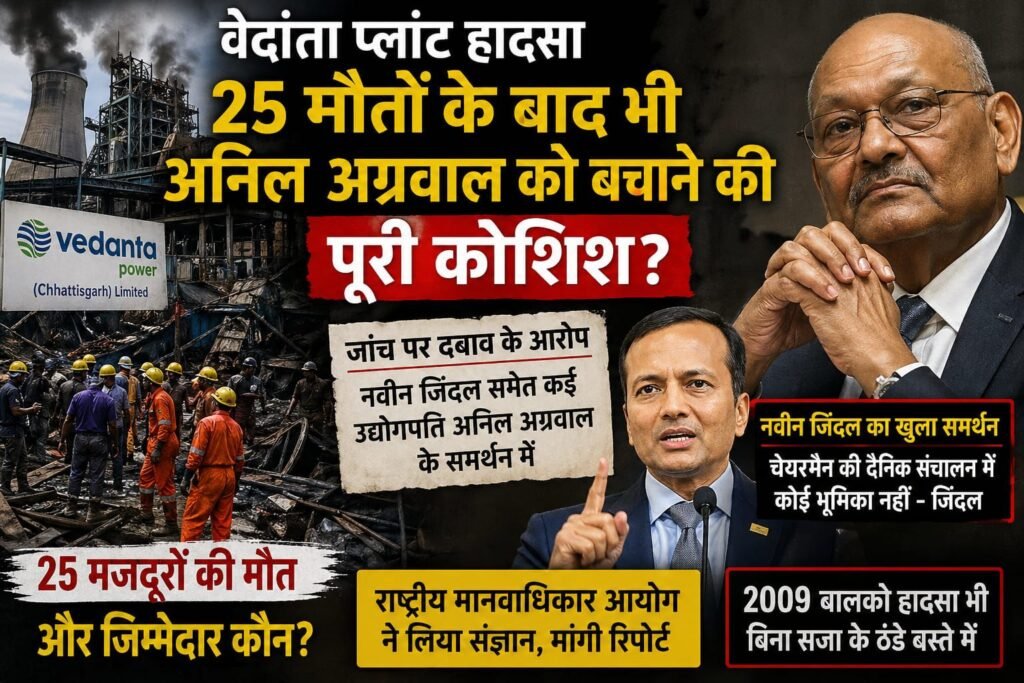
Sakti district, Chhattisgarh A deadly boiler explosion at a thermal power plant operated by Vedanta Group in central India has left at least 25 workers dead, triggering a widening controversy over corporate accountability, regulatory oversight, and alleged political influence.
The blast occurred on April 14 in the Sakti district of Chhattisgarh, a region known for its heavy industrial presence. What initially appeared to be an industrial accident has since evolved into a high-stakes debate involving government agencies, labor groups, and prominent business leaders.
Early Signs of Negligence
Preliminary reports and local accounts suggest that technical faults in the plant may have been identified prior to the explosion. Critics allege that despite warning signs, operations continued without adequate corrective measures—raising the possibility of gross negligence rather than an unavoidable accident.
If substantiated, such findings could expose the company and its management to serious legal consequences under India’s industrial safety and labor laws.
Corporate Leadership Under Scrutiny
As the investigation appears to move toward higher levels of management, public discourse has shifted to the role of top executives. Supporters of Vedanta’s chairman, Anil Agarwal, argue that individuals at the helm of large corporations are not involved in day-to-day plant operations and therefore should not be held directly liable.
However, labor unions and social activists strongly reject this view. They contend that corporate leaders who benefit from profits must also bear responsibility for systemic failures, especially in cases involving large-scale loss of life.
Industry Voices Enter the Fray
The controversy has intensified after public support for Agarwal from fellow industrialist Naveen Jindal. Jindal, associated with major power ventures, defended Agarwal in public remarks—fueling speculation that sections of India’s business community may be attempting to shape the narrative.
While there is no official confirmation of coordinated efforts, the emergence of such support has added a sensitive dimension to the case, raising concerns about potential influence on the investigative process.
Human Rights Commission Steps In
Taking serious note of the incident, the National Human Rights Commission has issued a notice to the state government, demanding a detailed report. The commission has asked authorities to clarify:
- What actions have been taken against those responsible
- The nature and extent of compensation provided to victims’ families
- Whether the investigation is identifying accountability at all levels
Fears of Limited Accountability
At the local level, concerns are mounting that the investigation may be confined to lower-level employees, allowing senior officials or decision-makers to evade scrutiny. Political leaders, including regional Member of Parliament Kamlesh Jangde, have called for an impartial and high-level probe to ensure transparency.
Echoes of a Past Tragedy
The incident has drawn comparisons to the BALCO Chimney Collapse, which also resulted in significant worker fatalities. Critics note that despite the scale of that disaster, accountability remained elusive for years—deepening fears that history could repeat itself.
Government Response
Chief Minister Vishnu Deo Sai has announced compensation for victims’ families and ordered an official investigation. However, questions persist about whether the probe will remain independent amid growing political and corporate pressure.
A Test of India’s Regulatory System
The Vedanta plant explosion has reignited a broader debate about industrial safety standards and the enforcement of laws in India. At its core lies a fundamental question: Are legal and regulatory frameworks applied equally, regardless of corporate influence?
For many, this tragedy is no longer just about a single accident—it has become a critical test of justice, governance, and institutional credibility in one of the world’s fastest-growing economies.