

New Delhi : India and Japan have taken a significant step towards strengthening their defence and maritime security partnership, with the two countries agreeing to expand cooperation in the Indo-Pacific region, enhance naval coordination and facilitate the transfer of advanced defence equipment.
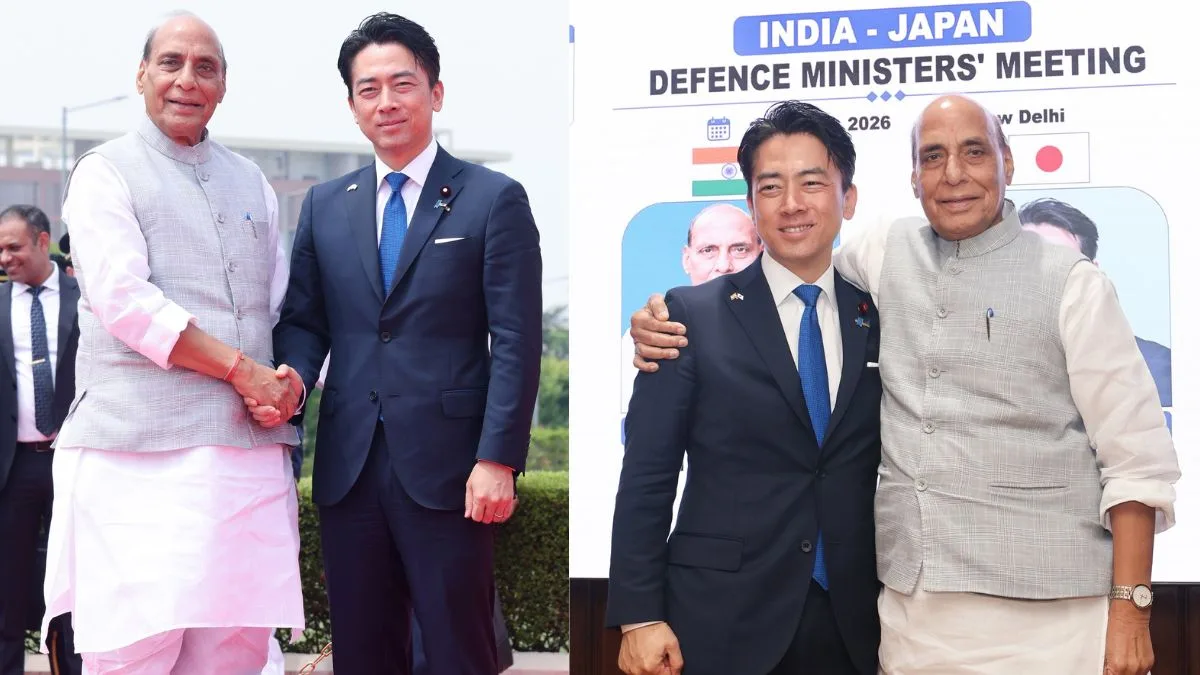
The development came during a bilateral meeting between Indian Defence Minister Rajnath Singh and his Japanese counterpart Shinjiro Koizumi on Thursday. The discussions focused extensively on the evolving security environment in the Indo-Pacific and ways to deepen defence cooperation between the two countries.
Although the joint statement issued after the meeting did not directly name China, both sides strongly opposed unilateral actions that could undermine freedom and safety of navigation and overflight. India and Japan also reiterated their opposition to attempts to alter the status quo through force or coercion.
India-Japan Sign Maritime Security Cooperation Agreement
One of the most significant outcomes of the meeting was the signing of the Memorandum of Arrangement on Maritime Security Cooperation between the Ministry of Defence of India and the Ministry of Defence of Japan.
The agreement provides a framework for further expanding cooperation in maritime security.
Under the arrangement, the Indian Navy and the Japan Maritime Self-Defense Force (JMSDF) will strengthen cooperation in several areas, including Maritime Domain Awareness (MDA).
The two countries are also expected to enhance cooperation in:
- Maritime information sharing
- Search and Rescue (SAR) operations
- Humanitarian Assistance and Disaster Relief (HADR)
- Joint naval exercises
- Naval ship visits
- Personnel exchanges
- Subject Matter Expert exchanges
- Logistical support
- Port access
- Maintenance and repair facilities
The agreement is expected to improve coordination between the two maritime forces and contribute to greater stability and security in the Indo-Pacific.
India to Receive Japan’s UNICORN System
Another major development was Japan’s decision to transfer its shipborne UNICORN integrated communications antenna system to India.
The transfer will be particularly significant because it represents the first defence equipment transfer project between India and Japan.
The UNICORN system is designed to integrate communications capabilities on naval platforms, helping improve secure and efficient communications.
The move also highlights the growing technological dimension of the India-Japan defence partnership.
Focus on Indo-Pacific Security
During the meeting, both ministers underlined the importance of protecting Sea Lines of Communications (SLOCs), which are vital for India, Japan and the wider international community.
The two sides agreed that maintaining safe and open maritime routes is essential for regional stability, international trade and economic security.
The ministers also welcomed the continued expansion of mutual visits by naval ships and units and agreed to strengthen joint exercises and operational cooperation.
Japan Seeks Faster Expansion of Defence Ties
Japanese Defence Minister Shinjiro Koizumi emphasised that defence cooperation is an indispensable component of the India-Japan strategic partnership.
He noted that the security environment in the Indo-Pacific is becoming increasingly complex and uncertain and expressed his intention to work towards rapidly elevating defence relations between the two countries.
The remarks underline Tokyo’s interest in taking bilateral defence cooperation to a higher level.
Cooperation Between Special Forces
India and Japan have also decided to promote exchanges between their respective Special Operations Forces.
The two countries will explore greater cooperation with India’s Integrated Theatre Commands, signalling a broader approach towards operational and strategic defence coordination.
Such cooperation could facilitate the exchange of operational experience, training practices and expertise between the two countries.
Defence Technology and R&D Cooperation
Technology cooperation also featured prominently in the discussions.
Defence Minister Rajnath Singh welcomed Japan’s recent review of its framework governing the transfer of defence equipment and technology.
India expressed its expectation that Japan would play a greater role in promoting peace and stability in the Indo-Pacific and further deepen the bilateral defence and technology partnership.
The two sides also agreed to deepen defence research and development cooperation between India’s Defence Research and Development Organisation (DRDO) and Japan’s Acquisition, Technology & Logistics Agency (ATLA).
The cooperation will focus on advanced and state-of-the-art defence technologies.
India and Japan also confirmed their intention to convene a Defence Industry Forum, which could provide a platform for greater interaction between defence industries, technology companies and research institutions from both countries.
India-Japan-Indonesia Naval Cooperation
The two ministers also welcomed the first-ever trilateral naval PASSEX exercise involving India, Japan and Indonesia.
The exercise represents another important dimension of India’s expanding maritime engagement with regional partners and reflects the growing importance of cooperation among Indo-Pacific countries.
Trilateral naval engagements can help improve interoperability, communication and coordination among participating maritime forces.
Strategic Significance
The latest developments demonstrate that India-Japan relations are moving beyond traditional diplomatic and economic cooperation towards a more comprehensive strategic and defence partnership.
The two countries share concerns about maintaining a free, open and rules-based Indo-Pacific, including freedom of navigation and respect for international law.
While the joint statement did not explicitly mention China, the emphasis on preventing unilateral changes to the status quo and protecting maritime routes carries considerable strategic significance amid growing geopolitical competition in the Indo-Pacific.
However, the latest agreements should not be interpreted as the creation of a formal military alliance between India and Japan. Instead, they represent an effort to build stronger defence capabilities, improve maritime coordination and enhance strategic cooperation under the existing Japan-India Special Strategic and Global Partnership.
A New Phase in India-Japan Defence Relations
The UNICORN equipment transfer, maritime security agreement, enhanced naval cooperation, Special Forces exchanges and expanded defence R&D cooperation together represent a significant broadening of the India-Japan security relationship.
With maritime security becoming increasingly important in the Indo-Pacific, New Delhi and Tokyo appear determined to develop stronger operational, technological and institutional links between their defence establishments.
The latest agreement could therefore mark an important new phase in the India-Japan defence partnership, with both countries seeking to contribute more actively to peace, stability and security across the Indo-Pacific region.