


New Delhi / In a significant step toward making quality higher education accessible to every deserving student, the Government of India is implementing the PM Vidyalaxmi Scheme, a flagship initiative of the Ministry of Education designed to eliminate financial barriers for meritorious students seeking admission to the country’s premier higher educational institutions.
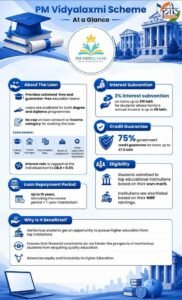
The scheme provides collateral-free and guarantor-free education loans to eligible students admitted on merit to 1,425 designated Quality Higher Education Institutions (QHEIs) across India. Additionally, students from families with an annual income of up to ₹8 lakh are eligible for a 3% interest subsidy on education loans of up to ₹10 lakh, making higher education significantly more affordable.
A Major Push Toward Educational Inclusion
The PM Vidyalaxmi Scheme supports India’s commitment to achieving Sustainable Development Goal (SDG) 4, which aims to ensure inclusive and equitable quality education and promote lifelong learning opportunities for all by 2030.
India’s Gross Enrollment Ratio (GER) in higher education has increased from 23.7% in 2014-15 to 30.0% in 2023-24. Despite this progress, many talented students continue to face financial challenges in accessing premier institutions such as the Indian Institutes of Technology (IITs), Indian Institutes of Management (IIMs), and other top-ranked universities.
To bridge this gap, the Union Cabinet approved the PM Vidyalaxmi Scheme on November 6, 2024, ensuring that no deserving student is denied higher education because of financial constraints.
Collateral-Free Education Loans Without a Guarantor
One of the scheme’s most significant features is the provision of education loans without any collateral or third-party guarantor for eligible students.
There is no upper limit on the loan amount. The loan covers:
- Tuition fees
- Hostel and mess charges
- Refundable and non-refundable institutional fees
- Cost of a quality laptop
- Reasonable living expenses during the course period
The Government of India also provides a 75% credit guarantee for education loans of up to ₹7.5 lakh, reducing risk for lending institutions and encouraging wider loan coverage.
The interest rate under the scheme is capped at the lending institution’s Externally Benchmarked Lending Rate (EBLR) + 0.5%, which is lower than regular education loan rates offered outside the scheme.
Students can repay the loan over a period of up to 15 years, excluding the course duration and one-year moratorium period.
Interest Subsidy Benefits
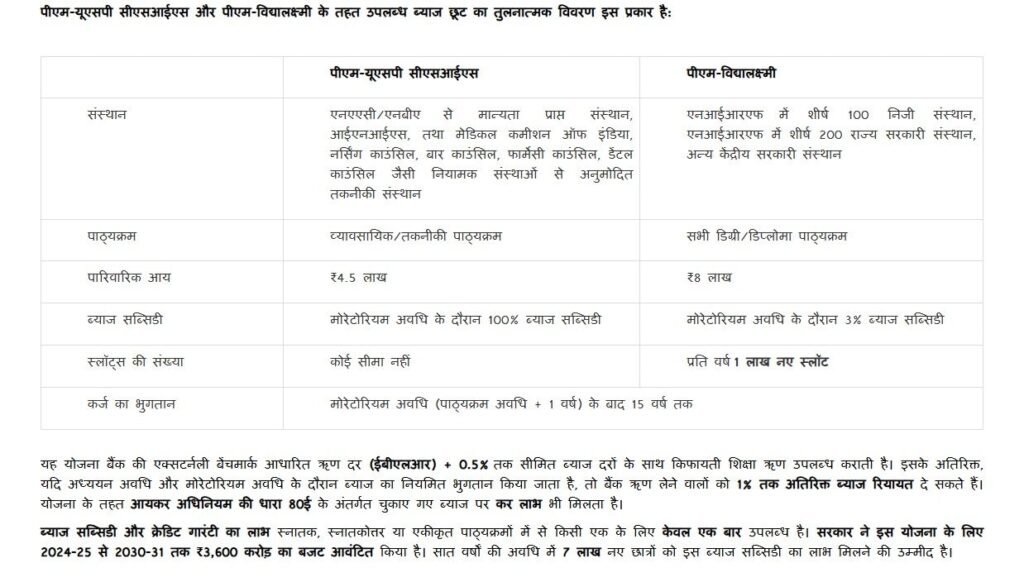
Students belonging to families with an annual income of up to ₹8 lakh are eligible for a 3% interest subsidy during the moratorium period, which includes the course duration plus one additional year.
The scheme complements the existing PM-USP Central Sector Interest Subsidy Scheme (CSIS), under which students from families earning up to ₹4.5 lakh annually receive 100% interest subsidy during the moratorium period for eligible technical and professional courses.
However, students already receiving benefits under any other Central or State Government scholarship, interest subsidy, or fee reimbursement scheme are not eligible to claim benefits under both schemes simultaneously.
Eligibility Criteria
The scheme is available to students who:
- Secure admission purely on merit through competitive examinations.
- Enroll in approved degree or diploma programs in designated QHEIs.
- Complete Aadhaar-based registration.
- Maintain satisfactory academic performance throughout the course.
Students who discontinue their studies or are expelled for academic or disciplinary reasons become ineligible for continued benefits.
Institutions Covered
The scheme currently covers 1,425 higher education institutions, including:
- Top 100 institutions in the latest National Institutional Ranking Framework (NIRF) rankings.
- Top 200 State Government institutions.
- All Central Government Higher Education Institutions.
Foreign universities, overseas campuses of Indian institutions, and Indian campuses of foreign universities are not covered under the scheme.
Completely Digital Loan Platform
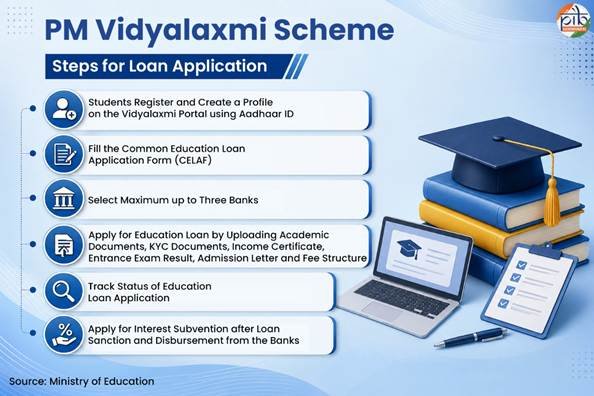
The PM Vidyalaxmi Scheme operates through a fully digital integrated portal, enabling students to:
- Submit a single online loan application
- Choose participating banks
- Track application status in real time
- Apply for interest subsidy
- File and monitor grievances online
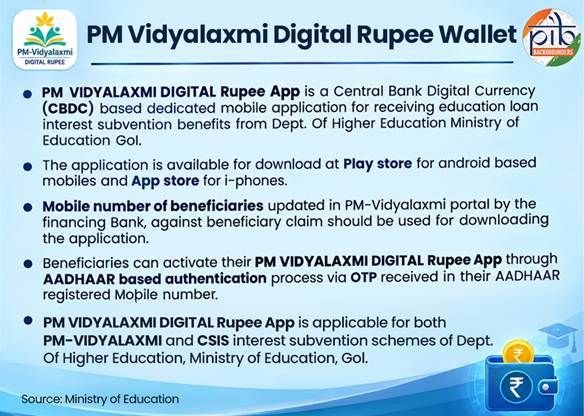
Once the loan is sanctioned, eligible subsidy amounts are credited directly into the student’s PM Vidyalaxmi Digital Rupee App (CBDC Wallet) before being transferred to the education loan account.
As of July 22, 2026, the platform had 35,777 active Digital Rupee wallets, facilitating subsidy disbursements totaling ₹57.66 crore.
For FY 2025-26, Canara Bank received 414,844 CSIS claims worth ₹892.81 crore.
Strong Performance and Growing Reach
According to official data:
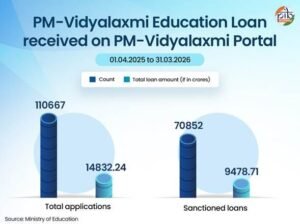
- During FY 2025-26, the portal received 645,514 education loan applications under various schemes.
- Of these, 110,667 applications were submitted under the PM Vidyalaxmi Scheme.
- 70,852 loans were approved.
- 67,728 loans have already been disbursed.
These figures demonstrate the growing acceptance and effectiveness of the scheme in expanding access to higher education financing.
Promoting Gender Equality
The PM Vidyalaxmi Scheme also supports gender-inclusive education by ensuring equal access to financial assistance for women, men, and transgender students.
During FY 2025-26:
- 368,742 male students applied for education loans.
- 276,764 female students submitted applications.
- 203,438 loans were approved for male students.
- 158,629 loans were approved for female students.
The initiative aims to improve educational opportunities, enhance employability, and encourage greater participation of women in the workforce.
Supporting Social Inclusion
The scheme has witnessed participation from students belonging to:
- Economically Weaker Sections (EWS)
- General Category
- OBC
- Non-Creamy Layer OBC (NCL-OBC)
- Scheduled Castes (SC)
- Scheduled Tribes (ST)
- Persons with Disabilities (PwD)
This broad participation reflects the government’s commitment to ensuring equitable access to higher education across all sections of society.
Building a Skilled and Future-Ready India
The PM Vidyalaxmi Scheme represents a major reform in India’s higher education financing ecosystem. By combining collateral-free education loans, targeted interest subsidies, digital transparency, and inclusive eligibility, the initiative removes financial barriers that often prevent talented students from pursuing higher education.
Aligned with the goals of the National Education Policy (NEP) 2020 and SDG 4, the scheme is expected to strengthen India’s human capital by empowering deserving students with opportunities to acquire quality education and contribute to the nation’s long-term economic and social development.
Source: Press Information Bureau (PIB), Government of India.