

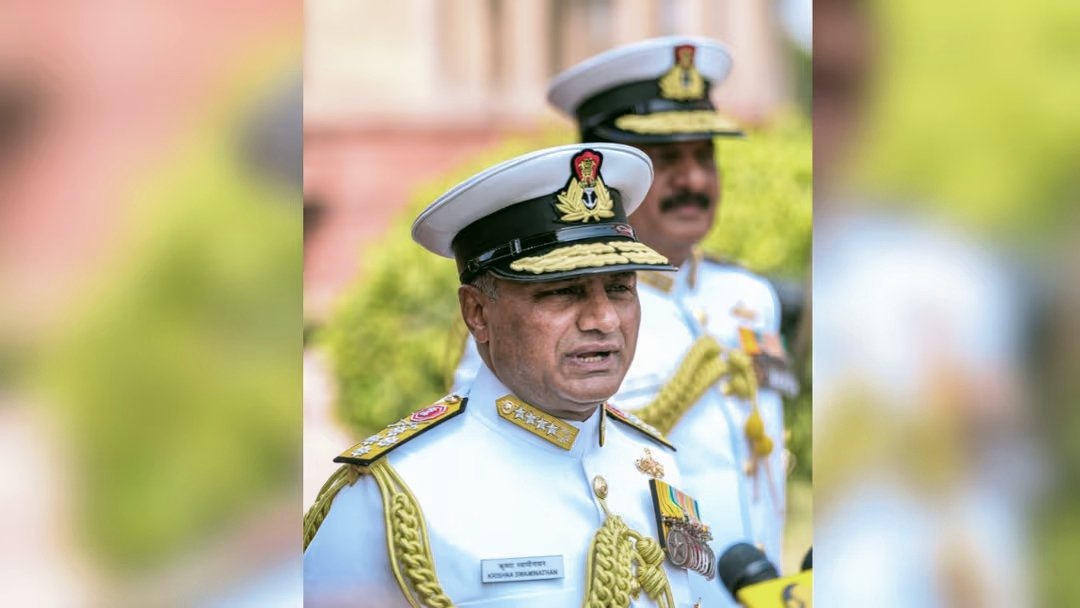


NEW DELHI — Admiral Krishna Swaminathan officially assumed charge as the 27th Chief of the Naval Staff (CNS) of the Indian Navy on Saturday, succeeding Admiral Dinesh Kumar Tripathi, who retired after completing more than 41 years of distinguished service to the nation.
A highly respected naval leader and a specialist in Communication and Electronic Warfare, Admiral Swaminathan takes command of the Indian Navy at a critical time, as India continues to strengthen its maritime capabilities, expand its strategic presence in the Indo-Pacific region, and accelerate the modernization of its naval forces.
Nearly Four Decades of Distinguished Service
Commissioned into the Indian Navy on July 1, 1987, Admiral Swaminathan brings nearly 39 years of operational, leadership, and strategic experience to the service’s highest position. Throughout his career, he has held a wide range of command, staff, and training appointments, earning recognition as one of the Navy’s most accomplished officers.
His extensive sea-going command experience includes leadership of several frontline warships, including INS Vidyut, INS Vinash, INS Kulish, INS Mysore, and the aircraft carrier INS Vikramaditya. These assignments played a significant role in enhancing the Indian Navy’s combat readiness, operational efficiency, and maritime defense capabilities.
Key Leadership Appointments
Following his promotion to the rank of Rear Admiral, Swaminathan served as Chief Staff Officer (Training) at the Southern Naval Command Headquarters in Kochi. He later held the prestigious appointments of Flag Officer Sea Training and Commander of the Western Fleet, often referred to as the “Sword Arm” of the Indian Navy due to its critical operational role.
He subsequently served as Flag Officer Offshore Defence Advisory Group and Advisor, Offshore Security and Defence to the Government of India, contributing significantly to the country’s maritime security framework.
After being promoted to Vice Admiral, he occupied several senior leadership positions, including Chief of Staff, Western Naval Command, Controller Personnel Services, Chief of Personnel, and Vice Chief of the Naval Staff at Naval Headquarters.
Before taking over as Navy Chief, Admiral Swaminathan was serving as the Flag Officer Commanding-in-Chief (FOC-in-C), Western Naval Command, one of the Indian Navy’s most strategically important operational commands.
Strong Academic and Strategic Credentials
In addition to his distinguished military career, Admiral Swaminathan possesses an impressive academic background. He is an alumnus of the National Defence Academy (NDA), Khadakwasla, the Joint Services Command and Staff College in the United Kingdom, the College of Naval Warfare, and the United States Naval War College in Newport, Rhode Island.
His educational qualifications include:
- Bachelor of Science from Jawaharlal Nehru University (JNU), New Delhi
- Master of Science in Telecommunications from Cochin University of Science and Technology
- Master of Arts in Defence Studies from King’s College London
- MPhil in Strategic Studies from Mumbai University
- PhD in International Studies from Mumbai University
His academic achievements have complemented his operational expertise, enabling him to contribute extensively to strategic planning and defense policy development.
Decorated for Distinguished Service
Over the course of his career, Admiral Swaminathan has received some of India’s highest peacetime military honors in recognition of his outstanding service and leadership. His decorations include:
- Param Vishisht Seva Medal (PVSM)
- Ati Vishisht Seva Medal (AVSM)
- Vishisht Seva Medal (VSM)
These honors reflect his exceptional contributions to national security, naval preparedness, and military leadership.
Leading the Navy Through a New Era
As the new Chief of the Naval Staff, Admiral Swaminathan is expected to oversee a transformative phase for the Indian Navy, characterized by advanced naval modernization programs, indigenous warship construction, enhanced maritime surveillance capabilities, and deeper strategic partnerships with friendly nations.
His leadership comes amid growing geopolitical competition in the Indian Ocean Region and the broader Indo-Pacific, where maritime security, freedom of navigation, and regional stability remain key priorities.
Defense analysts believe that Admiral Swaminathan’s extensive operational experience, strategic vision, and proven leadership credentials position him well to guide the Indian Navy through emerging challenges while strengthening India’s maritime power and safeguarding its national interests.
With his appointment, the Indian Navy enters a new chapter focused on modernization, operational readiness, strategic deterrence, and maritime security, reinforcing India’s role as a leading naval power in the region.