


New Delhi | India’s flagship Production Linked Incentive (PLI) Schemes have emerged as one of the country’s most successful industrial policy initiatives, attracting actual investments worth more than ₹2.40 lakh crore and creating over 14.15 lakh jobs as of March 31, 2026, according to the latest government data.
Launched to strengthen domestic manufacturing, reduce import dependence, and position India as a global manufacturing hub, the PLI Scheme now covers 14 strategic sectors with a total government outlay of ₹1.91 lakh crore.
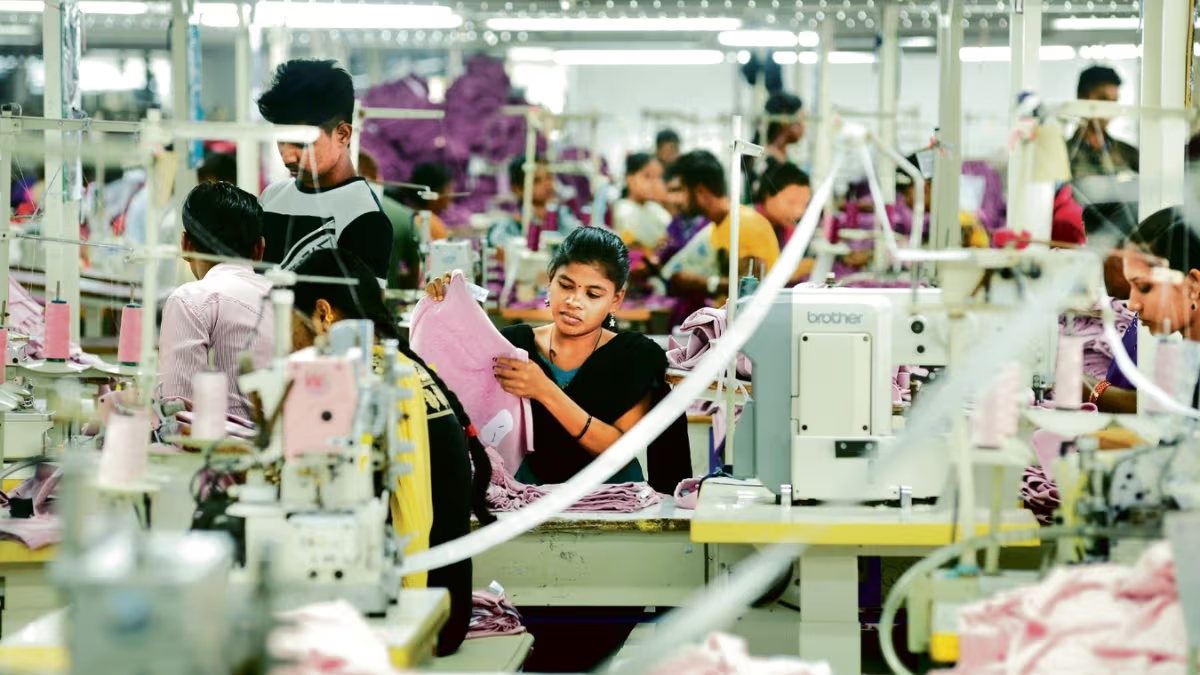
The latest figures indicate that the initiative has significantly boosted manufacturing, exports, employment, and industrial capacity, reinforcing the government’s “Make in India” vision.
Massive Growth in Investment, Exports, and Employment
According to the government, the PLI Schemes have delivered impressive results across multiple industries.
Key Achievements (As of March 31, 2026)
- Total Investment: ₹2.40 lakh crore
- Total Employment Generated: Over 14.15 lakh jobs (Direct and Indirect)
- Total Exports: More than ₹15.2 lakh crore
- Government Outlay: ₹1.91 lakh crore
- Coverage: 14 Manufacturing Sectors
The government noted that exports under the PLI program have grown sharply from approximately ₹4 lakh crore until FY2023-24 to over ₹15.2 lakh crore by March 2026.
Mobile Phone Manufacturing Becomes a Global Success Story
One of the biggest success stories under the PLI Scheme has been the mobile phone manufacturing sector.
The government reported that:
- Mobile phone production increased 2.4 times.
- Imports declined by 77%.
- 99.2% of mobile phones sold in India are now manufactured domestically.
The sector has transformed India into one of the world’s leading smartphone manufacturing destinations while significantly reducing dependence on imports.
Pharmaceutical Sector Records Strong Growth
India’s pharmaceutical industry has also achieved remarkable progress under the PLI initiative.
According to official figures:
- Cumulative sales exceeded ₹3.64 lakh crore.
- 1,931 pharmaceutical products are now being manufactured domestically.
- Several bulk drugs that were previously imported are now produced within India for the first time.
The initiative has strengthened India’s pharmaceutical supply chain while improving self-reliance in critical medicines and active pharmaceutical ingredients (APIs).
Medical Devices Manufacturing Expands
The Medical Devices PLI Scheme has encouraged domestic production of advanced healthcare equipment that was traditionally imported.
Manufacturing has commenced for sophisticated medical technologies such as:
- CT Scanners
- MRI Systems
- Advanced Diagnostic Equipment
The expansion supports India’s healthcare infrastructure while reducing dependence on imported medical technology.
White Goods Sector Witnesses Major Capacity Expansion
The government’s incentive program has also significantly boosted the White Goods Manufacturing sector.
Under the scheme:
- Compressor manufacturing capacity increased from approximately 1 million units to 10 million units.
The substantial capacity expansion is expected to strengthen India’s consumer appliance manufacturing ecosystem and improve export competitiveness.
Solar PV Module Manufacturing Gains Momentum
The Solar Photovoltaic (PV) Module sector has also experienced significant capacity addition through the PLI program.
The initiative supports India’s clean energy goals by encouraging domestic manufacturing of solar equipment while reducing reliance on imported renewable energy components.
Sector-Wise Performance (Till March 2026)
| Sector | Investment (₹ Crore) | Employment Generated |
|---|---|---|
| Large Scale Electronics | 20,580 | 169,249 |
| Pharmaceuticals | 45,158 | 114,880 |
| Automobiles & Auto Components | 44,326 | 67,820 |
| Specialty Steel | 23,896 | 14,138 |
| Total Across PLI Sectors | ₹2,40,138 Crore | 849,069 Direct Jobs |
In addition, the government reported approximately 566,000 indirect jobs across various sectors, taking the total employment generated under the schemes to more than 14.15 lakh.
Government Continues Regular Monitoring
The government stated that the implementation of the PLI Schemes is continuously monitored by the Empowered Group of Secretaries (EGoS).
Based on industry feedback, necessary policy adjustments are made to improve implementation, encourage additional investments, and maximize employment generation.
This continuous review mechanism aims to ensure that the schemes remain responsive to industry requirements and evolving global market conditions.
Strengthening India’s Manufacturing Ecosystem
Officials believe the Production Linked Incentive Schemes have significantly strengthened India’s industrial ecosystem by:
- Reducing Import Dependence
- Increasing Domestic Manufacturing
- Boosting Exports
- Creating Large-Scale Employment
- Attracting Private Investments
- Enhancing Global Competitiveness
- Strengthening Supply Chains
- Promoting Advanced Manufacturing Technologies
The initiative has positioned India as an increasingly attractive destination for global manufacturers seeking diversified and resilient supply chains.
A Major Milestone for ‘Make in India’
The latest achievements under the PLI Schemes mark a significant milestone for the Government of India’s “Make in India” campaign.
With ₹2.40 lakh crore in investments, over 14.15 lakh jobs created, and exports exceeding ₹15.2 lakh crore, the program has emerged as a key driver of India’s manufacturing transformation.
As investments continue to flow across sectors such as electronics, pharmaceuticals, automobiles, renewable energy, medical devices, and specialty steel, the PLI initiative is expected to further strengthen India’s position as a global manufacturing powerhouse while generating sustainable employment and accelerating long-term economic growth.