
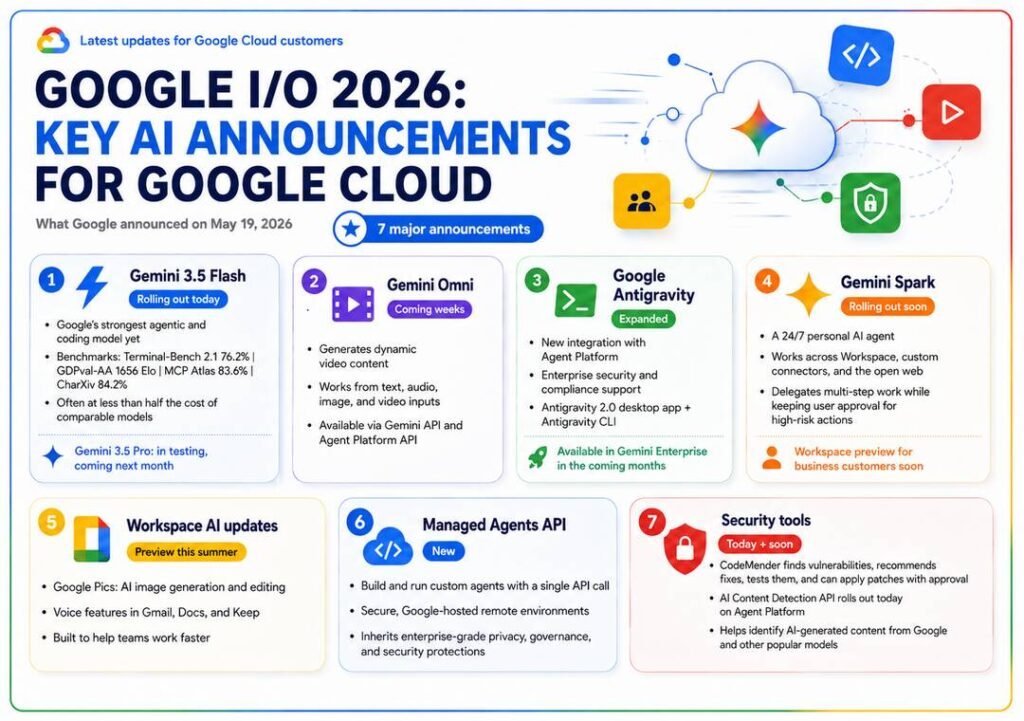
At its annual developer conference, Google introduced a massive wave of artificial intelligence innovations during Google I/O 2026, signaling what CEO Sundar Pichai called the beginning of the “Agentic Gemini Era.” The company focused heavily on AI-powered assistants, next-generation search, multimodal content creation, and autonomous digital agents.
One of the biggest announcements was the launch of the new Gemini 3.5 family of AI models. Google revealed that Gemini 3.5 Flash is designed to deliver high-speed performance for coding, reasoning, and autonomous AI tasks while being significantly faster than competing AI systems. The company said the model is optimized for long and complex workflows and will become the default AI engine across Gemini apps and Google Search.
Google also introduced Gemini Omni, its newest multimodal AI system capable of generating videos, images, audio, text, and other content from virtually any type of input. According to Google, Gemini Omni represents a major leap in “world understanding” and natural conversational editing, allowing users to create and modify content simply through voice or text instructions. Initially, the technology will focus on AI-powered video generation.
Another major highlight was Gemini Spark, described as a proactive 24/7 AI assistant that can independently help users complete tasks, manage schedules, deliver updates, and interact across multiple apps and services. Google said Spark is designed to move beyond traditional chatbots by acting more like a digital companion that continuously works in the background.
The company also expanded its AI development platform with Antigravity 2.0, aimed at helping developers create more advanced autonomous AI agents. Google said the platform will allow businesses and developers to build AI systems capable of taking actions, making decisions, and interacting with software tools in real time.
Search received what Google called its “biggest upgrade in 25 years.” The revamped AI-powered Search experience introduces conversational responses, intelligent summaries, deeper contextual understanding, and AI-generated results integrated directly into the search interface. New tools such as “Ask YouTube” and “Universal Cart” were also introduced to improve shopping and video discovery experiences.
Beyond software, Google showcased new AI-powered smart glasses developed alongside Android XR partners, signaling the company’s renewed push into wearable AI devices. The event also featured updates to Workspace apps, AI-generated interfaces, smarter Gmail tools, enhanced image editing, and new developer capabilities inside Google AI Studio.
Industry analysts believe Google’s announcements are part of a broader effort to strengthen its position in the rapidly intensifying AI race against competitors including OpenAI and Microsoft. Experts say Google’s focus on “agentic AI” could reshape how consumers interact with search engines, productivity tools, and digital assistants in the coming years.