


Jay Clayton to lead new federal task force as Washington seeks to maintain US leadership in advanced AI
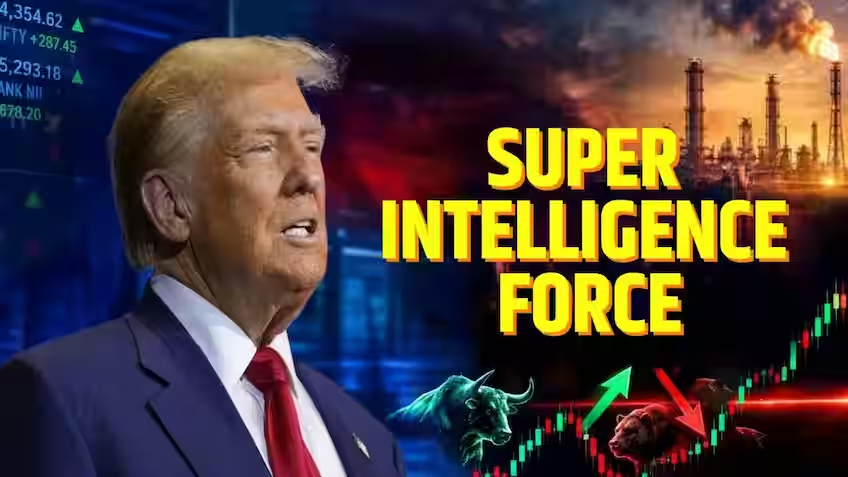
Washington : US President Donald Trump has announced the formation of a new federal “Super Intelligence Force” (SIF) to coordinate the US government’s approach to the rapidly developing field of artificial intelligence.
Trump announced the task force on October 4, saying its primary objective would be to coordinate federal efforts to ensure that the United States remains a global leader in what he calls “Super Intelligence.” The announcement followed a White House meeting with senior executives from major AI companies, where companies agreed to a voluntary set of safety commitments.
Trump has increasingly used the term “Super Intelligence” in place of “Artificial Intelligence,” and the new task force reflects that terminology.
Who Will Lead the Super Intelligence Force?
The SIF will be led by four senior US government officials:
- Jay Clayton, Director of National Intelligence
- Andrew Ferguson, Chairman of the Federal Trade Commission
- Emil Michael, Under Secretary of Defense for Research and Engineering and Pentagon Chief Technology Officer
- Scott Kupor, Director of the Office of Personnel Management
Trump said the force will report directly to the President and White House Chief of Staff Susie Wiles.
Jay Clayton, who heads the US intelligence community, is expected to play the central coordinating role in the administration’s AI strategy.
What Will the Super Intelligence Force Do?
According to Trump, the force will coordinate the federal government’s engagement with a broad range of stakeholders, including consumers, public-interest groups, religious organisations, critical infrastructure providers and AI companies.
The task force is intended to bring together different parts of the federal government as the technology develops and its applications expand across the economy and public life.
Recent reporting indicates that the group is expected to examine both the opportunities and risks associated with advanced AI, including questions surrounding national security, regulation and the government’s role in overseeing the technology.
Announcement Follows White House AI Accord
The formation of the SIF comes shortly after Trump hosted leaders of major technology companies at the White House.
The companies agreed to voluntary safety commitments covering measures such as internal controls, external reviews and oversight of AI development. Trump described the agreement as a framework under which companies would take responsibility for managing risks associated with their systems.
The companies involved included major players from the US technology and AI sector, making the meeting part of the administration’s broader effort to coordinate with the private sector on advanced AI.
Why the New Force Matters
The creation of the SIF comes as governments and technology companies are competing to develop increasingly capable AI systems while addressing concerns about their potential impact.
AI development is moving beyond conventional applications such as chatbots and automated content generation. Advanced systems are increasingly being developed for complex reasoning, software development, scientific research, business operations and other high-value tasks.
This has made AI a strategic issue involving technology, economic competitiveness, national security and regulation.
For the United States, maintaining a leading position in advanced AI has also become closely connected with its broader competition with other major technology powers, particularly China. Jay Clayton has argued that failing to remain at the forefront of AI development could create additional risks, including risks arising from foreign competitors.
Specific Powers Still Taking Shape
While Trump has announced the leadership and broad responsibilities of the SIF, the administration has provided relatively few details about its specific regulatory or statutory powers.
Current reporting indicates that the task force is expected to coordinate federal policy and examine the risks and opportunities associated with AI. Reports also indicate that it could develop recommendations concerning existing laws and possible future government action.
The exact structure and long-term role of the force therefore remain subject to further development.
A New Phase in US AI Policy
The Super Intelligence Force represents a new coordination mechanism within the Trump administration’s approach to advanced AI. Its creation comes alongside greater engagement with technology companies and a focus on maintaining US technological leadership.
The coming months are likely to provide greater clarity on how the task force will operate, what recommendations it will make and how its work will interact with existing federal agencies responsible for technology, competition, national security and consumer protection.