


India Reaffirms Confidence in E20 Fuel as Studies Confirm Engine Safety, Lower Emissions, Massive Foreign Exchange Savings, and Strong Benefits for Farmers
New Delhi, India: The Government of India has reaffirmed that E20 petrol—a fuel blend containing 20% ethanol and 80% petrol—is safe for use in vehicles, citing extensive scientific research, field trials, and large-scale real-world operational data. The clarification was provided by Minister of State for Petroleum and Natural Gas, Suresh Gopi, in a written reply in the Lok Sabha on July 23, 2026.
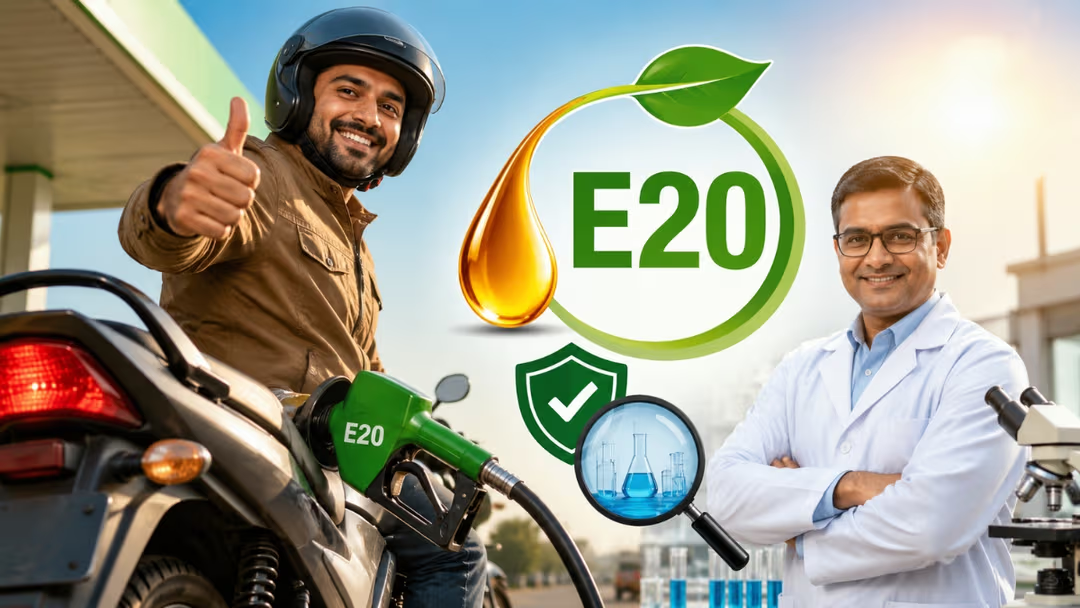
The Government emphasized that multiple technical evaluations have found no verified evidence of widespread engine failures or vehicle breakdowns directly linked to the use of E20 petrol, strengthening confidence in India’s ambitious Ethanol Blending Programme (EBP).
Scientific Studies Confirm E20 Safety
According to the Government, comprehensive testing was conducted by several leading automotive and energy research organizations, including:
- Automotive Research Association of India (ARAI)
- Society of Indian Automobile Manufacturers (SIAM)
- Indian Oil Corporation Limited (IOCL)
- Indian Institute of Petroleum (IIP)
- Leading Automobile Manufacturers
- Other Technical Institutions
The studies evaluated several critical performance parameters, including:
- Engine durability
- Vehicle drivability
- Fuel efficiency
- Corrosion resistance
- Material compatibility
- Emission performance
- Overall engine reliability
The findings concluded that E20 petrol is safe when used according to prescribed standards and manufacturer guidelines.
Evidence from Millions of Vehicles
The Government highlighted extensive real-world usage data demonstrating the successful adoption of higher ethanol-blended fuels across India.
According to official estimates:
- More than 20 crore two-wheelers have been operating on higher ethanol blends.
- Over 3 crore petrol-powered cars have also been using such fuels.
The Government stated that despite this widespread adoption, there is no verified evidence of large-scale engine failures or breakdowns attributable to E20 petrol.
Impact on Fuel Efficiency
While addressing concerns regarding mileage, the Government clarified that fuel economy depends on several factors, including:
- Vehicle model
- Engine design
- Driving habits
- Road conditions
- Vehicle maintenance
For older vehicles originally designed for E10 petrol, fuel efficiency may decrease by approximately 3% to 5% due to ethanol’s lower energy density.
However, the Government noted that E20 petrol offers higher octane ratings and superior anti-knock properties, contributing to smoother combustion and improved engine performance in compatible vehicles.
Major National Benefits of Ethanol Blending
The Government also highlighted the broader economic, environmental, and agricultural benefits achieved through the Ethanol Blending Programme.
Key Achievements Include:
| Indicator | Impact |
|---|---|
| Foreign Exchange Savings | ₹1.97 lakh crore |
| Crude Oil Substituted | Nearly 316 lakh metric tonnes |
| CO₂ Emissions Reduced | Around 952 lakh metric tonnes |
| Income Transferred to Farmers | Over ₹1.66 lakh crore |
These outcomes underline the programme’s contribution to energy security, environmental sustainability, and rural economic development.
Government’s Vision
The Ethanol Blending Programme forms a key component of India’s strategy to:
- Reduce dependence on imported crude oil
- Lower greenhouse gas emissions
- Promote cleaner transportation fuels
- Support domestic agriculture
- Enhance energy security
- Advance climate commitments
The Government continues to encourage automobile manufacturers and fuel retailers to facilitate the transition toward cleaner fuel technologies.
American Experts Share Their Views
Dr. Michael Anderson, an automotive fuels researcher based in Detroit, Michigan, said ethanol-blended fuels have been successfully used in several countries for decades.
“Extensive scientific testing and long-term vehicle performance data are essential before introducing higher ethanol blends. If national testing agencies confirm compatibility and manufacturers support the transition, E20 can contribute to cleaner transportation while maintaining engine reliability.“
Meanwhile, Emily Carter, a renewable energy policy analyst from Washington, D.C., emphasized the broader economic significance of ethanol blending.
“Blending ethanol with gasoline helps diversify fuel supplies, reduce oil imports, lower emissions, and create new income opportunities for agricultural communities. India’s reported savings and farmer benefits illustrate how biofuel policies can support both economic and environmental objectives.“
Why This Matters
The Government’s latest clarification is intended to address public concerns regarding engine safety, vehicle performance, and the long-term use of E20 petrol.
Key Highlights
- Government reaffirms E20 petrol is safe for use based on scientific evidence.
- More than 20 crore two-wheelers and 3 crore petrol cars have operated on higher ethanol blends.
- No verified evidence of widespread engine failures linked to E20.
- Older E10 vehicles may experience 3–5% lower fuel efficiency.
- ₹1.97 lakh crore saved in foreign exchange through ethanol blending.
- 316 lakh metric tonnes of crude oil substituted.
- 952 lakh metric tonnes of CO₂ emissions reduced.
- ₹1.66 lakh crore transferred to farmers, supporting rural incomes.
Outlook
With scientific validation, extensive field experience, and measurable economic and environmental gains, E20 petrol is emerging as a central pillar of India’s clean energy transition. As the country continues expanding its biofuel ecosystem, the Government’s reaffirmation is expected to strengthen public confidence in ethanol-blended fuels while advancing national goals of energy independence, reduced carbon emissions, and sustainable agricultural growth.