


New Delhi: Geographical Indication (GI) Tags have emerged as one of India’s most powerful tools for preserving cultural heritage, protecting traditional knowledge, and creating new economic opportunities for artisans, farmers, weavers, and producer communities. By linking products to their place of origin, GI certification enhances authenticity, prevents misuse, builds consumer trust, and enables producers to access premium domestic and international markets.
Backed by a robust legal framework and a series of government initiatives, India’s GI ecosystem has expanded significantly in recent years, transforming regional products into globally recognized brands while supporting rural livelihoods and export-led growth.
GI Tags Protect India’s Unique Identity
A GI Tag certifies that a product originates from a specific geographical region and possesses qualities, reputation, or characteristics that are unique to that location.
A classic example is the Banarasi Saree, where master weavers spend weeks creating intricate zari work using traditional techniques passed down through generations. The GI certification assures buyers that the saree is authentic, handmade in Banaras, and reflects centuries-old craftsmanship, allowing artisans to command higher prices in both domestic and global markets.
Why GI Tags Matter
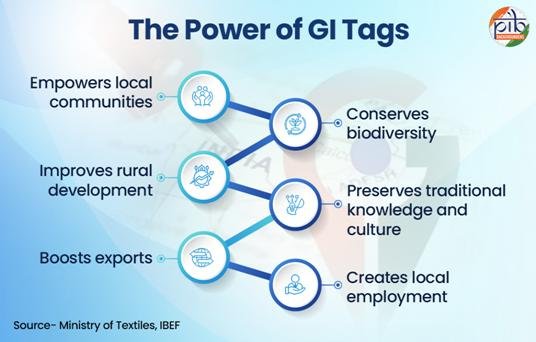
Beyond legal protection, GI Tags offer several long-term benefits:
- Protect traditional products from imitation and unauthorized commercialization.
- Increase artisan incomes by 20–30%, according to the Ministry of Textiles.
- Build consumer confidence through verified authenticity.
- Expand access to premium domestic and international markets.
- Preserve India’s cultural heritage and indigenous craftsmanship.
- Create sustainable employment in rural areas.
Success Story: Muzaffarnagar Jaggery Goes Global
The GI Tag awarded to Muzaffarnagar Jaggery strengthened its identity as a premium-quality product.
In 2025, Brijanandan Agro Farmer Producer Company exported 30 metric tonnes of GI-certified jaggery to Bangladesh. The certification enhanced buyer confidence, opened export opportunities, and increased income prospects for its 545 farmer members, demonstrating how GI recognition directly benefits local producers.
India’s GI Journey
India’s first GI-tagged product was Darjeeling Tea, which received legal protection along with its logo.
Other early GI registrations include:
- Aranmula Kannadi (Kerala)
- Pochampally Ikat (Telangana)
GI protection in India is governed under the Geographical Indications of Goods (Registration and Protection) Act, 1999, which became operational in 2003, with registrations beginning in 2004-05.
The 2025 amendments significantly reduced registration costs:
- Application fees reduced by 80%.
- Renewal fees lowered from ₹3,000 to ₹500.
India’s Expanding GI Landscape
As of December 2025, India has registered GI products across multiple categories:
Handicrafts
- 445 registered products
- 27 registered logos
- Examples include:
- Kashmir Pashmina
- Baluchari Saree
- Banaras Pink Meenakari Craft
Agricultural Products
- 251 registered products
- Covering grains, fruits, vegetables, spices, and non-Basmati rice.
Manufactured Products
- 64 registered products
- Including:
- Nashik Valley Wine
- Kannauj Perfume
Food Products
- 66 GI-tagged foods
- Examples:
- Bardhaman Mihidana
- Sitabhog
- Kendrapara Rasabali
- Tirupati Laddu
Natural Products
Five registered natural products include:
- Makrana Marble
- Chunar Sandstone
- Purulia Lac Products
- Panna Diamond
- Ambaji White Marble
States Leading in GI Registrations
As of December 2025:
- Uttar Pradesh – 81 GI products
- Tamil Nadu – 76
- Maharashtra – 55
These states have emerged as major contributors to India’s GI ecosystem.
How GI Registration Works
Applications can be submitted by:
- Producer associations
- Registered organizations
- Government authorities representing producers
Applications are processed by the Geographical Indications Registry in Chennai, which has nationwide jurisdiction.
Each GI registration remains valid for 10 years and can be renewed periodically.
When Can a GI Be Cancelled?
A GI registration may be cancelled if:
- It was obtained through fraud or misrepresentation.
- It is no longer protected in its country of origin.
- It misleads consumers.
- It violates existing laws.
- It contains offensive or objectionable content.
Government Initiatives Strengthening GI Products
The Government has launched several initiatives to promote GI-certified products.
PM Ekta Mall (Unity Mall)
With an allocation of ₹5,000 crore, these malls showcase:
- One District One Product (ODOP) items
- GI-tagged products
- Traditional handicrafts
One Station One Product (OSOP)
Railway stations across India now feature dedicated stalls promoting regional GI products, providing direct market access to artisans, farmers, and producer groups.
GI Tourism
India is integrating GI clusters into tourism circuits through initiatives such as:
- Darjeeling Tea Trails
- Pochampally Ikat Weaving Tours
- Assam Muga Silk Trail, announced in June 2026, alongside Silk Tourism Parks and Muga festivals.
Financial Assistance
Government schemes offer substantial support:
- MSME Innovative Scheme reimburses 100% of GI registration costs up to ₹2 lakh.
- Office of the Development Commissioner (Handicrafts) provides legal assistance up to ₹1.5 lakh for GI protection.
- Financial support is also available under the National Handloom Development Programme (NHDP) and National Handicrafts Development Programme.
Boosting Exports
The Agricultural and Processed Food Products Export Development Authority (APEDA) is helping GI-certified agricultural products expand globally through:
- Quality improvement
- Capacity building
- Infrastructure support
- Export promotion
Recent successes include:
- Export of GI-certified Indi Lime from Karnataka to Oman following the India-Oman CEPA.
- New Zealand’s commitment to recognize Indian GI products such as Darjeeling Tea, Basmati Rice, and regional handicrafts.
- Ongoing India-European Union Free Trade Agreement (FTA) negotiations include a dedicated chapter on GI protection.
Promotion Through National and International Events
GI products are increasingly showcased at:
- World Food India 2025
- Tribal Business Conclave 2025
- India AI Impact Summit 2026
- Delhi Haat
- Major airports in Delhi, Mumbai, and Varanasi
- Delhi Metro
International exhibitions have also featured Indian GI products, including events in:
- Birmingham (UK)
- Berlin (Germany)
Vision for the Future
India aims to register 10,000 GI products by 2030, positioning GI certification as a cornerstone of the country’s heritage economy.
By protecting authenticity, strengthening exports, increasing artisan incomes, and promoting sustainable rural development, GI Tags are transforming India’s traditional products into globally respected brands while preserving the country’s rich cultural legacy for future generations.