


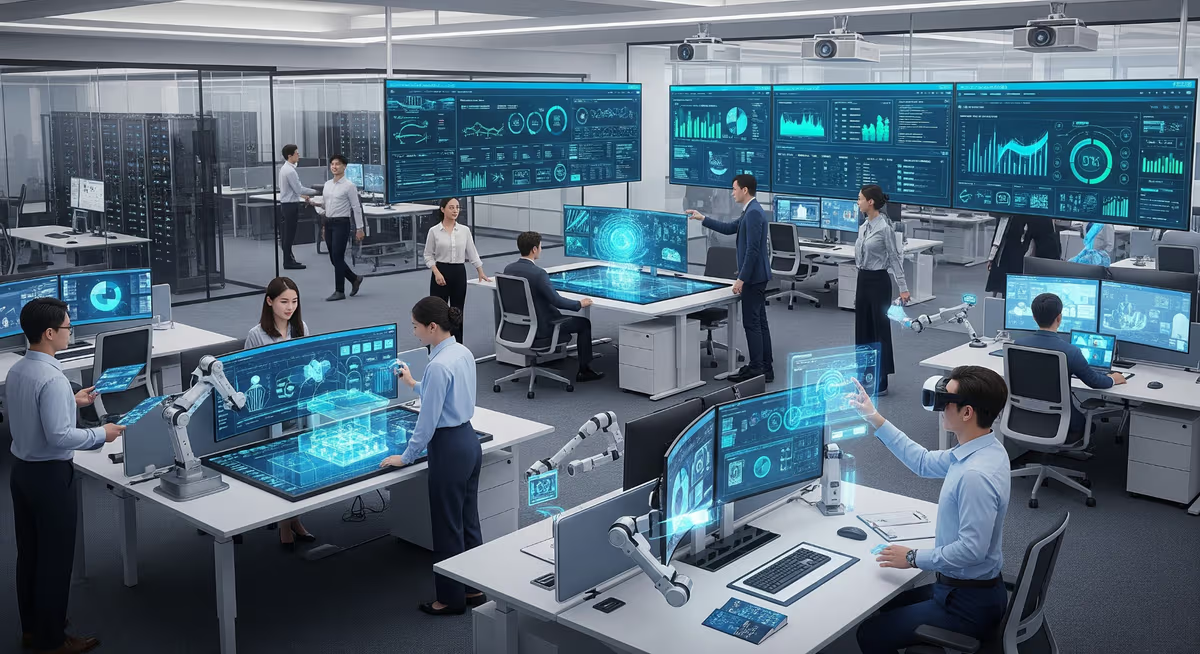

Global | — Digitalization is no longer about installing the latest software or upgrading office computers. Across industries, companies are fundamentally redesigning how they manage reporting, approvals, meetings, customer service, recruitment, finance, and marketing. Business leaders increasingly recognize that true Digital Transformation is about improving workflows—not simply adding more technology.
Experts say organizations that successfully embrace digital transformation allow employees to spend less time on repetitive administrative tasks and more time making strategic decisions, solving problems, and collaborating with teams. However, companies that fail often end up with more applications, endless notifications, and increased employee fatigue without improving productivity.
The Focus Has Shifted from Reports to Real-Time Dashboards
Traditional businesses relied heavily on weekly reports, requiring employees to gather data, prepare spreadsheets, and write summaries for management.
Today, businesses monitor sales, inventory, advertising performance, customer inquiries, and financial metrics through real-time dashboards. This transition has significantly changed workplace expectations.
Instead of rewarding employees for compiling numbers, organizations now value professionals who can identify unusual trends, interpret data, and recommend informed business decisions.
According to digital transformation specialists, business innovation is measured not by attractive dashboards but by faster and smarter decision-making.
Automation Is Eliminating Routine Office Tasks
Many repetitive office functions—including invoice processing, scheduling, inventory updates, customer query classification, and meeting note preparation—are increasingly being handled through Automation and Artificial Intelligence (AI).
With the rapid advancement of Generative AI, businesses can now quickly produce:
- Email drafts
- Contract summaries
- Market research reports
- Business presentations
- Internal documentation
Despite these advances, experts warn that AI-generated content still requires human verification. Numerical errors, missing context, compliance issues, and legal wording continue to require experienced professionals to review and approve AI-generated work.
Rather than replacing employees entirely, automation is transforming workers into reviewers, supervisors, and system designers.
Digital Onboarding Improves User Experience
Modern digital platforms are also changing how users interact with online services.
Companies increasingly simplify account creation, identity verification, and security authentication, ensuring smooth onboarding without lengthy manuals or complicated registration processes.
Industry analysts note that users now expect fast, intuitive, and mobile-friendly experiences, whether opening a business account, accessing digital services, or registering on online platforms.
Meetings Are Becoming More Decision-Oriented
One early expectation of digital transformation was that technology would significantly reduce meetings.
Instead, experts say meetings are evolving rather than disappearing.
Routine information sharing is now handled through messaging platforms, collaborative documents, and project management software, while meetings are increasingly reserved for:
- Strategic decision-making
- Problem-solving
- Conflict resolution
- Executive approvals
Business consultants emphasize that companies gain more value by reducing unnecessary meetings than simply automating meeting minutes.
Managers Must Oversee AI Usage, Not Just Employees
Digital transformation is also redefining management responsibilities.
Previously, managers primarily monitored attendance, report submissions, and task completion.
Today, they must oversee:
- AI-generated content quality
- Data security
- Access permissions
- Compliance standards
- Risk management
- Accountability frameworks
Organizations are increasingly developing formal AI Governance Policies, including usage guidelines, approval procedures, and data retention rules to minimize operational risks.
Data-Driven Decision Making Mirrors Competitive Esports
Business analysts compare modern corporate decision-making to the data-driven environment of esports, where performance metrics, strategy changes, and real-time analytics influence outcomes.
Much like professional gaming, organizations receive information faster than ever before, but human expertise remains essential for interpreting what the numbers actually mean.
The speed of data has increased—but the quality of decision-making still depends on human judgment.
Hiring Prioritizes Adaptability Over Software Skills
Recruitment strategies are also evolving.
Rather than hiring candidates solely because they know a specific software application, employers increasingly seek professionals who can:
- Break complex problems into manageable tasks
- Identify opportunities for automation
- Think critically
- Adapt to rapidly changing technologies
- Work effectively alongside AI tools
Marketing professionals are expected to design effective experiments rather than simply write advertisements.
HR specialists increasingly analyze recruitment data to identify hiring biases, while finance teams focus more on risk analysis and strategic forecasting than spreadsheet management.
Hybrid Work Continues to Define the Future
Although many organizations have encouraged employees to return to physical offices, Hybrid Work remains the preferred long-term model for many businesses.
Cloud collaboration platforms, video conferencing, digital approvals, and online project management have become permanent components of modern business operations.
Industry observers believe offices will increasingly serve as spaces for team collaboration, strategic planning, and relationship building, while routine administrative work continues remotely.
Too Many Digital Tools Can Lead to Failure
One of the biggest reasons digital transformation projects fail is not a lack of technology—but too much technology.
Organizations often introduce multiple disconnected platforms without clear objectives, resulting in:
- Duplicate data entry
- Inconsistent information
- Poor employee training
- Workflow confusion
- Reduced productivity
Experts argue that successful companies focus on using fewer, better-integrated tools that deeply improve core business processes rather than adopting every new digital solution available.
The Bottom Line
Business leaders increasingly agree that successful Digital Transformation is not defined by purchasing the latest software—it is defined by redesigning how work gets done.
Companies that eliminate unnecessary processes, embrace intelligent Automation, establish responsible AI Governance, and prioritize Data-Driven Decision Making are expected to remain more competitive in an increasingly digital economy.
As technology continues to evolve, organizations that balance innovation with thoughtful human oversight are likely to achieve the greatest long-term success.