

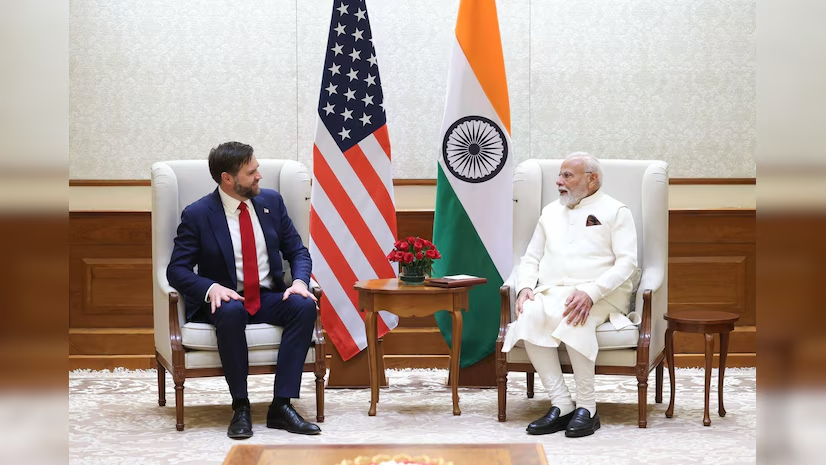

NEW DELHI: Prime Minister Narendra Modi spoke by phone with US Vice President JD Vance on Saturday, with the two leaders discussing ways to further strengthen the India-US Comprehensive Global Strategic Partnership across key areas.
The conversation also included a personal note, with Prime Minister Modi congratulating JD Vance and his wife, Usha Vance, on the birth of their son and extending his best wishes to the entire family.
“Received a phone call from US Vice President JD Vance. We discussed ways to further deepen India-US Comprehensive Global Strategic Partnership across key areas,” Modi said in a post on X.
He added, “Warmly congratulated him and the Second Lady on the birth of their son and conveyed best wishes to the entire family.”
FCRA Concerns Surface Ahead of the Call
The conversation came just days after US Congressman Riley Moore raised concerns over proposed amendments to India’s Foreign Contribution Regulation Act (FCRA) framework, which governs foreign donations received by non-governmental organizations (NGOs), trusts, educational institutions and religious organizations.
Moore alleged that the proposed changes could potentially allow the Indian government to exercise greater control over churches and religious charities. He described the proposed amendments as a “clear attack against Christians” and warned that the issue could have implications for India-US relations.
India’s Ministry of External Affairs (MEA) rejected the characterization of the issue as an international matter, saying the proposed FCRA amendments are an internal legislative matter for India.
The ministry also pointed out that several countries, including the United States, have their own laws and regulatory frameworks governing foreign funding.
Defence and Strategic Cooperation Expanding
The Modi-Vance conversation comes as India and the United States continue to expand cooperation in defence, civil nuclear energy, artificial intelligence and emerging technologies.
US Assistant Secretary of State S. Paul Kapur said earlier that Washington and New Delhi were working to broaden their cooperation in defence and civil nuclear energy, while also exploring trusted applications of artificial intelligence and other advanced technologies.
The two countries have also been strengthening defence cooperation across multiple operational domains.
India and the United States last year signed a framework for a major defence partnership aimed at improving interoperability across land, sea, air, space and cyberspace.
The agreement reflects the broader strategic importance both countries attach to their bilateral defence relationship amid evolving security challenges in the Indo-Pacific and beyond.
Regional Security Also in Focus
The latest Modi-Vance conversation also comes against the backdrop of significant geopolitical developments in West Asia and growing international security concerns.
The call took place days after Türkiye, Saudi Arabia and Pakistan signed a mutual defence pact amid the continuing conflict in West Asia.
Against this wider geopolitical backdrop, the strengthening of India-US strategic and defence cooperation remains a significant component of the two countries’ foreign policy engagement.
Modi and Vance Maintain High-Level Contact
Vance’s last publicly known phone conversation with Prime Minister Modi took place in May 2025, during Operation Sindoor, India’s military operation against Pakistan.
Prime Minister Modi later disclosed details of that conversation in the Lok Sabha, highlighting the importance of communication between the leadership of India and the United States during a period of heightened regional tensions.
The latest phone call underscores the continuing engagement between New Delhi and Washington, with both sides seeking to deepen cooperation in strategic affairs, defence, technology, energy and other key sectors.
The discussion between Modi and Vance is expected to contribute to ongoing efforts to further consolidate the India-US Comprehensive Global Strategic Partnership, while addressing emerging challenges and expanding cooperation in areas of mutual interest.