

Hyderabad : Scientists at SASTRA Deemed University have developed an innovative nanofluid electrolyte that significantly improves the performance of electrically rechargeable Zinc-Air Batteries (ZABs), marking a major advancement in safe, affordable, and environmentally friendly energy storage technology.
The breakthrough could accelerate the adoption of next-generation green batteries for electric vehicles, renewable energy storage, and grid-scale power systems. The research has been supported by the Department of Science and Technology (DST), Government of India, through its Nano and Advanced Materials Division.
Importantly, the technology has already been secured under Indian Patent IN570691, making it ready for commercial deployment.
A Major Step Beyond Lithium-Ion Batteries
Rechargeable Zinc-Air Batteries have long been considered a promising alternative to lithium-ion batteries because they offer:
- High theoretical energy density
- Lower manufacturing costs
- Water-based chemistry for improved safety
- Reduced environmental impact
However, two major technical challenges have slowed their commercialization:
- Hydrogen gas evolution at the zinc anode, which wastes energy and accelerates corrosion.
- Slow oxygen reactions at the air cathode, typically requiring expensive catalysts made from platinum or ruthenium.
How the New Nanofluid Electrolyte Solves These Problems
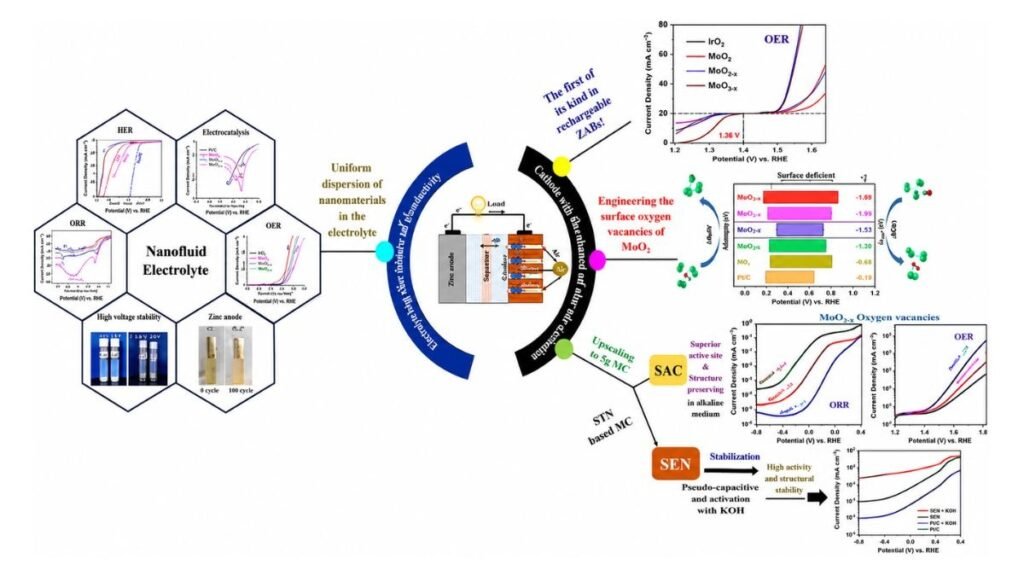
The research team, led by Dr. S. Devaraj, developed a cost-effective nanofluid electrolyte by adding small quantities of silica and zinc oxide nanoparticles to the conventional electrolyte.
The new formulation successfully:
- Suppresses unwanted hydrogen evolution
- Reduces zinc corrosion
- Enhances oxygen reduction and oxygen evolution reactions
- Improves battery charging and discharging efficiency
- Remains chemically stable for more than three months
This long-term stability makes the technology especially suitable for large-scale energy storage and electric mobility applications.
Advanced Catalysts Deliver Superior Performance
Alongside the electrolyte, the scientists also designed bifunctional catalysts capable of efficiently driving both:
- Oxygen Reduction Reaction (ORR)
- Oxygen Evolution Reaction (OER)
Among the tested materials, alpha manganese dioxide (α-MnO₂) demonstrated exceptional performance because of its unique tunnel-like crystal structure.
Researchers further enhanced its efficiency through copper doping, achieving performance that exceeded several commercial platinum- and ruthenium-based catalyst benchmarks, even with only 2 wt% dopant loading.
Turning Waste into High-Performance Battery Materials
The project also focused on sustainable recycling by converting waste materials into advanced battery components.
Researchers transformed:
- Used activated carbon from household water filters into MnO₂/carbon nanocomposites suitable for high-performance electrocatalysts and supercapacitor electrodes.
- Discarded surgical face masks into activated carbon with an exceptionally high surface area, delivering oxygen reduction activity comparable to platinum-based materials.
The waste-to-material process has also been filed for patent protection (Application No. 202441032753).
American Experts Welcome the Innovation
Reacting to the breakthrough, Dr. Michael Reynolds, an American energy storage researcher from Massachusetts, praised the development.
“Rechargeable zinc-air batteries have enormous potential because they combine safety, affordability, and sustainability. Innovations like this nanofluid electrolyte could significantly accelerate their commercial adoption worldwide.”
Meanwhile, Dr. Emily Carter, an American materials scientist based in California, emphasized the importance of recycling in battery innovation.
“Transforming discarded materials into high-performance battery components is exactly the kind of circular economy approach the clean energy sector needs. Combining advanced nanotechnology with waste recycling makes this research particularly impressive.”
Commercial and Environmental Impact
Researchers believe the new technology has applications well beyond Zinc-Air Batteries. The nanofluid electrolyte concept could potentially be adapted for other water-based battery systems, opening new possibilities for safer, lower-cost, and more sustainable energy storage.
Likewise, the team’s waste upcycling techniques can be applied to a wide range of carbon-rich waste materials, reducing environmental pollution while creating valuable components for future battery technologies and supercapacitors.
Looking Ahead
With patent protection secured, commercial readiness achieved, and support from the Department of Science and Technology, the breakthrough positions India at the forefront of next-generation battery research. If successfully commercialized, the innovation could strengthen renewable energy infrastructure, improve electric vehicle performance, reduce dependence on expensive battery materials, and contribute significantly to the global transition toward clean and sustainable energy.