

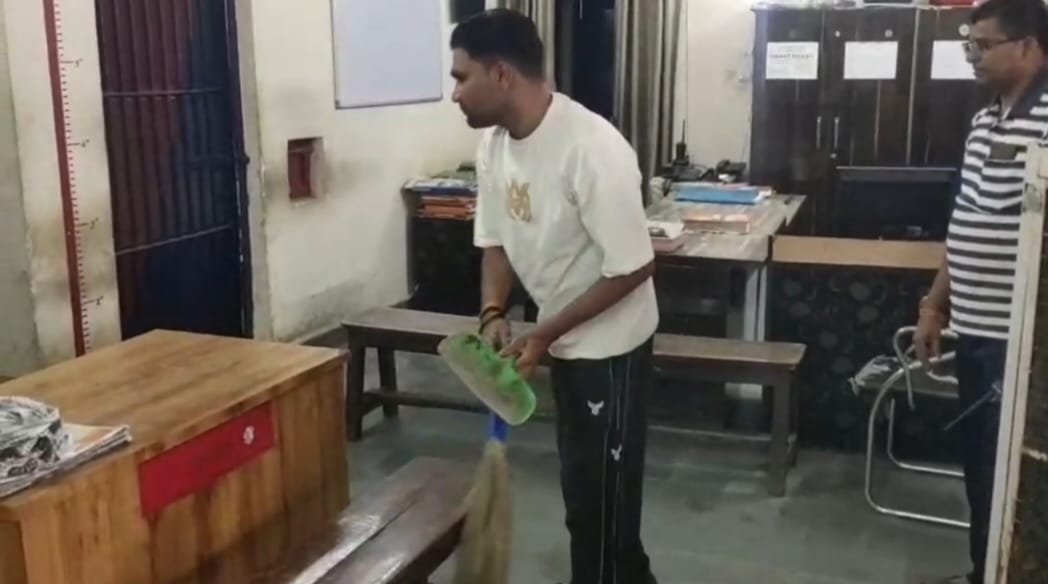

Janjgir-Champa, Chhattisgarh, India — In a unique road safety judgment, the Chief Judicial Magistrate (CJM) Court in Janjgir-Champa, Chhattisgarh, has ordered a 30-day community service sentence for a man who was caught driving under the influence of alcohol for the third time. Instead of imposing only a monetary penalty, the court directed the offender to perform daily cleaning duties at Kotwali Police Station and participate in public awareness campaigns against drunk driving.
The decision has attracted attention as an example of a rehabilitative approach to justice, combining punishment with public education to promote road safety and responsible driving.
Third-Time Offender Receives an Unusual Sentence
According to local authorities, the offender, Swadesh Kumar Yadav, was apprehended during a traffic enforcement campaign conducted by the Janjgir-Champa Traffic Police under the supervision of Superintendent of Police Vijay Kumar Pandey.
Police had been carrying out regular vehicle inspections across major intersections, checking for:
- Drunk driving
- Helmet compliance
- Traffic rule violations
- Road safety awareness
During one of these operations, officers found Yadav allegedly driving under the influence of alcohol for the third time.
Court Orders Community Service Instead of Only a Fine
After reviewing the case under Section 185 of the Motor Vehicles Act, the Chief Judicial Magistrate ordered that the offender:
- Clean the Kotwali Police Station every day for 30 days.
- Spread awareness at major intersections, urging citizens not to drink and drive.
- Encourage responsible road behavior and educate motorists about the dangers of impaired driving.
Authorities said the sentence is intended not only to punish the offender but also to promote public awareness and reduce road accidents caused by alcohol-impaired driving.
Repeat Violations Led to Stronger Action
Officials stated that this was not the first offense committed by the accused.
On two previous occasions, the traffic police had booked him for drunk driving and presented the cases before the court. Each time, the court imposed a fine of ₹10,000.
Despite those penalties, the offender allegedly continued violating traffic laws, prompting the court to adopt a community service-based punishment aimed at encouraging behavioral change.
Police Continue Strict Enforcement
Police officials emphasized that they are conducting continuous traffic enforcement drives throughout the district.
Under Section 185 of the Motor Vehicles Act, motorists found driving under the influence of alcohol face legal action, including fines and other penalties prescribed by law. Authorities reiterated that the objective of these campaigns is to improve road safety and prevent accidents caused by impaired driving.
American Experts React
David Miller, an American road safety consultant from Chicago, described the judgment as an innovative example of restorative justice.
“Community service can sometimes have a greater long-term impact than financial penalties alone. It reminds offenders of their responsibility to the community while reinforcing safe driving habits.”
Sarah Thompson, an American legal researcher based in Boston, said combining punishment with education can help reduce repeat offenses.
“Courts around the world are increasingly exploring corrective measures that encourage behavioral change. Public awareness campaigns conducted by offenders themselves can send a powerful message about the consequences of dangerous driving.”
Why the Case Matters
Road safety experts note that drunk driving remains one of the leading causes of preventable road accidents worldwide. The Janjgir-Champa court’s decision highlights an approach that focuses on both accountability and public education, aiming to discourage repeat violations while promoting safer roads.
As the offender completes the 30-day community service, authorities hope the sentence will not only reform individual behavior but also encourage other motorists to avoid drinking and driving, ultimately contributing to a safer transportation environment for everyone.