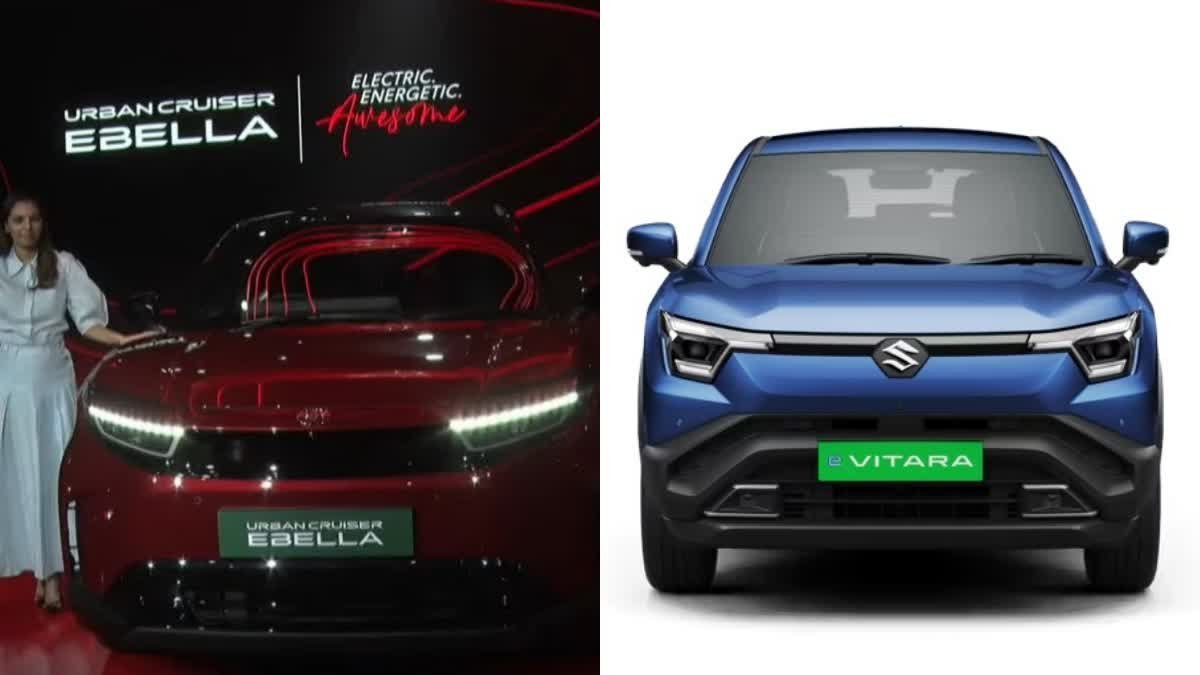
Hyderabad: Earlier this week, Japanese automaker Toyota unveiled its first electric vehicle for the Indian market — the Toyota Urban Cruiser Ebella. This new mid-size electric SUV is essentially a rebadged version of the Maruti Suzuki e-Vitara, which is also Maruti’s first electric car. While both vehicles share the same core platform, Toyota has made a few design and feature changes to give the Ebella its own identity.
Here’s a closer look at how the two electric SUVs differ.
Design: Subtle but Noticeable Differences
Despite sharing identical dimensions and a 2,700 mm wheelbase, the Toyota Urban Cruiser Ebella and Maruti e-Vitara look distinct at the front. Both SUVs feature active air flaps for improved battery cooling, but the headlight and DRL designs set them apart.
The Toyota Ebella gets monopod LED headlights with pine-shaped DRLs, while the Maruti e-Vitara features Y-shaped DRLs paired with advanced matrix LED technology. The bumper design is also different — Toyota’s styling leans toward a more refined and sophisticated look, while the e-Vitara appears more muscular and aggressive. Notably, fog lamps are available on the Maruti but missing on the Toyota.
From the side, both SUVs look largely identical, with heavy body cladding and similar proportions. However, they differ in 18-inch alloy wheel designs. The rear LED light bars on both models complement their respective front-end designs.
Interior: Nearly Identical Layouts
Inside the cabin, both SUVs share a black-and-tan interior theme and an almost identical dashboard layout. Key features common to both include a dual-screen setup, floating center console, flat-bottom steering wheel, ambient lighting, glass roof, powered driver seat, electric parking brake, and ventilated front seats.
The main difference lies in the audio systems. The Toyota Ebella comes equipped with a 10-speaker JBL sound system, while the Maruti e-Vitara offers a 10-speaker Infinity system. Rear-seat passengers in both SUVs benefit from slide and recline functions, along with a 40:20:40 split for added practicality.
Powertrain and Performance
Both electric SUVs offer two battery pack options — 49 kWh and 61 kWh.
- The smaller battery produces 142 bhp and 189 Nm of torque, delivering a claimed range of 440 km.
- The larger battery generates 172 bhp with the same torque, offering an extended range of 543 km.
Trim levels differ by branding. Maruti offers the e-Vitara in Delta, Zeta, and Alpha trims through its Nexa network, while Toyota names its variants E1, E2, and E3.
Safety Features
Safety equipment is identical on both models, including seven airbags, a 360-degree camera, and Level-2 ADAS features. The Maruti e-Vitara has already secured a 5-star Bharat NCAP safety rating, while Toyota has yet to reveal the crash-test rating for the Urban Cruiser Ebella.
Pricing and Ownership Benefits
Pricing for both electric SUVs has not been announced yet. However, Toyota has taken an extra step by offering a 60 percent buyback guarantee after three years, aimed at boosting customer confidence. The Urban Cruiser Ebella will also be available with a Battery as a Service (BaaS) option, which could significantly reduce the initial purchase cost.
Both vehicles come with a standard 8-year battery warranty.
Overall, while the Toyota Urban Cruiser Ebella and Maruti e-Vitara share the same foundation, Toyota has introduced subtle design tweaks and ownership benefits to differentiate its first electric SUV in India.