



New Delhi | On the occasion of International Tiger Day, India has reaffirmed its position as the global leader in tiger conservation, showcasing remarkable achievements in protecting the country’s national animal through science-based policies, advanced technology, strong governance, and community participation.
According to the latest All India Tiger Estimation (2022), India is now home to 3,682 wild tigers, accounting for nearly 70% of the world’s total wild tiger population. This milestone reflects decades of sustained conservation efforts under flagship initiatives such as Project Tiger, the National Tiger Conservation Authority (NTCA), and state-led Tiger Conservation Plans.
India’s Remarkable Conservation Success
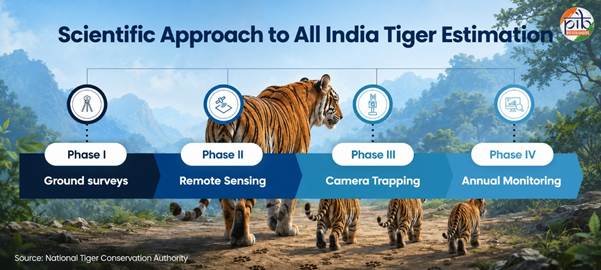
India’s tiger population has more than doubled since 2006, making it one of the world’s greatest wildlife conservation success stories. The 2022 All India Tiger Estimation, recognized as one of the largest wildlife surveys in the world, covered 20 states and surveyed more than 641,000 square kilometres on foot.
The steady rise in tiger numbers has been driven by long-term habitat protection, scientific monitoring, strict anti-poaching measures, and effective coordination between central and state governments.
Why Tigers Matter
Beyond their cultural significance, tigers play a crucial ecological role as apex predators and an umbrella species, helping maintain healthy forest ecosystems. Protecting tiger habitats safeguards forests, rivers, biodiversity, and thousands of other species, while supporting water security, soil conservation, pollination, climate regulation, and sustainable livelihoods for millions of people.
The Government of India emphasized that conserving tiger landscapes also contributes significantly to the country’s broader vision of “Viksit Bharat” (Developed India) by strengthening ecological security and promoting sustainable development.
International Tiger Day: A Global Conservation Movement
International Tiger Day, observed every year on July 29, was established following the 2010 St. Petersburg Tiger Summit, where leaders of 13 tiger-range countries, including India, adopted the ambitious TX2 goal of doubling the global wild tiger population.
Global tiger numbers have shown remarkable recovery over the past decade. From an estimated 3,200 wild tigers in 2010, the global population increased to around 4,500 by 2022, with recent estimates placing the number at approximately 5,711 wild tigers worldwide, representing nearly a 78% increase since 2010.
Project Tiger: The Backbone of Conservation
Launched in 1973, Project Tiger remains India’s flagship conservation programme under the Ministry of Environment, Forest and Climate Change (MoEFCC).
According to the NTCA Annual Report 2023, the programme now oversees a network of 58 Tiger Reserves across 18 tiger-range states, covering nearly 84,500 square kilometres, which accounts for approximately 2.56% of India’s geographical area.
The programme provides financial assistance, technical support, scientific management, and regular field monitoring, ensuring long-term protection of tiger habitats.
Strong Institutional Framework
India’s tiger conservation model is supported by a robust institutional framework led by the National Tiger Conservation Authority (NTCA).
The NTCA is responsible for:
- Approving Tiger Conservation Plans
- Providing scientific and financial guidance
- Issuing Standard Operating Procedures (SOPs)
- Monitoring the management effectiveness of Tiger Reserves
- Strengthening habitat conservation through evidence-based policies
The authority is chaired by the Union Minister for Environment, Forest and Climate Change and includes members of Parliament, senior government officials, and wildlife experts.
Technology-Driven Monitoring
India has integrated cutting-edge technology into wildlife conservation.
Key digital tools include:
- M-STrIPES (Monitoring System for Tigers – Intensive Protection and Ecological Status) using GPS, GPRS, and remote sensing for field monitoring.
- CaTRAT (Camera Trap Data Repository and Analysis Tool) for automated image classification.
- ExtractCompare, an Artificial Intelligence (AI)-based system that identifies individual tigers through their unique stripe patterns.
These technologies have significantly improved the accuracy, transparency, and scientific reliability of tiger population estimation.
World’s Largest Biodiversity Survey
The All India Tiger Estimation (AITE), conducted every four years jointly by the NTCA and the Wildlife Institute of India (WII), is recognized as the world’s largest biodiversity survey.
The NTCA’s camera trap survey has also earned a place in the Guinness World Records as the largest camera trap wildlife survey globally.
Management Effectiveness Evaluation
India regularly assesses the performance of Tiger Reserves through the Management Effectiveness Evaluation (MEE) framework.
By 2022, 51 Tiger Reserves had been evaluated.
Key findings include:
- 12 Tiger Reserves received an “Excellent” rating.
- The average management score reached 78%, highlighting significant improvements in reserve management and accountability.
Global Leadership in Tiger Conservation
India is actively expanding international cooperation to strengthen wildlife conservation.
The country collaborates with:
- Nepal and Bhutan on transboundary biodiversity conservation.
- Myanmar to combat illegal timber trade and wildlife crimes.
- Russia through the India-Russia Working Subgroup on Tiger and Leopard Conservation.
- China, Botswana, South Africa, Kenya, Namibia, Cambodia, and Guatemala on biodiversity conservation and sustainable wildlife management.
International Big Cat Alliance (IBCA)
India has also emerged as the driving force behind the International Big Cat Alliance (IBCA), approved by the Union Cabinet on March 12, 2024.
Headquartered in India, the alliance brings together 95 big cat range and partner countries to strengthen conservation of seven major big cat species:
- Tiger
- Lion
- Leopard
- Snow Leopard
- Cheetah
- Jaguar
- Puma
The initiative builds upon India’s globally recognized expertise in wildlife conservation.
Global Tiger Forum
Headquartered in New Delhi, the Global Tiger Forum (GTF) remains the world’s only intergovernmental organization dedicated exclusively to tiger conservation.
It brings together 13 tiger-range countries to promote landscape-level conservation, capacity building, scientific collaboration, and technology-driven conservation efforts.
Future Roadmap
Looking ahead, India aims to create climate-resilient, well-connected tiger landscapes that benefit both wildlife and local communities.
Future priorities include:
- Data-driven conservation
- Technology-enabled protection
- Capacity building of frontline forest staff
- Habitat connectivity
- International collaboration
- Youth engagement through conservation awareness
The Government reaffirmed that International Tiger Day serves as an important platform to inspire citizens, particularly young people, to participate in protecting India’s rich natural heritage.
With its science-based conservation model, strong institutional framework, advanced monitoring technologies, and global partnerships, India continues to set a benchmark for tiger conservation worldwide while securing a sustainable future for both wildlife and people.
Source: Press Information Bureau (PIB), Government of India.