

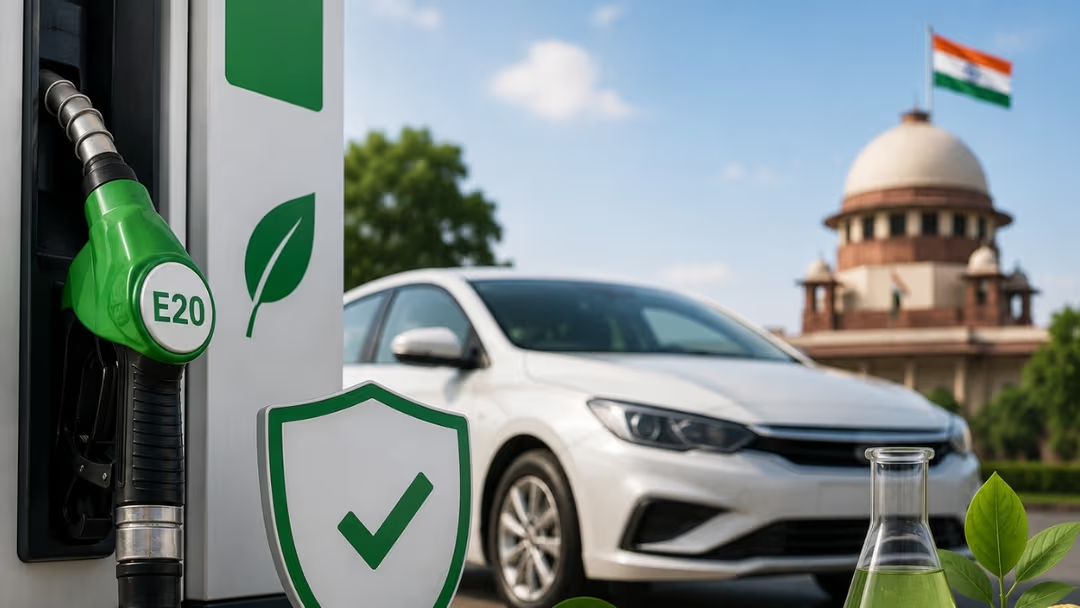

New Delhi, India | July 28, 2026: The Government of India has officially clarified that using E20 petrol will not invalidate a vehicle’s motor insurance policy or result in the automatic rejection of an insurance claim, putting to rest widespread misinformation circulating on social media.
The clarification comes after viral posts falsely claimed that filling a vehicle with E20 fuel could cause insurers to deny claims, particularly for older vehicles. Officials from the Ministry of Petroleum and Natural Gas and the Press Information Bureau (PIB) Fact Check Unit have dismissed these claims as misleading after consulting insurance companies and automobile manufacturers.
What Is E20 Petrol?
E20 petrol is a fuel blend containing:
- 20% Ethanol
- 80% Petrol (Gasoline)
The fuel is part of India’s Ethanol Blending Programme (EBP), which aims to:
- Reduce dependence on imported crude oil
- Lower carbon emissions
- Support Indian farmers through increased ethanol production
- Promote cleaner and more sustainable transportation
Similar ethanol-blended fuels are already widely used in countries such as:
- Brazil (E27)
- United States
- Japan
Government’s Official Clarification
According to the Ministry of Petroleum and Natural Gas and the PIB Fact Check Unit, the use of E20 petrol alone does not:
- Void a motor insurance policy
- Automatically invalidate warranty coverage
- Cause insurance claims to be rejected
Officials emphasized that insurance companies evaluate claims based on:
- The actual cause of damage
- Terms and conditions of the insurance policy
- Policy exclusions
- Surveyor reports
- Supporting evidence
The type of fuel used is not, by itself, a valid reason to deny an insurance claim.
What Insurance Companies Say
Major insurers, including ICICI Lombard, have confirmed that they do not consider the use of E20 petrol to be negligence, even in vehicles manufactured before widespread E20 adoption.
Insurance claims continue to be assessed based on insured events such as:
- Road accidents
- Vehicle theft
- Fire
- Natural disasters
- Other covered losses
An insurer cannot reject a claim solely because the vehicle was fueled with E20. To deny a claim, the insurer would need clear evidence that the damage resulted from a specific policy exclusion.
What About Older Vehicles?
Many passenger vehicles manufactured before April 2023 were originally engineered for E10 fuel (10% ethanol).
According to industry experts:
- Some rubber hoses, seals, or fuel system components may experience faster wear over extended periods.
- However, there is no widespread evidence linking E20 fuel to large-scale engine failures.
- Using E20 petrol does not automatically void vehicle warranties, provided the fuel complies with approved specifications.
The Society of Indian Automobile Manufacturers (SIAM) has also confirmed that warranty coverage remains valid for vehicles using specification-compliant E20 fuel.
How the Rumors Started
Officials say the confusion largely originated from:
- Misinterpreted social media posts.
- Outdated online articles.
- Selective interpretation of insurer blogs.
- Recirculated images lacking proper context.
The government has urged vehicle owners to rely on official notifications, vehicle manufacturers, and licensed insurance providers rather than unverified social media claims.
Benefits of India’s Ethanol Blending Programme
India’s expanding ethanol blending initiative has delivered several significant benefits, including:
- Saving more than ₹1.4 lakh crore in foreign exchange by reducing crude oil imports.
- Supporting farmers through increased demand for ethanol feedstocks.
- Lowering greenhouse gas emissions.
- Improving energy security.
- Promoting the use of cleaner transportation fuels.
Before nationwide rollout, E20 fuel underwent testing and evaluation by:
- Automotive Research Association of India (ARAI)
- Indian Oil Corporation Limited (IOCL)
- Leading automobile manufacturers
Advice for Vehicle Owners
Government agencies and industry experts recommend that motorists:
- Continue using E20 petrol from authorized fuel stations.
- Follow the vehicle manufacturer’s recommended maintenance schedule.
- Pay particular attention to routine servicing for older vehicles.
- Read their insurance policy wording carefully.
- Contact their insurer if they have specific questions regarding coverage.
Officials stress that any future insurance dispute would depend on the facts of the case, technical inspection, and policy provisions, not simply on the presence of ethanol-blended fuel.
American Perspectives
David Mitchell, an automotive insurance analyst from Dallas, Texas, said misinformation about fuel compatibility often creates unnecessary concern among motorists.
“Insurance companies evaluate claims based on documented causes of damage and policy language—not simply because a vehicle used an approved fuel blend. Consumers should rely on official guidance rather than social media rumors,” Mitchell said.
Dr. Emily Carter, an automotive engineering researcher from Ann Arbor, Michigan, noted that ethanol-blended fuels have been used internationally for many years.
“Countries including the United States and Brazil have extensive experience with ethanol-blended gasoline. When fuel meets approved standards and manufacturers’ recommendations are followed, insurance decisions continue to be based on actual mechanical evidence and policy coverage—not the fuel itself,” Carter explained.
Looking Ahead
The Government of India’s clarification provides reassurance to millions of motorists as E20 petrol becomes the country’s standard gasoline blend. Authorities have emphasized that motor insurance claims are determined by the cause of the loss, policy terms, and technical assessments—not by the simple use of E20 fuel. Vehicle owners are encouraged to continue using authorized fuel, maintain their vehicles according to manufacturer recommendations, and seek information from official government sources, automobile manufacturers, and licensed insurers when questions arise.