

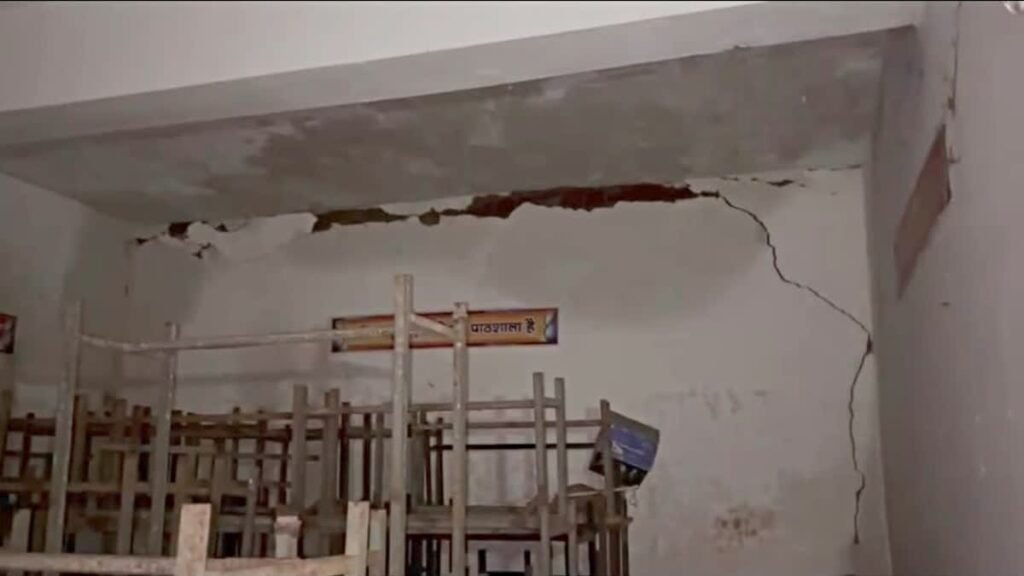
Kanker, Chhattisgarh | A serious concern over school infrastructure has emerged from Mahud village in the Charama development block of Kanker district, Chhattisgarh, where more than 40 students are being forced to attend classes in a garbage shed after their government school building became dangerously dilapidated.
The condition of the Government Middle School has raised questions about student safety, quality of education, and the urgent need for investment in rural educational infrastructure. Following public attention to the issue, district authorities have assured that the school will be repaired or upgraded within the next year using District Mineral Foundation (DMF) funds.
School Building Declared Unsafe
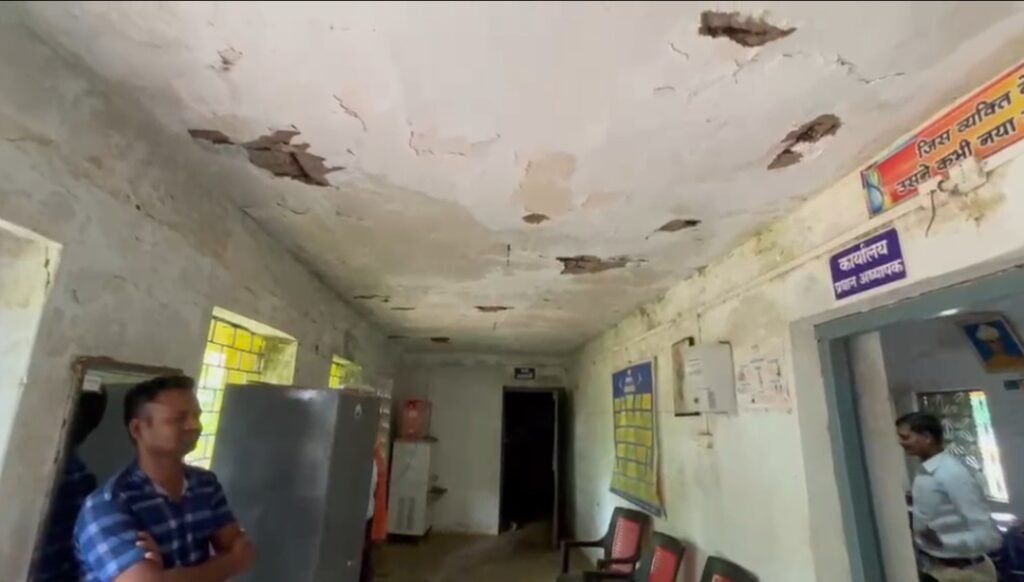
The existing school building has deteriorated to a point where it is considered unsafe for regular use.
Major structural problems include:
- Plaster falling from walls and ceilings
- Deep cracks in the walls
- Damaged windows
- Broken boundary wall
- Weak and deteriorating structure
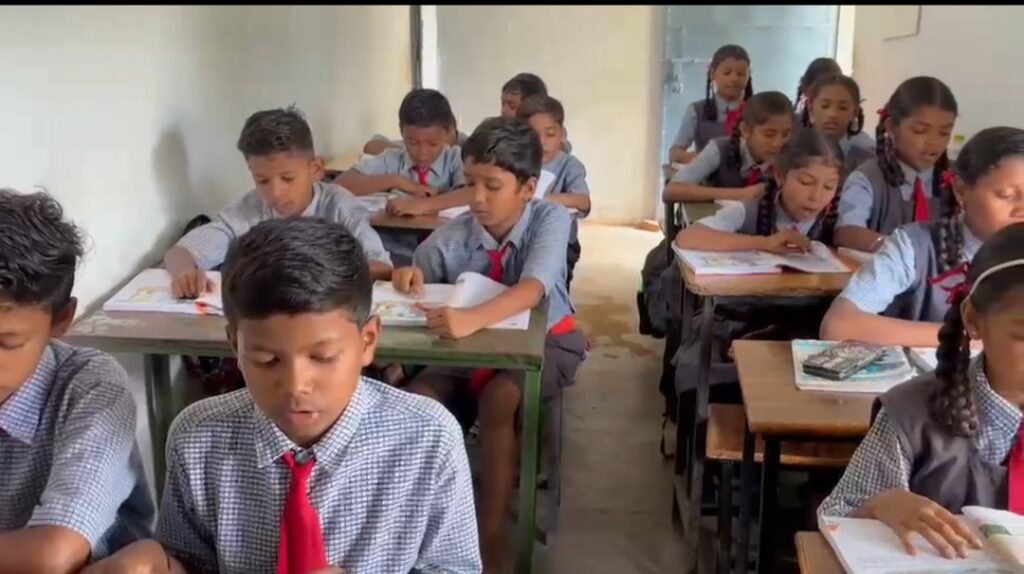
Due to the risk of collapse, school authorities shifted classroom activities to a nearby garbage shed, where students now attend daily lessons.
The same temporary structure is also being used to serve the Mid-Day Meal, highlighting the lack of basic educational facilities.
More Than 40 Students Affected
Over 40 schoolchildren are currently studying in the makeshift shed, where learning conditions remain far from ideal.
The temporary classroom exposes students to several risks, including:
- Rainwater entering the shed during the monsoon
- Strong winds disrupting classes
- Poor sanitation
- Potential encounters with snakes and scorpions
- Limited protection from extreme weather
Parents and local residents have expressed concern that such conditions negatively affect both student safety and academic performance.
Flood Risk Adds to the Crisis
The school is located close to National Highway-30 and along the banks of the Mahanadi River.
During the monsoon season, rising river levels often allow floodwaters to reach the school campus, making the already fragile infrastructure even more vulnerable.
Waterlogging around the temporary classroom further disrupts teaching activities and increases health and safety concerns.
Village Leaders Demand Immediate Action
Village Sarpanch Balkrishna Salam said local residents have repeatedly requested the construction of a new school building, but no substantial action has been taken.
He emphasized that many children come from economically weaker families and depend entirely on the government school for their education, leaving them with no practical alternative.
According to village representatives, improving the school’s infrastructure has become an urgent necessity rather than a long-term development goal.
District Collector Assures Improvement
Responding to the issue, Kanker Collector Nilesh Kumar Mahadev Kshirsagar confirmed that the district administration is aware of the school’s condition.
He stated that the Government of Chhattisgarh has recently relaxed rules governing the use of District Mineral Foundation (DMF) funds, allowing these resources to be spent on schools and basic infrastructure even in non-mining areas.
The Collector announced that:
- Necessary funding will be arranged within one year.
- Mahud School will be upgraded or repaired.
- Schools, Anganwadi centres, and hostels across Charama, Kanker, and Narharpur will also undergo repairs.
- Existing Pota Cabins will gradually be replaced with permanent concrete buildings.
The administration believes these measures will significantly improve educational infrastructure across the district.
Concerns Remain Until Construction Begins
Although officials have promised improvements, the immediate concern remains the welfare of students who continue to study in unsafe temporary conditions.
Education advocates argue that children should not have to risk their safety in order to receive an education, and that interim arrangements should ensure:
- Safe classrooms
- Proper sanitation
- Protection from weather
- A healthy learning environment
Until permanent infrastructure is completed, concerns over student safety, learning quality, and educational equity are expected to remain.
American Education Experts React
Dr. Sarah Johnson, an education infrastructure specialist from the University of Michigan, described the situation as deeply concerning.
“Every child deserves access to a safe and secure learning environment. Temporary classrooms may serve as emergency solutions, but prolonged exposure to unsafe conditions can negatively affect both education and student well-being.”
Meanwhile, David Miller, a public education policy analyst based in Washington, D.C., said:
“The decision to expand the use of District Mineral Foundation funds for school infrastructure is a positive policy step. However, swift implementation is essential to ensure that students are no longer forced to study in hazardous conditions.”
Outlook
The situation at Mahud Government Middle School highlights the broader challenge of maintaining rural educational infrastructure in vulnerable regions. While the district administration has committed to improving the school within a year through DMF funding, the immediate priority remains ensuring the safety, health, and continuous education of the students currently studying in temporary conditions.
If implemented effectively, the proposed infrastructure upgrades could significantly improve learning conditions not only in Mahud but also across several schools, Anganwadi centres, and hostels in Kanker district.