
What is it — Hangxing No. 1
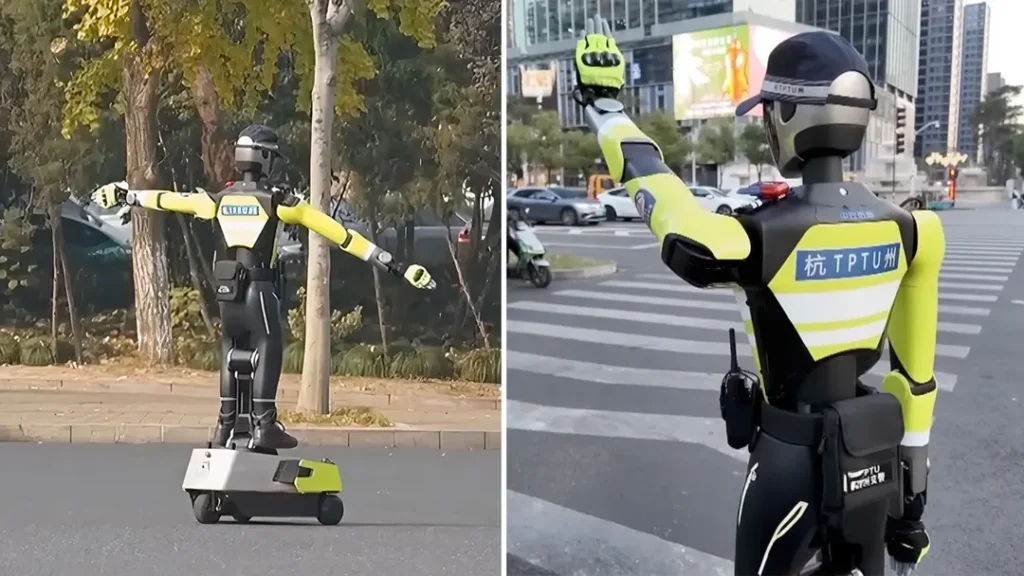
- Hangxing No. 1 is an AI-powered humanoid traffic-control robot recently deployed on the streets of Hangzhou, in eastern China’s Zhejiang province.
- It stands about 1.8 metres tall and is built to resemble a traffic-officer; the robot uses human-like gestures, a whistle, and audio prompts to control traffic.
- The project is the result of collaboration between local traffic police and technology developers in Hangzhou, combining hardware, motion-control systems, sensors/cameras, visual analysis, and voice-interaction capabilities.
📍 Where and When — Deployment Details
- The robot began its trial run on 1 December 2025 at the busy intersection of Binsheng Road and Changhe Road in the Binjiang district of Hangzhou.
- Before the official launch, Hangxing No. 1 had reportedly been tested at multiple intersections across Binjiang since October 2025.
🔧 How It Works — Features & Functions
- Traffic-directing gestures & signals: The robot performs standard traffic-officer gestures — e.g. indicating “go straight” or “stop” — learned from real police officers’ motions.
- Detection of violations: Using high-definition cameras and sensors, Hangxing No. 1 monitors vehicles and pedestrians. It can spot common traffic violations such as:
- Motorbike riders without helmets.
- Vehicles crossing the stop-line.
- Pedestrians jaywalking or crossing dangerously.
- Real-time alerts and guidance: Upon detecting a violation, the robot issues polite verbal warnings (via a built-in speaker) — such as telling someone to wait for the green signal or to wear a helmet. It can also blow a (digital) “whistle” to attract attention if needed.
- Integration with traffic signals: Hangxing No. 1 is synchronized with the existing traffic-light system, allowing it to manage signal phases and coordinate its instructions with lights.
- Dual modes — traffic control & civility guidance: The robot operates in two main modes: direct traffic flow (vehicles/pedestrians) and guiding civility (ensuring people follow rules, wear helmets, don’t jaywalk, etc.).
- Adaptive AI & continuous learning: Its AI model improves over time — learning from real-world traffic and human behaviour at the intersections.
👮♂️ Role with Human Officers & Police Backup
- Hangxing No. 1 isn’t a replacement for humans — rather, it assists human police officers. A human officer remains nearby to intervene when necessary.
- The idea is to lighten human officers’ workload, especially at busy intersections — while ensuring continuous monitoring and fair enforcement.
🔮 What the Future Holds — Planned Upgrades
- Officials have revealed plans to integrate advanced large-language model (LLM) capabilities into future versions of Hangxing No. 1. This would allow it to:
- Interact with people via voice (give directions, answer questions).
- Provide safety education, public guidance, and possibly even perform traffic-related consultations.
- There is talk of designing a next-generation fleet of traffic-management robots — potentially deploying many such robot officers across Hangzhou (and maybe beyond) if trials succeed.
📰 Why This Matters — Significance of This Innovation
- The deployment of Hangxing No. 1 marks a new chapter in urban automation and smart-city traffic management — integrating robotics, AI, and urban infrastructure.
- It may help reduce traffic violations and improve road safety, by providing instant detection and reminders, and acting as a visible deterrent.
- It could relieve pressure on human police forces, allowing them to focus on more complex tasks, while robots take care of routine monitoring and enforcement.
- If scaled, such systems could transform how cities handle traffic, law enforcement and public safety, especially in densely populated metropolises.