


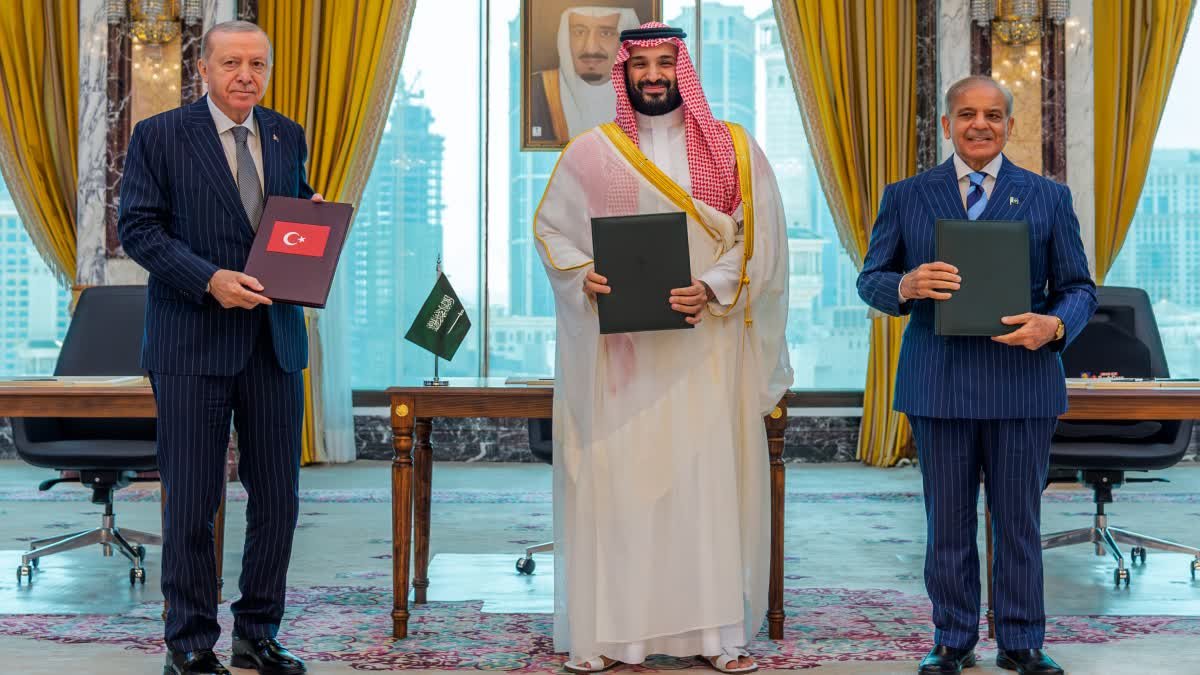

ANKARA: Turkey’s Foreign Minister Hakan Fidan has said that a new defense agreement between Turkey, Saudi Arabia and Pakistan is not directed against Iran or any other specific country, describing the pact as an important step toward strengthening regional stability and deterrence.
The agreement was signed on Friday in Mecca, Saudi Arabia, by Saudi Crown Prince Mohammed bin Salman, Turkish President Recep Tayyip Erdogan and Pakistani Prime Minister Shehbaz Sharif.
Under the agreement, an armed attack against any one of the three countries will be treated as an attack against all three, establishing a framework for mutual defense cooperation.
Turkey Says Iran Is Not the Target
Speaking to Turkey’s state-run Anadolu Agency, Foreign Minister Hakan Fidan emphasized that the agreement does not identify any particular country as a common enemy.
Fidan said the three countries do not consider a country an enemy unless it takes hostile action against them.
“We have nothing written down. There is nothing we have signed that identifies a common threat,” Fidan said.
He added that any country that does not attack them would not be considered a target.
The clarification comes amid heightened tensions in the Middle East, particularly concerns surrounding Iran and the possibility of a wider regional conflict.
Pact Brings Together Three Major Military Powers
The Mecca Joint Defense Agreement brings together three countries with significant military and strategic capabilities.
Saudi Arabia is one of the world’s major oil-producing nations and has invested heavily in modernizing its armed forces.
Pakistan is a nuclear-armed state with a large and experienced military.
Turkey, meanwhile, is a NATO member and has the alliance’s second-largest military by personnel. The country has also developed a rapidly expanding domestic defense industry, including capabilities in drones, armored vehicles, missiles and other military technologies.
The agreement therefore creates a new framework for defense coordination among three strategically important countries spanning the Middle East, South Asia and the Mediterranean region.
Mutual Defense Clause Similar to NATO Article 5
Fidan described the mutual-defense provision of the agreement as technically similar to NATO’s Article 5, under which an armed attack against one NATO member is considered an attack against all members.
However, the implementation mechanism under the new agreement would depend on the nature and severity of the threat.
Fidan explained that a member country would first need to make a formal request for assistance.
The other two countries could then provide different forms of support, ranging from intelligence sharing and logistical assistance to the deployment of military units, depending on the circumstances.
“These are multilayered matters that differ according to the level of the threat,” Fidan said, explaining the approach adopted by the three countries.
Cooperation Comes Amid Regional Uncertainty
The defense pact comes at a time of growing geopolitical uncertainty in the Middle East, including concerns over conflict involving Iran and the potential for regional instability.
Turkey has sought to position itself as an important diplomatic and security actor in the region, while Saudi Arabia has increasingly expanded its defense partnerships and Pakistan maintains longstanding military ties with both Saudi Arabia and Turkey.
The new arrangement could provide the three countries with a broader mechanism for security coordination, intelligence cooperation and military preparedness.
Other Countries Interested in Joining
Fidan also said that other countries, which he did not identify, have expressed interest in becoming part of the framework.
He specifically mentioned Egypt as a potential future participant, describing Cairo as a “natural partner.”
The Turkish foreign minister said he expected Egypt could participate at a later stage, potentially expanding the defense arrangement’s regional reach.
Any expansion of the agreement could make the emerging security framework more significant across the Middle East and wider Muslim-majority world.
Regular Meetings and New Secretariat Planned
The agreement also establishes a mechanism for continued institutional cooperation.
Under the arrangement, the foreign and defense ministers of Turkey, Saudi Arabia and Pakistan, together with their respective military chiefs, will hold regular committee meetings.
The three countries also plan to establish a permanent secretariat in Saudi Arabia to coordinate the framework and support ongoing cooperation.
The proposed institutional structure is intended to ensure that the agreement goes beyond a symbolic declaration and develops into a functioning system for defense coordination and mutual assistance.
Turkey Emphasizes Defensive Nature of Agreement
Fidan’s comments appear aimed at preventing the agreement from being interpreted as the formation of an alliance against Iran or another specific regional power.
Instead, Turkey is presenting the pact as a defensive arrangement designed to strengthen cooperation among the three signatories and deter potential attacks.
With the Middle East facing continuing security challenges, the Mecca Joint Defense Agreement could become an important new element in the region’s evolving security architecture, particularly if additional countries such as Egypt eventually join the framework.