


Surajpur, Chhattisgarh: The recent increase in bus fares across Chhattisgarh has added to the financial burden on passengers in Surajpur district, where a large section of the population lives in rural areas and depends on buses for daily travel. From government employees and traders to patients travelling to larger cities for treatment, commuters are feeling the impact of higher fares. While passengers describe the increase as another blow from inflation, bus operators and transport officials say the revision was necessary because of rising operating costs.
Bus Fares Increased by 50 Paise Per Kilometre
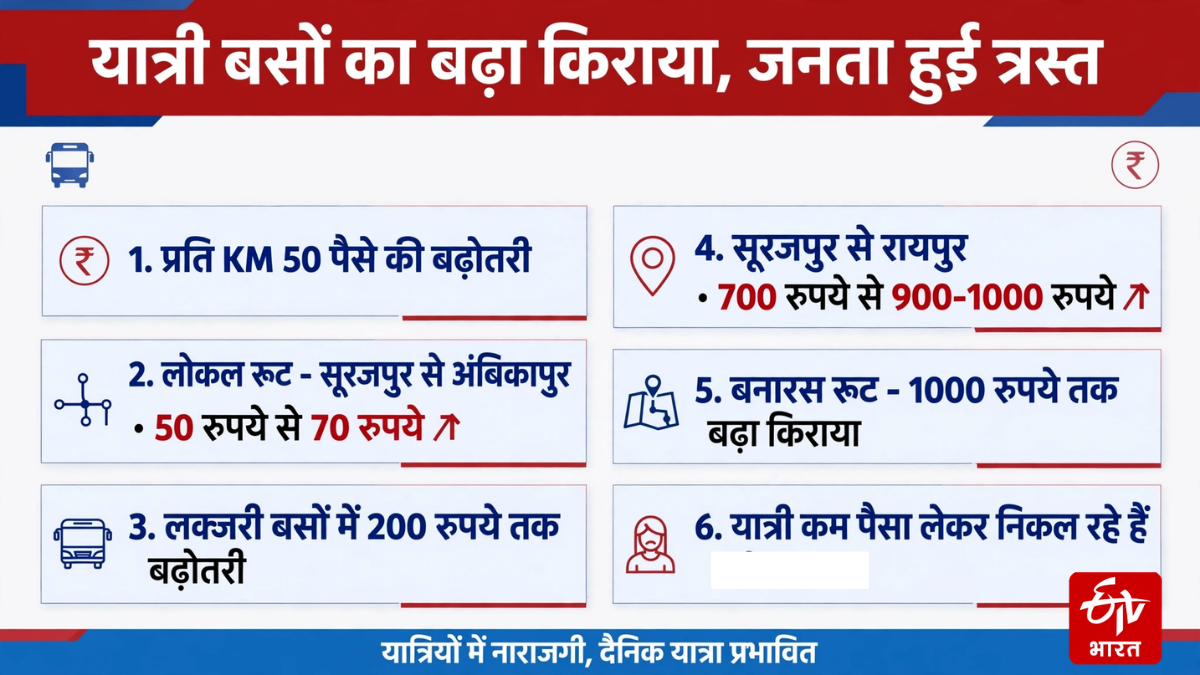
Following a government notification, revised passenger bus fares have come into effect across the state. According to the information provided by local transport representatives, fares have increased by 50 paise per kilometre compared with the previous rates, with changes varying by bus category.
The increase has affected passengers travelling between Surajpur and nearby towns, as well as those using long-distance services.
Jafar Alam, a bus agent, said passengers travelling from Surajpur to Ambikapur are now paying ₹70 instead of ₹50. He added that fares on the Surajpur–Baikunthpur route have also increased.
Luxury Bus Fares to Raipur and Varanasi Rise Sharply
Passengers travelling on long-distance routes are facing even steeper increases, particularly on luxury buses.
According to local transport representatives, the fare from Surajpur to Raipur, which was previously around ₹700, has risen to ₹900–₹1,000. Similarly, fares on buses travelling to Varanasi have increased from the earlier range of ₹500–₹700 to as much as ₹1,000.
The revised fares have caused difficulties for passengers who leave home with a fixed travel budget but discover the higher charges only when they reach the bus stand.
Passenger Triveni Singh said, “We leave home carrying money according to our travel plans. But after reaching here, we find out that the bus fare has increased. We do not know what to do in such a situation.”
Limited Railway Connectivity Adds to Passengers’ Problems
For many residents of Surajpur, buses are the main means of reaching destinations outside the district. Limited railway connectivity in several areas makes it difficult for passengers to switch to trains as a cheaper alternative.
Passenger Narendra Singh said that the limited availability of train services leaves people dependent on buses for long-distance journeys.
“Since railway connectivity is limited in our area, we have to depend on buses to travel long distances. With only a few train services available, paying higher bus fares has become a necessity for us,” he said.
The situation is particularly difficult for people with limited incomes who travel regularly for work, business or medical treatment.
Transport Officials Cite Five Years Without a Fare Revision
Transport officials have defended the increase, stating that bus fares had not been revised for five years and that rising fuel prices had increased operating expenses.
Vijay Nikunj, a transport officer, said the revised fares were implemented in accordance with the state government’s orders.
“The fare increase has been introduced following the government’s instructions. Fares have been revised after five years, with the state government allowing an increase of up to 40 per cent. The revised rates also apply in Surajpur district. Rising petrol and diesel prices made the increase necessary,” he said.
Bus operators and transport representatives argue that higher fuel costs have placed additional pressure on their operations. Passengers, however, say that the increase has not been accompanied by any noticeable improvement in travel facilities.
Patients and Long-Distance Travellers Face Higher Expenses
Surajpur has regular bus connections to destinations in Uttar Pradesh, Bihar and Jharkhand. Passengers also travel to cities such as Raipur and Bilaspur for medical treatment and other essential services.
For families with limited financial resources, the higher fares mean additional expenses for journeys that are often unavoidable. Patients travelling with family members may face an even greater financial burden.
While the revised fares are being justified on the grounds of rising operating costs, passengers are demanding better services in return. Their concerns include affordable travel, reliable bus operations and improved facilities for daily commuters.
The fare increase has therefore emerged as a major concern in Surajpur, particularly for rural residents who have few alternatives to road transport.