

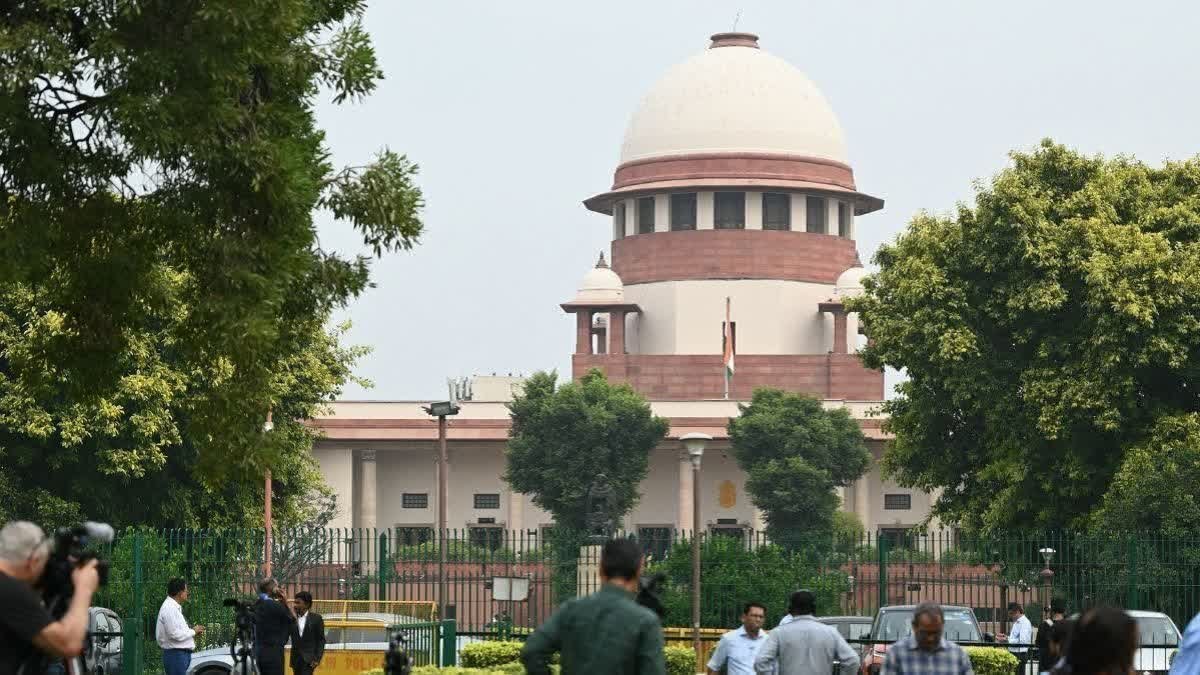

New Delhi : The Supreme Court of India on Tuesday declined to entertain a petition seeking the installation of the Ashoka Chakra (National Emblem) on the main dome of the Supreme Court building. During the hearing, Chief Justice of India (CJI) Surya Kant remarked that decisions regarding the appearance and administrative affairs of the Court would be handled by the institution itself.
The matter came before a three-judge Bench comprising Chief Justice Surya Kant, Justice Joymalya Bagchi, and Justice V. Mohan.
Court Refuses to Entertain the Petition
The petition was filed by Badravad Venugopal, also known as “Baba Khatarnak,” who requested that the National Emblem (Ashoka Chakra) be installed on the main dome of the Supreme Court building. The petitioner argued that the installation would reinforce the Court’s constitutional identity.
During the proceedings, Chief Justice Surya Kant made it clear that such issues fall within the Court’s own administrative domain.
He observed:
“We will decide what should be placed at the Supreme Court gate. There are many other issues in the world that deserve attention.”
The Bench subsequently declined to hear the plea, indicating that decisions concerning the Court’s infrastructure and symbols are administrative matters rather than issues requiring judicial intervention.
Background of the Case
According to court records, Badravad Venugopal had earlier filed a writ petition under Article 32 of the Constitution of India, seeking directions for the installation of the National Emblem on the Supreme Court’s main dome.
In March 2026, the Supreme Court disposed of the petition, observing that the issue required administrative consideration rather than judicial adjudication.
At that time, the Court directed the Secretary General of the Supreme Court to place an appropriate note before the competent administrative authority for examination.
Fresh Application Filed
Following the earlier administrative direction, the petitioner submitted another application seeking information regarding the status of the administrative process and requesting effective implementation of the earlier directions concerning the installation of the National Emblem.
However, during Tuesday’s hearing, the Bench reiterated that the matter would remain within the administrative jurisdiction of the Supreme Court and declined to issue further judicial directions.
Administrative vs. Judicial Functions
The proceedings highlighted the distinction between the judicial and administrative responsibilities of the Supreme Court.
While the Court adjudicates constitutional and legal disputes through judicial proceedings, decisions regarding the design, maintenance, and symbolic features of the Supreme Court premises are generally handled through its administrative mechanism.
The Bench’s observations reinforced the principle that such institutional decisions are managed internally by the Court’s competent authorities.
Legal Significance
The decision does not address the merits of whether the National Emblem should or should not be installed on the Supreme Court building. Instead, it clarifies that the matter is one of institutional administration rather than judicial determination.
As a result, any future consideration of the proposal would continue through the Court’s internal administrative process.
International Perspective
Commenting on the development, Michael Anderson, an American constitutional law scholar, said:
“Many constitutional courts worldwide maintain a clear distinction between judicial decision-making and institutional administration. Decisions regarding court buildings, symbols, and internal management are typically handled through administrative procedures rather than judicial orders.”
Meanwhile, Jennifer Collins, a U.S.-based legal affairs analyst, observed:
“Courts often emphasize judicial restraint in matters concerning their own administration. Allowing internal authorities to manage institutional affairs helps preserve the separation between administrative governance and constitutional adjudication.”
Key Highlights
- The Supreme Court of India declined to hear a petition seeking the installation of the Ashoka Chakra (National Emblem) on the main dome of the Supreme Court building.
- The matter was heard by a Bench comprising Chief Justice Surya Kant, Justice Joymalya Bagchi, and Justice V. Mohan.
- Chief Justice Surya Kant stated that decisions regarding what should be placed on the Supreme Court premises would be decided by the Court itself through its administrative process.
- The petitioner, Badravad Venugopal (also known as Baba Khatarnak), had argued that installing the National Emblem would strengthen the Court’s constitutional identity.
- The petitioner had previously filed a writ petition under Article 32, after which the Supreme Court directed its Secretary General to place the matter before the competent administrative authority.
- The latest application sought implementation of those administrative directions, but the Court declined further judicial intervention, reiterating that the issue falls within its administrative jurisdiction.