


Partnership to Provide End-to-End Rail Consultancy and Strengthen Petroleum Logistics and Rail Connectivity
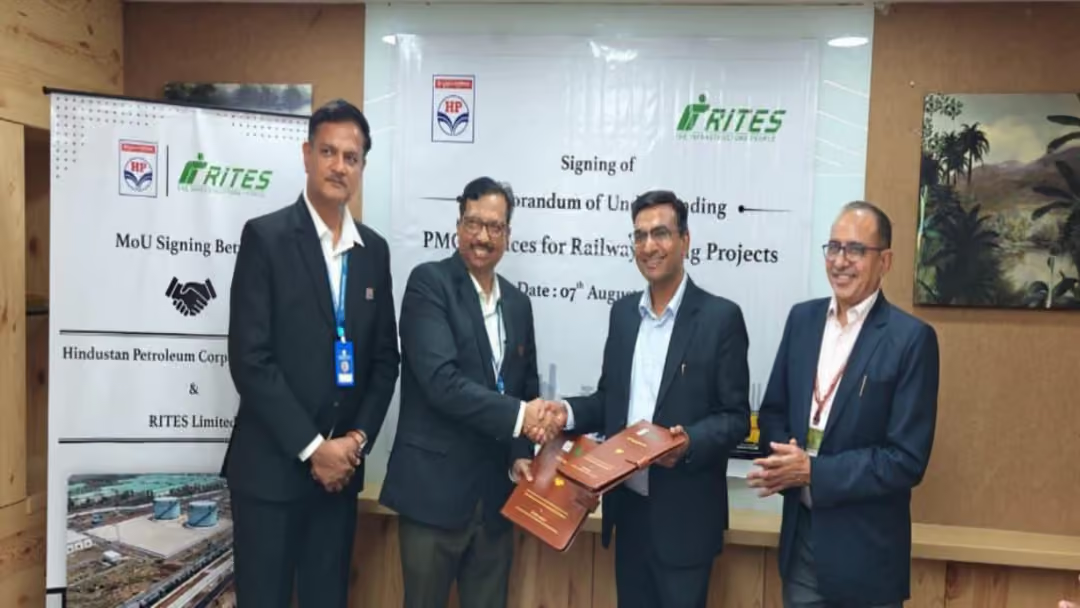
Gurugram : State-owned transport infrastructure consultancy RITES Limited has signed a Memorandum of Understanding (MoU) with Hindustan Petroleum Corporation Limited (HPCL) to provide comprehensive consultancy services for the development and expansion of railway siding infrastructure across HPCL’s facilities in India.
The strategic collaboration is aimed at strengthening rail-based transportation of petroleum products, improving connectivity at HPCL locations, and supporting the country’s broader efforts to build a more efficient and sustainable logistics network.
RITES to Provide End-to-End Railway Consultancy
Under the MoU, RITES will provide comprehensive consultancy support throughout the lifecycle of railway siding projects—from the initial concept and feasibility stage to commissioning.
The scope of services will include:
- Feasibility Studies
- Final Location Surveys (FLS)
- Detailed Project Reports (DPRs)
- Detailed Engineering
- Project Management Consultancy (PMC)
- Construction Supervision
- Coordination with Indian Railways for statutory approvals and other required clearances
The end-to-end approach is expected to help streamline project implementation, improve planning efficiency, and accelerate the development of rail infrastructure at HPCL facilities.
Boost to Rail-Based Petroleum Logistics
A key objective of the partnership is to enhance the movement of petroleum products by rail.
The development of new railway sidings, expansion of existing rail connectivity, and modernization of rail infrastructure at HPCL locations are expected to improve the company’s logistics capabilities.
By utilizing RITES’ expertise in railway engineering, project planning, and infrastructure consultancy, HPCL aims to address transportation bottlenecks and improve the efficiency of its nationwide petroleum supply chain.
Supporting Efficient and Sustainable Freight Movement
The collaboration comes at a time when India is placing increasing emphasis on rail-based freight transportation as a more efficient and sustainable alternative for moving large volumes of commodities over long distances.
Greater use of rail for petroleum logistics can help improve cargo movement efficiency, reduce dependence on road transportation for bulk movement, and strengthen the overall resilience of the country’s logistics infrastructure.
The proposed railway siding projects are therefore expected to contribute to India’s broader logistics modernization and infrastructure development objectives.
Strengthening HPCL’s Infrastructure Network
Improved railway connectivity at HPCL’s refineries, terminals, depots, and other facilities could enable smoother movement of petroleum products and enhance operational flexibility.
The partnership is expected to support:
- New railway siding development
- Expansion of existing rail infrastructure
- Improved connectivity with the Indian Railways network
- Faster movement of petroleum cargo
- Reduction of logistics bottlenecks
- Improved supply-chain efficiency
- Modernization of petroleum transportation infrastructure
Public Sector Collaboration for Infrastructure Growth
The MoU highlights the growing role of Public Sector Enterprises (PSEs) in supporting India’s infrastructure and logistics transformation.
While HPCL brings its extensive petroleum distribution and infrastructure network, RITES contributes decades of expertise in railway engineering, transportation infrastructure, project management, and consultancy.
Combining these capabilities is expected to facilitate the development of technically sound and efficiently managed railway siding projects across HPCL’s facilities.
A Step Toward Modernizing India’s Logistics Network
The RITES–HPCL partnership represents a strategic effort to integrate petroleum infrastructure with India’s expanding railway network.
As rail continues to emerge as a preferred mode for bulk freight transportation, the development of dedicated railway siding infrastructure can play an important role in improving cargo handling, reducing transportation constraints, and strengthening India’s overall supply chain.
The MoU is therefore expected to support long-term infrastructure development, efficient petroleum logistics, and the country’s broader vision of creating a modern, integrated, and sustainable transportation ecosystem.