

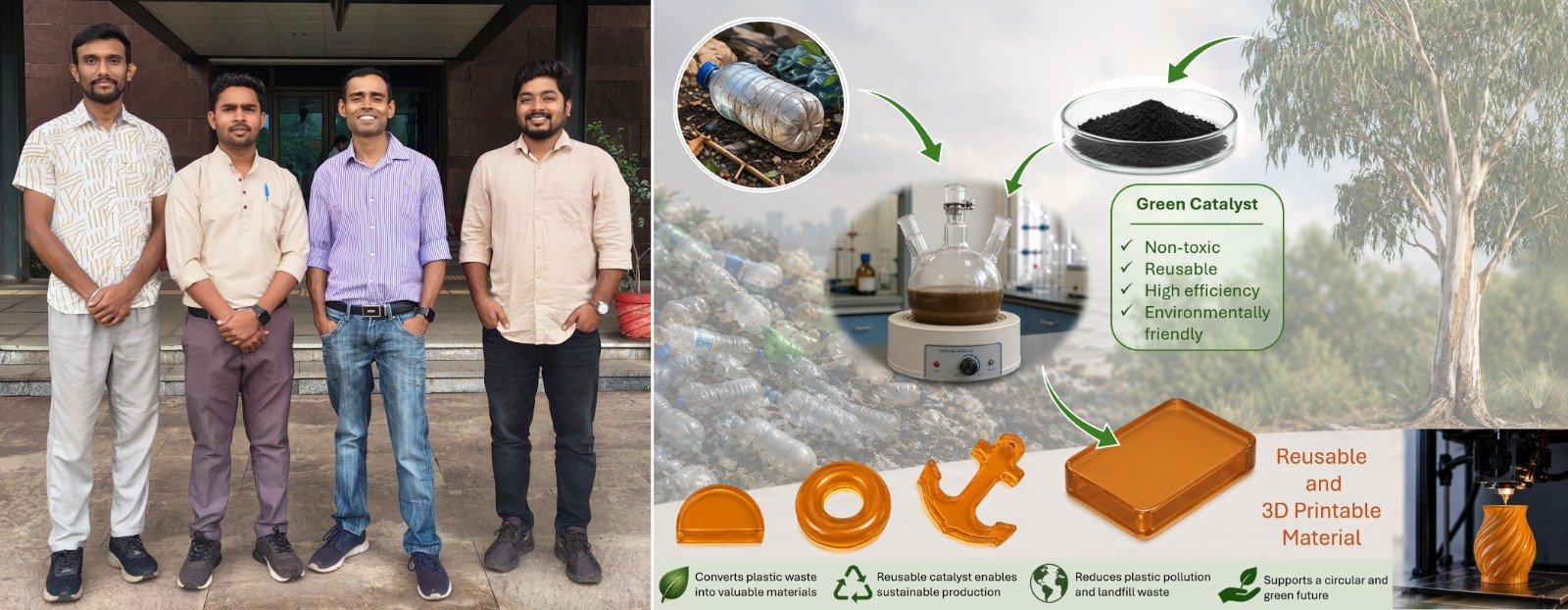

Raipur, India | August 3, 2026: In a significant breakthrough for sustainable manufacturing and plastic waste management, researchers at Indian Institute of Technology (IIT) Bhilai have developed an innovative technology that converts waste Polyethylene Terephthalate (PET) plastic bottles into high-value, reusable engineering materials. The newly developed material can be reshaped, repaired, and recycled multiple times without losing its performance, offering a promising solution for reducing plastic pollution and promoting a circular economy.
The pioneering research was led by Dr. Sanjib Banerjee from the Department of Chemistry, IIT Bhilai, along with researchers Priyank Sinha, Bharatbhushan Meshram, and Omkarnath Verma. The team’s findings have been published in the internationally recognized scientific journal Materials Today Catalysis, and an Indian patent application has also been filed for the technology.
Green Catalyst Developed from Eucalyptus Leaves
One of the most remarkable aspects of the research is the development of a green, reusable catalyst derived from eucalyptus leaves. This environmentally friendly catalyst efficiently converts discarded PET bottles into valuable chemical building blocks, which serve as the foundation for manufacturing advanced engineering materials.
Unlike conventional recycling methods that gradually degrade the quality of plastic, this catalyst enables a cleaner, more efficient, and sustainable recycling process. Furthermore, the catalyst can be easily separated using a magnet and reused several times, significantly lowering both environmental impact and processing costs.
A New Generation of Recyclable Engineering Material
Using the chemical building blocks obtained from recycled PET, the IIT Bhilai researchers created a high-performance dynamic polymer capable of being reprocessed repeatedly.
The material possesses several unique characteristics:
- Can be reshaped multiple times using heat
- Maintains its mechanical properties after repeated processing
- Can be repaired if damaged
- Can be reused without significant loss of quality
- Suitable for long-term engineering applications
When heated, the material becomes flexible and can be molded into different shapes. Once cooled, it permanently retains the desired form. Laboratory testing demonstrated that even after multiple reshaping cycles, the material exhibited no significant deterioration in its structural performance.
Potential for Future 3D Printing Applications
Researchers believe the new polymer could become a valuable material for Three-Dimensional (3D) Printing and Additive Manufacturing technologies.
Its combination of strength, reusability, and recyclability makes it suitable for manufacturing:
- Customized plastic products
- Reusable consumer goods
- Educational models
- Engineering prototypes
- Advanced 3D-printed components
The technology has the potential to reduce manufacturing waste while improving the sustainability of future industrial production.
Solving a Major Limitation of Traditional Thermoset Plastics
According to Dr. Sanjib Banerjee, most conventional thermoset plastics are known for their durability and strength but cannot be reshaped or effectively recycled once manufactured. As a result, enormous quantities of plastic waste ultimately end up in landfills, contributing to long-term environmental pollution.
The newly developed material overcomes this limitation by combining high mechanical strength with repairability and recyclability, demonstrating that discarded PET bottles can be transformed into valuable engineering materials instead of becoming waste.
Supporting India’s Sustainability Goals
The innovation aligns closely with several major initiatives of the Government of India, including:
- Swachh Bharat Mission
- Atmanirbhar Bharat
- Make in India
- National Resource Efficiency Policy
By promoting resource efficiency, waste reduction, and clean manufacturing, the technology could play a significant role in building a more sustainable industrial ecosystem.
A Major Step Toward the “Waste-to-Wealth” Vision
With billions of PET bottles discarded every year worldwide, IIT Bhilai’s breakthrough presents an effective strategy for transforming plastic waste into valuable engineering resources. The innovation not only addresses the growing challenge of plastic pollution but also supports the global transition toward a circular economy, where materials remain in use for as long as possible.
If successfully commercialized, this technology could reduce dependence on virgin plastics, create new opportunities in advanced manufacturing, and reinforce India’s commitment to developing environmentally responsible and resource-efficient technologies.