

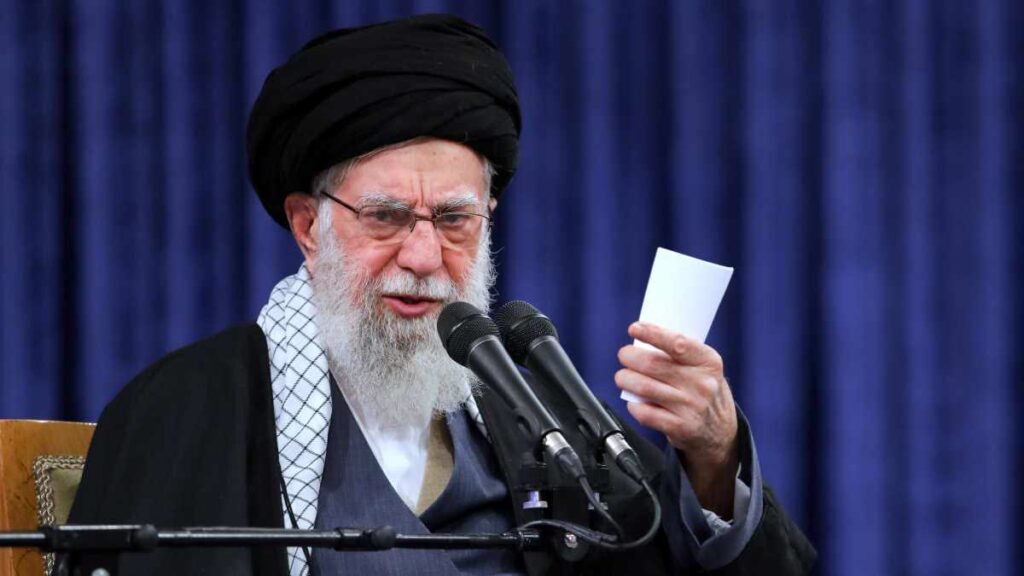
Tehran : Iranian state-aligned media outlets Tasnim News Agency and Fars News Agency have reported that Iran’s Supreme Leader, Ayatollah Ali Khamenei, has been killed in what they described as a joint U.S.–Israeli attack on Tehran.
According to the reports, Khamenei died following aerial bombardment carried out on Saturday. Iranian media said a 40-day period of public mourning has been declared in his honor, a traditional practice following the death of a senior religious figure.
There has been no independent confirmation from Iranian state authorities or international organizations at the time of reporting.
Conflicting Statements and Earlier Denials
Earlier, U.S. President Donald Trump and Israeli officials had claimed that strikes carried out in Tehran had eliminated Iran’s top leadership. Iranian officials initially dismissed those claims as “psychological warfare,” denying that Khamenei had been harmed.
Fars News Agency, which is affiliated with the Islamic Revolutionary Guard Corps (IRGC), also reported that Khamenei’s daughter, son-in-law, and grandchild were killed in one of the attacks.
Who Was Ayatollah Ali Khamenei
Born on April 19, 1939, in Mashhad, Khamenei emerged as a key figure in Iran’s revolutionary movement against the monarchy. He received religious education in Mashhad and later pursued advanced studies in Qom and Najaf, where he came under the influence of revolutionary cleric Ruhollah Khomeini.
During the rule of Shah Mohammad Reza Pahlavi, Khamenei was repeatedly arrested by the secret police SAVAK for political activism. He later played an active role in the 1979 Islamic Revolution.
Khamenei served as Iran’s president from 1981 to 1989, during the Iran–Iraq War, when Iran was led militarily by Iraq’s Saddam Hussein. He survived an assassination attempt in 1981 that left his right arm partially paralyzed.
Following Khomeini’s death in 1989, Khamenei was elevated to the post of Supreme Leader, becoming the most powerful authority in the Islamic Republic of Iran under the doctrine of Velayat-e-Faqih (Guardianship of the Islamic Jurist).
Regional and Global Impact
If confirmed, Khamenei’s death would mark a historic turning point for Iran and the Middle East, potentially triggering major political uncertainty, internal power struggles, and regional escalation amid already heightened tensions involving Iran, the United States, and Israel.
International reactions are still emerging, and global observers are closely monitoring developments for official confirmation and further clarification.