

Raipur: The Chhattisgarh Budget 2026–27, presented by Finance Minister O. P. Chaudhary, has placed agriculture at the center of the state’s development agenda, promising strong income support for farmers. While the government has projected the budget as farmer-friendly, agricultural economists caution that its long-term impact on sustainability and structural reform remains limited.
As an agriculture-dependent state where nearly two-thirds of the population relies directly or indirectly on farming, Chhattisgarh’s budget decisions carry significant implications for rural livelihoods and economic stability. The latest budget introduces major allocations for crop procurement, subsidies, and credit support—measures that offer immediate relief but raise questions about long-term agricultural resilience.
Paddy-Centric Support: Income Security with Structural Risks
The most prominent announcement is under the Krishak Unnati Yojana, which guarantees paddy procurement at ₹3,100 per quintal. In the short run, this policy ensures income security, improves rural purchasing power, and provides much-needed liquidity to small and marginal farmers.
However, economists argue that continued emphasis on paddy reinforces Chhattisgarh’s mono-cropping pattern. High price support discourages crop diversification, increases pressure on groundwater resources, and contributes to declining soil health. While the policy protects farmer incomes today, it may lock the state into an environmentally and economically rigid agricultural structure.
Subsidy-Led Strategy: Lower Costs, Limited Efficiency
The budget proposes substantial spending on irrigation pumps, electricity subsidies, and interest-free agricultural loans. These measures help reduce production costs but rely heavily on input-based subsidies. Experts warn that such an approach often delivers short-term gains at the expense of long-term efficiency and resource conservation.
Without strong linkages to water-saving technologies, micro-irrigation, and crop–water suitability, increased investment in irrigation infrastructure could intensify future water stress.
Natural Farming: Acknowledged, but Not Prioritized
The inclusion of natural farming in the budget signals policy awareness of climate change and rising input costs. Natural farming has the potential to reduce expenses, enhance soil health, and improve risk management for farmers.
Yet, limited financial allocation suggests that sustainable agriculture remains a secondary priority. Analysts note that without adequate training, transition support, and market incentives, natural farming will struggle to move beyond pilot initiatives.
Livestock and Allied Sectors: Untapped Income Potential
The budget recognizes livestock and allied activities as supplementary income sources. While allocations have been made, experts point out that real income diversification requires stronger investment in processing units, cold storage, value addition, and market connectivity—areas that remain underfunded.
Key Agricultural Allocations (2026–27)
- Krishak Unnati Yojana: ₹10,000 crore
- Irrigation Pumps and Support: ₹5,500 crore
- Other Agriculture Schemes: ₹6,000 crore
- Landless Farm Household Assistance: ₹600 crore
- Interest-Free Agricultural Loans: ₹300 crore
- Total Agriculture and Allied Sectors: approximately ₹23,357 crore
A significant share of this spending is directed toward income support and subsidies, while structural investments in marketing infrastructure, storage, processing, and diversification receive comparatively less emphasis.
Marketing and Risk Management: The Missing Link
Agricultural economists underline that farmer income is ultimately determined by market access rather than production alone. The budget, however, offers limited focus on marketing reforms, cold storage expansion, rural warehouses, and agri-processing units. Similarly, strategies for climate risk management, weather-based advisories, and digital agriculture tools remain underdeveloped.
Expert View
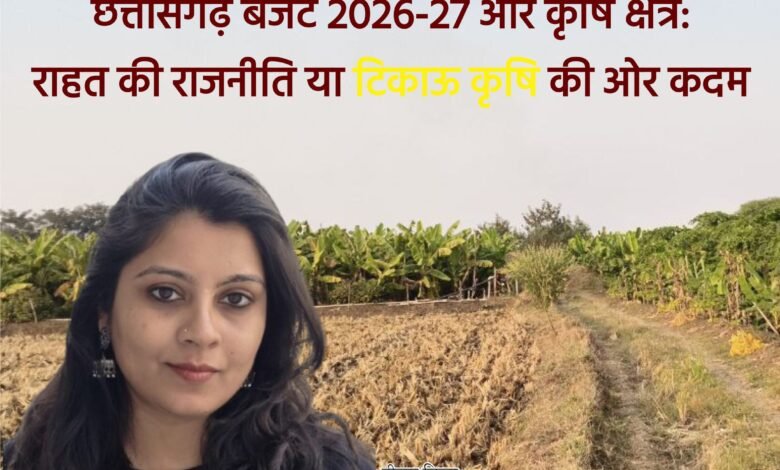
According to Neelam Sinha, agricultural economist and research scholar at Indira Gandhi Agricultural University, the Chhattisgarh Budget 2026–27 succeeds in providing immediate economic relief but falls short of driving long-term agricultural transformation.
“Income support and subsidies are helpful in the short term, but sustainable agricultural growth depends on crop diversification, expansion of allied sectors, strong market reforms, and investments in climate-resilient farming,” she said.
If future policies prioritize these structural reforms, the current budget could serve as a foundation for a more resilient and forward-looking agricultural economy in Chhattisgarh.