


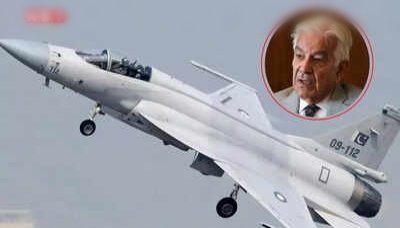

Islamabad: Pakistan has claimed that last year’s brief military confrontation with India has unexpectedly benefited its defence industry. Pakistani Defence Minister Khawaja Asif has said that following the four-day conflict, Pakistan has seen a rise in orders for its fighter aircraft, particularly the JF-17 Thunder, and asserted that successful execution of these deals could reduce the country’s dependence on loans from the International Monetary Fund (IMF).
Speaking to Pakistani broadcaster Geo News, Asif said the conflict served as a “test” for Pakistan’s military aircraft. “The orders we are receiving are very important because our aircraft have now been tested,” he said, adding that if these deals materialise within the next six months, Pakistan may no longer need IMF assistance.
Push to Export JF-17 Fighter Jets
Asif’s remarks came as a high-level Bangladeshi defence delegation met Pakistan Air Chief Marshal Zaheer Ahmed Baber Sidhu in Islamabad. According to reports, discussions focused on the possible sale of the JF-17 Thunder, a multi-role fighter aircraft jointly developed by China and Pakistan and operational with the Pakistan Air Force for over a decade.
The JF-17 gained international attention during the India–Pakistan military standoff in May last year. Pakistan launched an aggressive publicity campaign, claiming it had shot down multiple Indian aircraft, including French-made Rafale jets—claims India strongly rejected. Islamabad has since used these assertions to promote the JF-17 in international defence markets.
Propaganda vs Ground Reality
Pakistani military leadership and diplomatic teams have reportedly reached out to several countries to pitch the JF-17 as a cost-effective alternative to Western fighter jets, highlighting Chinese military technology as competitive and reliable. Pakistan projects itself as a supplier capable of offering aircraft, training and maintenance outside Western supply chains.
However, Indian officials and defence analysts argue that Pakistan’s claims do not reflect the actual outcome of the conflict. During Operation Sindoor, the Indian Air Force conducted precision strikes deep inside Pakistan, targeting 11 airbases, including strategically important locations such as Chaklala, Murid and Rafiqui, where damage was officially confirmed.
IMF Dependence Claim Draws Skepticism
While Asif claimed that increased aircraft exports could ease Pakistan’s financial crisis, experts remain sceptical. Pakistan is currently facing severe economic challenges, with high inflation, foreign exchange shortages and heavy reliance on IMF bailout programmes. Defence analysts note that even if a few fighter jet contracts are signed, revenues are unlikely to be sufficient in the short term to offset Pakistan’s broader economic vulnerabilities.
The statement nevertheless underscores Islamabad’s effort to portray military confrontation with India as a strategic and economic opportunity, even as questions remain over the performance of Chinese-origin weapons and the sustainability of Pakistan’s defence export ambitions.