

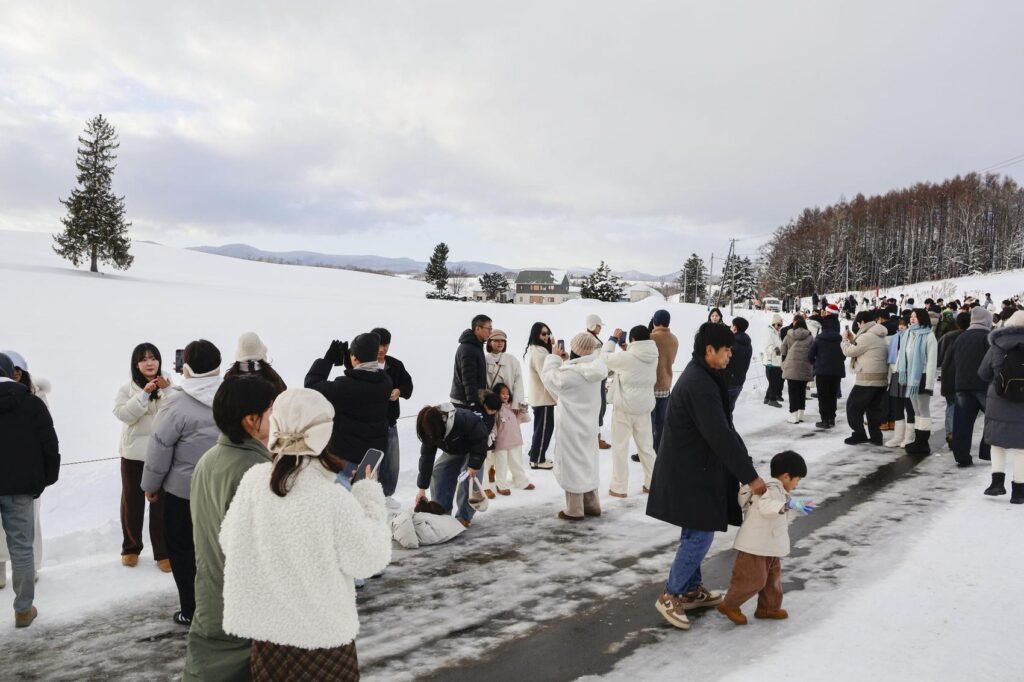
Asahikawa, Japan: Overtourism continues to challenge the small town of Biei in Hokkaido, even after local authorities cut down a row of photogenic white birch trees last year in an effort to curb the influx of visitors.
Biei, a town of around 9,000 residents known for its patchwork hills and scenic farmland, had become a hotspot for tourists seeking Instagram-worthy photos. The popularity of the birch trees led to frequent trespassing on farm fields, traffic congestion, and the arrival of numerous tour buses daily. In January last year, the town approved the felling of the trees to ease the pressure.
While officials noted a temporary decline in visitor numbers, the effect has been short-lived. Tourists have simply shifted their focus to other nearby attractions such as the “Seven Stars Tree,” famously featured on cigarette packaging, and the so-called “Christmas Tree.” These sites continue to draw large crowds, often overwhelming local infrastructure.
On December 6, tour buses were seen unloading visitors who largely ignored the snow-covered stumps of the felled birches and instead hurried to other famous trees, spending only a few minutes before leaving. In other parts of town, security guards struggled to manage traffic as crowds surged, whistles echoing through the area.
According to the Biei Tourism Association, tourists frequently walk from nearby stations to popular spots, trampling farmland and causing damage. In response, the association has introduced pilot shuttle bus services between key attractions and JR Biei Station and increased the number of security personnel during the winter season.
However, officials admit these measures may not be enough. “It will be difficult to fundamentally resolve the issue without restricting the number of buses and private cars,” said Takeo Izumi, deputy secretary general of the association.
Tourism in Biei remains strong, with approximately 2.68 million visitors recorded in fiscal 2024. The rise in foreign tourists, particularly in recent years, has been notable and has sparked debate among residents. At a recent community meeting, some locals expressed frustration, especially toward overseas visitors.
Others, however, see opportunities alongside the challenges. Cafe owner Shigekazu Ishimura said the increase in visitors from China has benefited his business. “This landscape was created by farmers. We should explore ways for them to profit from it as well,” he said.
Photographer Takahiro Saito, who helps organize local discussions on overtourism, emphasized that the issue goes beyond foreign visitors. “This is not only about foreigners,” he said, calling for broader community involvement to find sustainable solutions.
As Biei grapples with balancing tourism and local livelihoods, the town’s experience highlights the growing challenge of overtourism in scenic rural destinations across Japan.