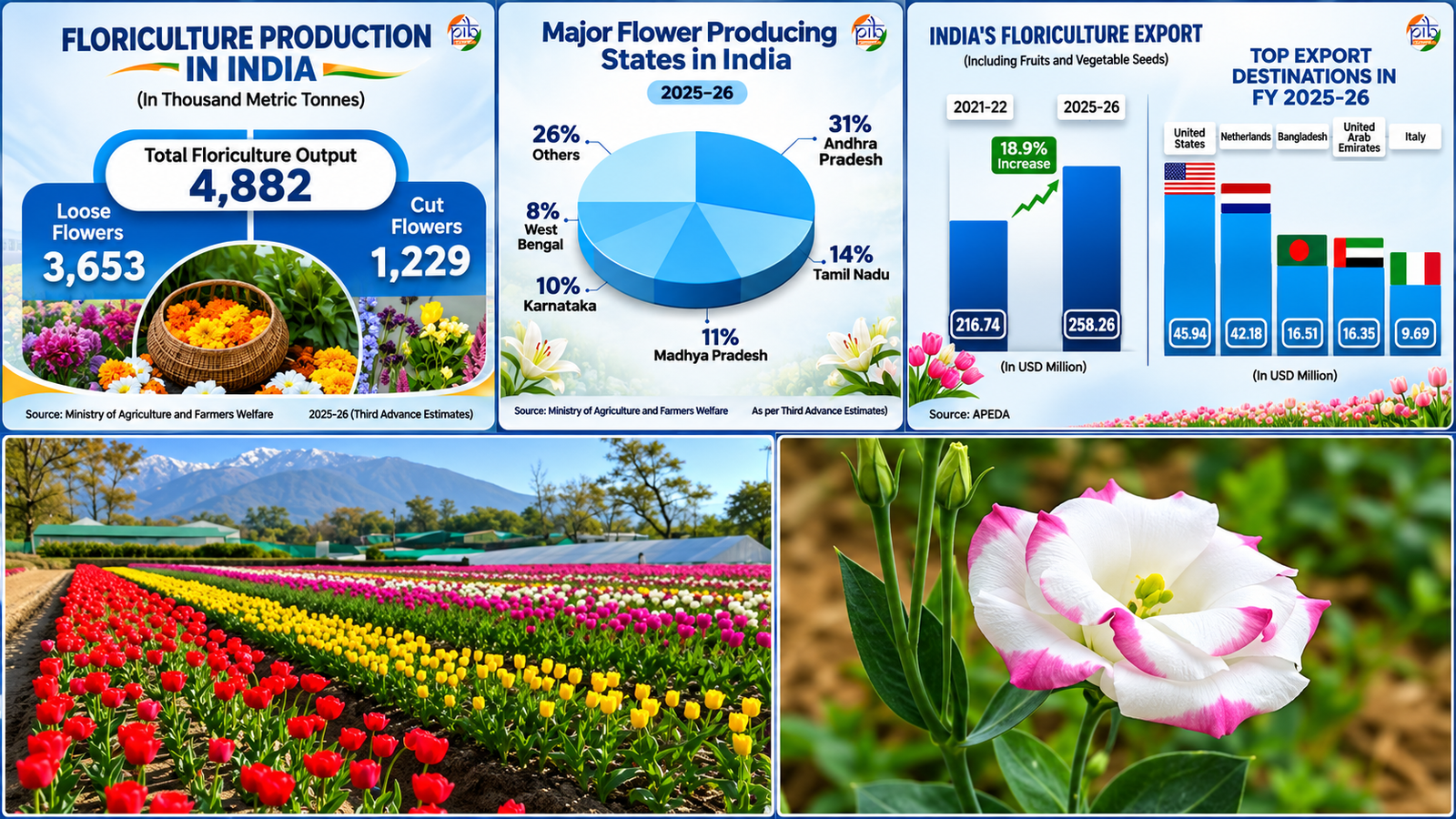

New Delhi: Floriculture has emerged as a dynamic segment of India’s horticulture sector, driven by favourable agro-climatic conditions, strong cultural demand and expanding commercial applications. According to the Third Advance Estimates for 2025-26, the area under flower cultivation stood at 4.1 lakh hectares, with total production reaching 48.82 lakh tonnes. Andhra Pradesh led the country in production. Exports have also grown steadily, rising from USD 216.74 million in FY 2021-22 to USD 258.26 million in FY 2025-26, reflecting rising international demand.
The sector meets the needs of religious, ornamental, industrial and medicinal markets while creating new opportunities for farmers through value-added production and export diversification. Government support through horticulture missions, research institutions, financial assistance and export facilitation has strengthened production systems. Science-led initiatives, including those under the Council of Scientific and Industrial Research (CSIR), are promoting crop diversification, regional specialisation and wider market access.
Roots of a Flourishing Industry
India’s extraordinary natural diversity — from snow-covered mountains and fertile plains to arid deserts and long coastlines — provides ideal conditions for growing a wide variety of flowers across regions and seasons. Combined with the deep cultural, spiritual and emotional significance of flowers in Indian society, these agro-climatic advantages have fuelled the growth of floriculture.
Recognising its economic and aesthetic potential, the government has identified floriculture as an “emerging industry.” Once a relatively limited activity within Indian agriculture, the sector has evolved into a vibrant component of horticulture. It now contributes to farmers’ incomes, agricultural exports and rural enterprise development, while increasingly adopting modern cultivation practices and technologies.
Understanding India’s Floriculture Economy
Floriculture is the art and science of growing flowers to achieve high quality and aesthetic appeal. As an integral branch of horticulture, it covers the cultivation of flowers and ornamental crops from planting to harvesting, production of planting material through seeds, cuttings, budding and grafting, and the marketing of flowers and flower-based products.
Major product categories include:
- Loose flowers – Harvested without long stems and sold by weight, primarily used for making garlands and gajras. Key examples: marigold and jasmine.
- Cut flowers – Harvested and sold with stems for bouquets and vase arrangements. Major examples: rose, gerbera, carnation, orchid and lily.
- Other products – Cut foliage, potted plants, bedding plants and ornamental planting material, including seeds for landscaping and beautification.
Flowers Shaping the Market
India grows a diverse range of flowers to meet domestic and international demand. Key varieties include:
- Rose – Extensively cultivated in Karnataka and Maharashtra; high export value.
- Marigold – Widely used in religious rituals; major production in Tamil Nadu and Madhya Pradesh.
- Carnation, chrysanthemum and gerbera – Grown under controlled conditions for export.
- Lily and orchid – High-value flowers cultivated in selected regions such as Sikkim and Mizoram.
Demand for exotic flowers is rising. In the Northeast, orchids and anthurium have emerged as commercially viable crops. These flowers are also gaining popularity in urban landscaping, event decoration and the wellness industry.
From Open Fields to Protected Cultivation
Floriculture in India is practised both in open fields and under protected systems such as greenhouses, depending on crop requirements. Open-field cultivation is common for chrysanthemum, rose, gaillardia, lily, marigold, aster and tuberose.
Growing demand for quality flowers and year-round availability has accelerated the adoption of protected cultivation. Greenhouses are particularly important for export-oriented crops such as gerbera and carnation. They enable better control of temperature, humidity and other growing conditions, ensuring uniform quality, higher productivity and compliance with international market standards.
Beyond Bouquets: Diverse Uses of Flowers
Flowers hold an important place in daily life in India and are deeply linked to cultural, social and religious traditions. Beyond traditional uses, floriculture has evolved into a diversified sector with growing applications in the perfume, cosmetics and pharmaceutical industries.
Key domestic uses include:
- Religious and social traditions – Jasmine, marigold and crossandra are widely used in worship, social ceremonies and personal adornment.
- Lifestyle and decorative uses – Rising urbanisation and disposable incomes have increased demand for bouquets, event decoration, and beautification of residential and commercial spaces.
- Perfume and cosmetics – Flowers such as jasmine, lavender and rose petals serve as raw material for fragrance and beauty products.
- Medicinal uses – Calendula, hibiscus and chamomile are used in medicinal products.
- Natural dyes – Marigold and hibiscus are used for extracting natural colours and dyes.
Mapping India’s Flower-Producing Regions
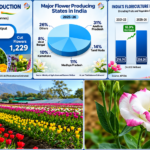
Favourable climate and rising market demand have expanded floriculture across several regions. In 2025-26, the total area under flower cultivation was 4.1 lakh hectares. Production comprised 36.53 lakh tonnes of loose flowers and 12.29 lakh tonnes of cut flowers, totalling 48.82 lakh tonnes.
Leading producing states (2025-26 Third Advance Estimates):
- Andhra Pradesh – approximately 31% of total production
- Tamil Nadu – 14%
- Madhya Pradesh – 11%
- Karnataka – 10%
- West Bengal – 8%
Other significant producers include Chhattisgarh, Gujarat, Uttar Pradesh, Odisha, Maharashtra and Telangana. The Northeastern states together contributed about 4% of India’s total flower production, with Assam playing a major role in both loose and cut flowers, followed by Nagaland in cut flower production.
India’s Growing Presence in Global Flower Markets
Floriculture is an important component of value-added agricultural exports and provides additional income opportunities beyond traditional crops. India’s floriculture exports rose from USD 216.74 million in FY 2021-22 to USD 258.26 million in FY 2025-26.
Top export destinations in FY 2025-26:
- United States – USD 45.94 million
- Netherlands – USD 42.18 million
- Bangladesh – USD 16.51 million
- United Arab Emirates – USD 16.35 million
- Italy – USD 9.69 million
Major export crops include rose, carnation, chrysanthemum, gerbera, gladiolus, gypsophila, liatris, nerine, orchid, achillea, anthurium, tulip and lily.
Export categories:
- Fresh cut flowers – primarily to Europe, Japan, Australia, West Asia and the USA
- Loose flowers – mainly to Gulf markets serving the Indian diaspora
- Cut foliage – largely to European countries
- Dried flowers – exported to the USA, Europe, Japan, Australia, the Far East and Russia (these form a major share of total floriculture exports due to longer shelf life)
- Potted plants – limited destinations
Landmark Achievement from the Northeast
In February 2025, the first consignment of anthurium flowers was exported from Mizoram to Singapore. The shipment comprised 1,024 cut anthurium flowers (70 kg) packed in 50 cartons. The initiative was led by the Agricultural and Processed Food Products Export Development Authority (APEDA) in collaboration with the Horticulture Department of the Government of Mizoram, opening new international market linkages for Northeast flower growers.
Policy Support Driving Growth
The government has launched several programmes focused on production, infrastructure, research, capacity building and export facilitation. Key areas of support include:
- Policy and institutional support through the Mission for Integrated Development of Horticulture (MIDH), including the National Horticulture Mission (NHM), the Horticulture Mission for Northeast and Himalayan States, and the National Horticulture Board.
- Financial assistance and credit support from NABARD for protected and precision farming.
- Quality planting material production by seed companies in major flower-growing states.
- Incentives and concessions on seeds, planting material, equipment and air freight to boost exports.
- Export promotion through the Ministry of Commerce, primarily via APEDA.
- Training and capacity-building programmes for farmers and entrepreneurs.
- Research and development by ICAR, CSIR, state agricultural universities and the All India Coordinated Research Project on Floriculture.
CSIR Floriculture and Aroma Missions
CSIR has developed two major science-based programmes to strengthen India’s floriculture and aroma sectors.
The CSIR Floriculture Mission, launched in 2021, aims to increase farmers’ incomes, promote entrepreneurship and encourage technology-driven growth. By December 2025, the Mission had brought more than 2,208 hectares under flower cultivation, benefiting 16,220 individuals across 399 clusters in 26 states and Union Territories. Several technologies have been developed and transferred to entrepreneurs, accompanied by training and capacity-building initiatives.
The CSIR Aroma Mission, started in 2017, focuses on improving rural livelihoods through the cultivation and processing of aromatic crops that supply quality raw material to the fragrance and essential oil industries. By December 2025, aromatic crop cultivation had expanded to over 51,000 hectares. More than 4,500 aroma clusters were established across 28 states, including 20 clusters in tribal areas. The Mission trained 1.22 lakh people through 2,096 training and awareness programmes (including 10,000 women) and supported over 110 entrepreneurs in developing value-added products. These efforts generated approximately one crore rural employment opportunities and enabled production of more than 6,000 tonnes of essential oils valued at around ₹600 crore.
A Sector Moving Towards Sustained Growth
India’s floriculture sector has evolved from a limited horticultural activity into a diversified and commercially significant agricultural enterprise. Its growth rests on the country’s rich agro-climatic diversity, rising domestic demand, strengthening market linkages and expanding export opportunities.
The future of the sector lies in moving beyond cultivation to value addition. Wider adoption of protected cultivation, precision agriculture technologies, improved planting material, post-harvest management and quality standards can further strengthen productivity and competitiveness. With continued policy support, robust institutional frameworks and better market linkages, floriculture can significantly boost farmers’ incomes, rural enterprises and agricultural exports.
From traditional flowers to exotic varieties and value-added applications, the expanding scope of the sector continues to open doors for regional specialisation and new entrepreneurial opportunities — one flower at a time.