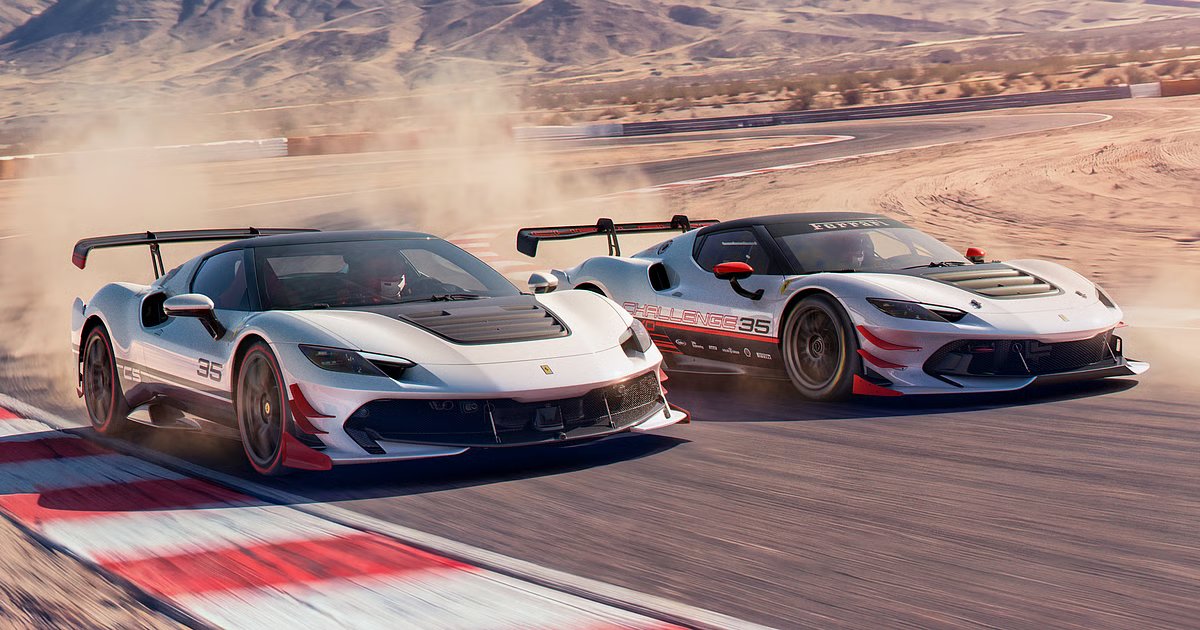

Italian luxury sports carmaker Ferrari has unveiled the 296 Challenge Stradale, a road-legal, track-focused supercar powered by a 670hp twin-turbocharged V6 engine, alongside the new 296 Challenge Evo race car at the 2026 Ferrari Finali Mondiali in Barcelona, Spain.
The new 296 Challenge Stradale draws heavily from Ferrari’s motorsport engineering and revives the Challenge Stradale nameplate, last used on the 360 Challenge Stradale in 2003.
Based on the 296 GTB, the new model eliminates the hybrid powertrain in favour of a lighter, combustion-only configuration, with extensive aerodynamic and chassis modifications aimed at improving performance on racing circuits.
𝐏𝐨𝐰𝐞𝐫𝐟𝐮𝐥 𝐕𝟔 𝐞𝐧𝐠𝐢𝐧𝐞
The Ferrari 296 Challenge Stradale is powered by a 3.0-litre, 120-degree twin-turbocharged V6 engine producing 670hp at 8,000rpm and 740Nm of peak torque at 6,250rpm.
Unlike the standard 296 GTB, which uses an electrified powertrain, the Challenge Stradale relies entirely on its internal combustion engine. Power is transmitted through an eight-speed dual-clutch automatic gearbox.
Removing the hybrid system and introducing lightweight components have reduced the car’s claimed dry weight to 1,330kg, making it 140kg lighter than the 296 GTB.
Ferrari claims the supercar can accelerate from 0 to 100kph in 2.8 seconds and reach 200kph in 7.9 seconds. Its maximum speed exceeds 300kph.
The company has also recorded a claimed lap time of one minute and 18.5 seconds at its Fiorano test circuit in Italy.
𝐑𝐚𝐜𝐞-𝐢𝐧𝐬𝐩𝐢𝐫𝐞𝐝 𝐚𝐞𝐫𝐨𝐝𝐲𝐧𝐚𝐦𝐢𝐜 𝐝𝐞𝐬𝐢𝐠𝐧
The 296 Challenge Stradale features significant aerodynamic modifications, including a fixed rear wing, redesigned front splitter, additional airflow-management elements and a fully enclosed underbody.
According to Ferrari, these changes enable the car to generate 617kg of downforce at 250kph, representing a 72 per cent increase over the standard 296 GTB.
The supercar also features a redesigned twin-exit exhaust system with larger tailpipes to reduce back pressure and produce a more pronounced V6 exhaust note.
An optional track-only exhaust system is available, although Ferrari specifies that it can only be installed or removed at an authorised dealership.
𝐔𝐩𝐠𝐫𝐚𝐝𝐞𝐝 𝐜𝐡𝐚𝐬𝐬𝐢𝐬 𝐚𝐧𝐝 𝐛𝐫𝐚𝐤𝐞𝐬
Ferrari has revised the suspension setup, including spring rates and semi-active damper calibration, to improve handling and stability during high-speed driving.
The manufacturer claims the modifications deliver a 7 per cent improvement in lateral performance, 34 per cent greater stability and a 68 per cent reduction in roll gradient compared with the 296 GTB.
Braking duties are handled by carbon-ceramic discs, while specially developed Pirelli P Zero R and P Zero Trofeo RS tyres provide additional grip.
Inside, the Challenge Stradale retains the basic dashboard layout of the 296 GTB but adopts a more minimalist, motorsport-inspired design.
Its door panels are constructed from single pieces of carbon fibre, eliminating conventional armrests and storage compartments.
Buyers can also opt to remove additional interior trim beneath the seats, carpets and centre console, exposing sections of the chassis to further reduce weight.
𝐂𝐡𝐚𝐥𝐥𝐞𝐧𝐠𝐞 𝐄𝐯𝐨 𝐚𝐥𝐬𝐨 𝐮𝐧𝐯𝐞𝐢𝐥𝐞𝐝
Alongside the road-going model, Ferrari introduced the 296 Challenge Evo, an upgraded version of the 296 Challenge race car developed for the Ferrari Challenge one-make racing championship.
The Evo uses a non-hybrid 3.0-litre twin-turbocharged V6 engine producing 700hp at 7,500rpm and 740Nm of torque at 6,000rpm, paired with a seven-speed dual-clutch gearbox.
Its revised aerodynamic package offers two configurations, High Downforce and Low Drag, designed to optimise performance across different racing circuits.
Ferrari claims maximum downforce has increased by 12 per cent compared with the outgoing 296 Challenge, adding approximately 100kg at 250kph.
The Low Drag configuration, meanwhile, reduces aerodynamic drag by 4 per cent.
Other modifications include a redesigned front splitter, rear diffuser, rear wing and exterior mirrors, alongside updated traction control and electronic differential systems.
During testing at the Mugello circuit, the Challenge Evo recorded a lap time 0.8 seconds quicker than the standard 296 Challenge in its High Downforce configuration.
The Ferrari 296 Challenge Evo is scheduled to make its racing debut during the 2027 season, initially competing in the European and North American Ferrari Challenge championships.