


Three years after its launch, the scheme has achieved its 30 lakh registration target, offering artisans training, modern toolkits, credit support, digital incentives and wider market opportunities
New Delhi: The PM Vishwakarma Scheme, launched to strengthen India’s traditional artisans and craftspeople and support their livelihoods, is set to complete three years on September 17, 2026. The scheme has already achieved its target of registering 30 lakh beneficiaries ahead of its third anniversary.
Launched on September 17, 2023, the Central Sector Scheme provides traditional artisans and craftspeople with a range of support, including formal recognition, skill training, modern toolkits, concessional credit, incentives for digital transactions and assistance in accessing wider markets.
The scheme seeks to preserve traditional skills while connecting artisans with modern markets, formal financial systems and broader domestic and global supply chains.
Built Around the Three Pillars of Samman, Samarthya and Samriddhi
PM Vishwakarma is based on three key pillars—Samman (dignity), Samarthya (capability) and Samriddhi (prosperity). The scheme aims to give traditional artisans recognition for their skills, enhance their capabilities and create new economic opportunities.
It also seeks to preserve and strengthen the guru-shishya tradition and family-based transfer of traditional skills from one generation to another.
With a total outlay of ₹13,000 crore for the period from FY 2023-24 to FY 2027-28, the scheme covers 18 traditional trades.
A key objective is to improve the quality of products and services offered by artisans, expand their market reach and integrate them into domestic and global supply chains.
Support from Recognition to Business Development
PM Vishwakarma provides an integrated package of support covering multiple stages of an artisan’s journey. Its key components include formal recognition, skill upgradation, toolkit assistance, credit support, digital transaction incentives and marketing assistance.
Formal Recognition Through Certificate and ID Card
After completing the registration and verification process, eligible beneficiaries receive a PM Vishwakarma Certificate and Identity Card. This provides formal recognition and facilitates access to other benefits under the scheme.
Skill Development and Training
The scheme introduces artisans to modern tools, improved working practices and contemporary designs. Training also covers digital transactions, marketing and entrepreneurship.
Basic training generally lasts five to seven days, while advanced training is conducted for 15 days or more. Trainees receive a stipend of ₹500 per day during the training period.
Modern Toolkits Worth Up to ₹15,000
Eligible beneficiaries are provided modern toolkits worth up to ₹15,000 to help them perform their traditional occupations more efficiently.
Access to improved tools is intended to enhance productivity, improve the quality of work and help artisans respond to changing market requirements.
Collateral-Free Loans of Up to ₹3 Lakh
Credit support is a major component of PM Vishwakarma. Artisans can access collateral-free enterprise development loans of up to ₹3 lakh, provided in two tranches.
The first tranche offers up to ₹1 lakh for a period of 18 months. Completion of basic training is required for availing the first tranche.
The second tranche provides up to ₹2 lakh for a period of 30 months. Eligibility for the second tranche is linked to successful repayment of the first tranche along with adoption of digital transactions or completion of advanced training.
The concessional interest rate on the loan is 5 per cent, while the government provides interest subvention of up to 8 per cent.
The credit support is intended to help artisans purchase raw materials, upgrade equipment, increase production and expand their small enterprises.
Digital Incentives and Market Support
The scheme also seeks to bring traditional artisans into the digital economy. Beneficiaries receive an incentive of ₹1 per digital transaction, up to a maximum of 100 transactions per month.
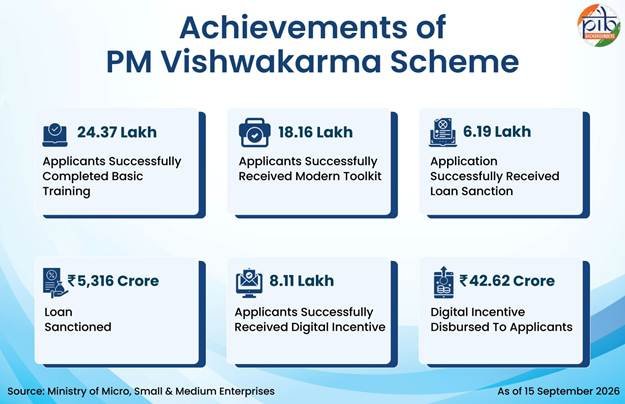
As of September 15, 2026, more than 8.11 lakh beneficiaries had received digital incentives, with over ₹42 crore distributed under this component.
Marketing assistance includes opportunities to participate in trade fairs and exhibitions, along with support for branding, advertising and promotion. Artisans are also being connected with e-commerce platforms such as the Government e-Marketplace (GeM).
Eligibility, Registration and Formalisation
Who Can Apply?
PM Vishwakarma is intended for artisans and craftspeople aged 18 years or above who work with their hands and tools in one of the 18 notified traditional trades.
Eligible beneficiaries must be self-employed and working in the unorganised sector.
Applicants should also not have availed themselves of loans under similar government credit-based schemes for self-employment or business development during the preceding five years.
Registration and benefits are restricted to one member per family, including the husband, wife and unmarried children. Government employees and their family members are not eligible.
Beneficiaries of MUDRA and PM SVANidhi who have fully repaid their loans are also eligible to apply under PM Vishwakarma.
Self-Employed Workers and the Unorganised Sector
A self-employed person is someone who operates their own occupation or business rather than working under an employer.
The unorganised sector broadly comprises small and informal businesses and workers operating outside the formal organised sector.
Registration Through Common Service Centres
Applications under the scheme can be submitted through Common Service Centres (CSCs).
Three-Level Verification and Approval
The scheme follows a three-level verification and approval process:
- Verification: At the Gram Panchayat or Urban Local Body level.
- Review and recommendation: By the District Implementation Committee.
- Approval: By the Screening Committee.
PM Vishwakarma beneficiaries are also being brought into the formal MSME ecosystem through the Udyam Assist Platform, enabling them to access applicable government benefits and formalisation opportunities.
Udyam Assist Platform
The Udyam Assist Platform is an online system designed to register informal micro enterprises and provide them with an Udyam Registration Number and Certificate.
The platform is also being used to help PM Vishwakarma beneficiaries become part of the formal MSME ecosystem.
Progress Under PM Vishwakarma
Skill Training and Toolkit Support
As of September 15, 2026, more than 24.37 lakh artisans had completed basic skill training, while more than 18.16 lakh beneficiaries had received toolkits.
Strengthening Access to Institutional Credit
More than 6.19 lakh loans, amounting to approximately ₹5,316 crore, have been sanctioned under the scheme.
The credit support is aimed at helping artisans purchase raw materials, modernise equipment, expand their businesses and strengthen their enterprises.
Digital Empowerment
More than 8.11 lakh beneficiaries have received digital incentives, with over ₹42 crore distributed.
In addition, more than 12,000 artisans have been trained in the use of AI tools for branding, product design, packaging and marketing. The initiative is intended to help artisans present their products more effectively in line with the requirements of modern markets.
Expanding Market Access and Outreach
The scheme has undertaken a range of initiatives to connect artisans with consumers and new markets.
Across the country, more than 1,500 awareness programmes and camps, over 50 workshops, 82 trade fairs, 37 state-level exhibitions and more than 50 flash mobs have been organised.
National Exhibition-Cum-Trade Fair at Delhi Haat
The first PM Vishwakarma National Exhibition-cum-Trade Fair was organised at Delhi Haat from January 17 to January 31, 2026.
More than 117 artisans from across the country participated in the event, generating sales of over ₹2 crore. More than 60,000 visitors attended the fair.
Connecting Artisans with E-Commerce Platforms
More than 30,000 PM Vishwakarma beneficiaries have been connected with e-commerce and digital commerce platforms including GeM, ONDC, Meesho, Amazon, FabIndia and Sulekha.
The Ministry of MSME has also signed a Memorandum of Understanding with Amazon to strengthen market linkages for artisans.
The scheme is also using the Udyam Assist Platform to facilitate the formal integration of PM Vishwakarma beneficiaries into the MSME ecosystem.
New Market Opportunities Through Railway Stations and Airports
The One Station One Product (OSOP) initiative is being used to create market opportunities for Divyang Vishwakarma artisans.
More than 42 Divyang beneficiaries across 14 States and Union Territories have been provided stalls at railway stations to operate businesses related to their respective trades.
PM Vishwakarma stalls have also been established at airports, including those in Bhopal and Chandigarh, providing artisans with access to new customer segments.
Focus on Packaging and Branding
Workshops have been organised in six cities in collaboration with the Indian Institute of Packaging to improve the packaging and branding of artisan products.
A total of 1,500 artisans, or around 250 artisans per city, received training through these workshops.
The initiative is aimed at helping traditional products become more attractive and competitive in modern markets.
Supporting Tribal Artisans
Efforts are also being made to connect tribal artisans with larger markets through tribal artisan fairs organised with platforms such as TRIFED and Tribes India.
PM Vishwakarma stalls have also been set up at prominent hotels and resorts in several states, including Bihar, Gujarat, Goa, Himachal Pradesh, Odisha and Puducherry. Locations associated with major hotel groups such as Taj and Radisson have also hosted such stalls.
IIM Mumbai Concurrent Evaluation
A concurrent evaluation of the PM Vishwakarma Scheme was conducted by IIM Mumbai, covering 11,591 beneficiaries across all States and Union Territories.
The assessment also incorporated feedback from banks, Common Service Centres, India Post personnel and training centres.
According to the evaluation, 93 per cent of beneficiaries reported moderate to significant increases in their income after training.
The finding indicates that a large proportion of participating artisans reported economic gains following skill development, although the long-term impact of the scheme can also be assessed through broader indicators such as sustained income growth, productivity, market access and business expansion.
Preserving Traditional Skills While Creating New Livelihood Opportunities
Traditional artisanship and handicrafts are not only sources of employment but also an important part of India’s cultural heritage and local economies. Many of these occupations have been passed down through families for generations, with skills traditionally transferred through the guru-shishya system.
PM Vishwakarma seeks to bring these traditional occupations within the ambit of national support while retaining their local and family-based character.
By providing assistance ranging from recognition and training to toolkits, credit, digital payments and market access, the scheme aims to help artisans preserve their traditional skills while adapting to changing economic conditions and emerging market opportunities.
As PM Vishwakarma completes three years on September 17, 2026, the achievement of its 30 lakh registration target marks a significant milestone in its implementation. Its longer-term impact will also depend on the extent to which participating artisans experience sustained improvements in income, productivity, market access and the strength of their enterprises.