

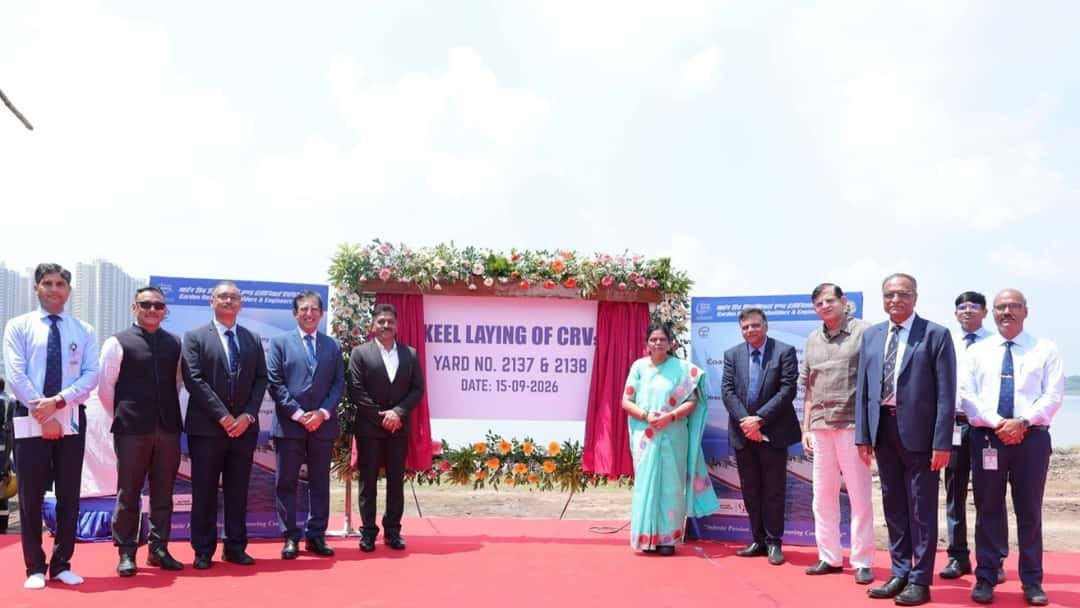

Kolkata : Garden Reach Shipbuilders & Engineers Ltd. (GRSE) has achieved a significant milestone in India’s shipbuilding and marine research sector by laying the keels of two Coastal Research Vessels being constructed for the Geological Survey of India (GSI).
The keel-laying ceremony was held in Kolkata on September 15, 2026, marking the transition of the two vessels from the design and planning stage to the actual construction of their hulls. Smt. Varsha Ashok Aglawe, Director General of GSI, attended the ceremony as the Chief Guest. Senior officials from GRSE, GSI, TNSL and the Indian Register of Shipping (IRS) were also present.
Keel Laying Marks Major Construction Milestone
In shipbuilding, keel laying is considered one of the key milestones in the construction of a vessel. The keel forms the central structural foundation of a ship, and its installation marks the beginning of the vessel’s major hull construction.
With the keel of both vessels now laid, the project is moving into an important phase of ship construction and assembly.
Key Specifications of the Coastal Research Vessels
The two vessels are being designed as specialised platforms for marine geological surveys, mineral exploration and ocean research.
Each vessel will have the following specifications:
- Length: 64 metres
- Width: 13 metres
- Deadweight: Approximately 461 tonnes
- Endurance: Up to 15 days
- Maximum Speed: 10 knots
- Personnel Capacity: 35 people
The vessels will also be equipped with modern scientific laboratories, allowing researchers and technical teams to conduct investigations and analysis during offshore operations.
Advanced Technology and Propulsion System
The Coastal Research Vessels will incorporate several modern technologies designed to support specialised scientific operations.
One of the key features will be a Dynamic Positioning (DP-1) system. This technology helps a vessel maintain its position and heading during offshore operations, which can be particularly useful while conducting geological surveys, sampling and dredging activities.
The vessels will also use diesel-electric propulsion, a propulsion arrangement suited to vessels that require flexibility and efficient operation across different types of marine missions.
Designed for Operations in India’s Exclusive Economic Zone
The vessels are being designed to operate within India’s Exclusive Economic Zone (EEZ). They will be capable of carrying out operations in water depths ranging from 5 metres to 1,000 metres.
This operational capability will allow the vessels to undertake research and exploration activities across a wide range of offshore environments.
Role in Offshore Geological Mapping and Mineral Exploration
The primary objective of the vessels is to strengthen the Geological Survey of India’s offshore exploration capabilities.
The vessels will support several important activities, including:
- Offshore geological mapping
- Marine mineral exploration
- Dredging-related exploration activities
- Ocean environment monitoring
- Marine scientific research
- Collection and study of geological and seabed data
Through these missions, the vessels are expected to provide valuable scientific information about India’s offshore mineral resources and marine environment.
Boost to India’s Offshore Mineral Exploration
India has been increasing its focus on the exploration and assessment of mineral resources located in offshore areas. The new Coastal Research Vessels are expected to provide GSI with dedicated platforms for conducting systematic surveys and research in Indian waters.
The availability of specialised research vessels can help government agencies undertake long-duration offshore surveys, collect geological samples and improve the understanding of seabed resources.
The project is therefore expected to contribute to India’s broader objective of strengthening domestic mineral resource assessment and self-reliance in the mineral sector.
What GSI Leadership Said
Speaking at the keel-laying ceremony, Smt. Varsha Ashok Aglawe, Director General of GSI, highlighted the importance of the vessels for exploring mineral resources located beyond India’s land boundaries.
According to GSI, the vessels will play an important role in expanding the organisation’s capabilities in offshore mineral exploration and supporting the country’s efforts towards greater self-reliance in the mineral sector.
GRSE Highlights Project Milestone
Cmde P.R. Hari (Retd), Chairman and Managing Director of GRSE, described the keel laying as a significant milestone for the project.
He said the event marks the transition from the design phase to physical construction and expressed confidence that GRSE would deliver the vessels on schedule and in accordance with the required quality standards.
GRSE Expands Specialised Research Vessel Portfolio
The project further strengthens GRSE’s portfolio of specialised vessels being developed for India’s scientific, research and defence organisations.
The shipbuilder is currently constructing an Ocean Research Vessel for the National Centre for Polar and Ocean Research (NCPOR). It is also building an Acoustic Research Ship for the Naval Physical and Oceanographic Laboratory (NPOL) under the Defence Research and Development Organisation (DRDO).
GRSE has previously delivered specialised survey and research vessels, including the Sandhayak-class survey vessels for the Indian Navy and the research vessel INS Sagardhwani.
The shipyard has also recently secured an order from ONGC for four Platform Supply Vessels, adding another category of specialised offshore vessels to its order portfolio.
Strategic Importance of the Project
The construction of these two Coastal Research Vessels is significant not only for GRSE and GSI, but also for India’s growing capabilities in marine science, offshore exploration and indigenous shipbuilding.
Once commissioned, the vessels will provide GSI with dedicated platforms capable of operating in challenging offshore conditions and supporting geological surveys, mineral exploration and ocean research.
The project also reflects the growing role of Indian shipyards in designing and constructing specialised vessels for scientific, environmental, offshore and defence-related missions.
Key Highlights at a Glance
ParticularDetailsBuilder Garden Reach Shipbuilders & Engineers (GRSE) Client Geological Survey of India (GSI) Vessels2 Coastal Research VesselsKeel-Laying DateSeptember 15, 2026LocationKolkataLength64 metres eachWidth13 metres eachDeadweight Approximately 461 tonnes eachEndurance15 daysTop Speed10 knotsPersonnel Capacity35 personsPropulsionDiesel-electricPositioning SystemDP-1Operating Depth5 to 1,000 metresPrimary MissionsGeological mapping, mineral exploration, dredging, ocean monitoring and research
Conclusion
The keel laying of the two Coastal Research Vessels represents an important step in the development of India’s offshore research and mineral exploration infrastructure. With advanced laboratories, DP-1 technology, diesel-electric propulsion and the ability to operate across a wide range of water depths, the vessels are being developed to undertake specialised scientific missions within India’s Exclusive Economic Zone.
For GRSE, the project adds another important chapter to its expanding portfolio of specialised research, survey and offshore vessels, while for GSI, the vessels are expected to provide enhanced capabilities for investigating India’s offshore geological and mineral resources.