
₹4.35 Lakh/MW/Month Tariff Signals a More Disciplined Approach to India’s Growing Energy Storage Market
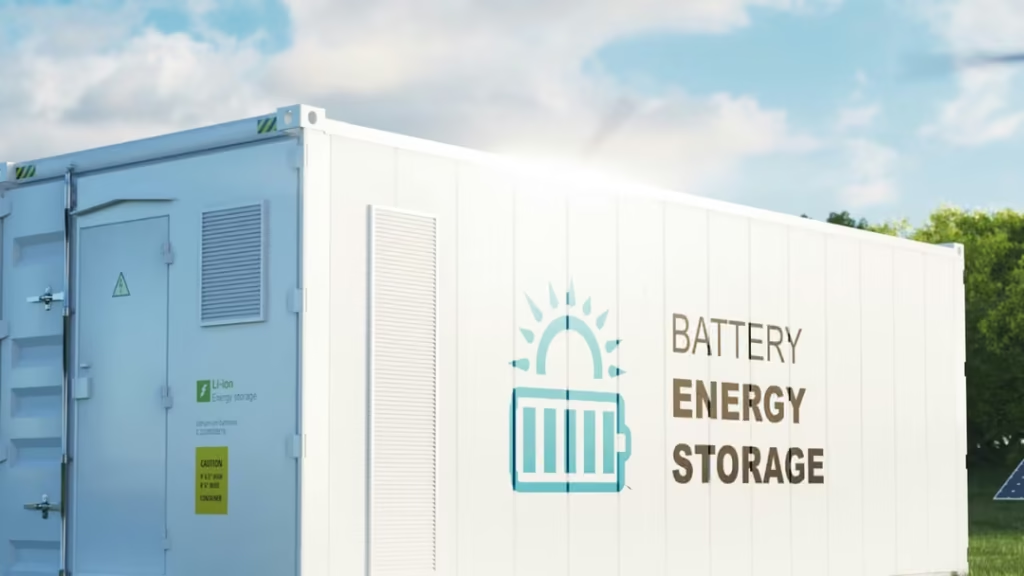
New Delhi : A day after the e-reverse auction concluded, the headline was straightforward: NTPC Green Energy Limited (NGEL) has secured 200 MW/800 MWh of battery energy storage capacity in West Bengal.
But the bigger story lies in what the winning tariff and the size of the award indicate about India’s rapidly evolving energy storage market and NGEL’s growing ambitions in the sector.
The West Bengal State Electricity Distribution Company Limited (WBSEDCL) had floated a substantial tender for 500 MW/2,000 MWh of standalone Battery Energy Storage System (BESS) capacity. When the e-reverse auction concluded on August 7, NGEL emerged with 200 MW, representing 40% of the total tendered capacity, at a tariff of ₹4.35 lakh per MW per month.
While the tariff was not the lowest figure that could have emerged from an intensely competitive auction, it was sufficiently competitive to enable a major player such as NTPC Green Energy to secure a significant share of the project.
A Strategic Bid Rather Than a Race to the Bottom
What makes the outcome particularly interesting is the apparent commercial discipline behind NGEL’s bid.
Rather than aggressively pursuing the lowest possible tariff, the company secured substantial capacity at a rate that could potentially provide a more sustainable balance between project viability, capital deployment, and long-term returns.
This approach could signal a shift in the way large power-sector companies are approaching India’s energy-storage opportunity. As competition increases, winning capacity at any cost may not necessarily translate into attractive returns. Developers are increasingly required to balance tariff competitiveness with financial sustainability.
A Significant Step for West Bengal
For West Bengal, the award is also strategically important.
The state is looking to expand battery storage capabilities to address peak-power requirements, renewable-energy integration, and grid-balancing needs. The participation of an established player such as NGEL in a 200 MW/800 MWh project strengthens the prospects for large-scale energy storage deployment in the state.
However, the entire 500 MW/2,000 MWh tender is yet to be fully accounted for, making the final allocation an important development to watch.
Storage Becomes a Core Growth Area for NTPC Green
The award also adds another important dimension to NTPC Green Energy’s expanding renewable-energy portfolio.
The company has built its growth strategy around large-scale solar, wind, and hybrid renewable-energy projects. Its increasing participation in battery storage auctions suggests that BESS is emerging as a strategic growth vertical rather than simply a supporting technology for renewable projects.
Battery storage can play a crucial role in addressing the intermittent nature of solar and wind power while providing utilities with greater flexibility during periods of high electricity demand.
What the ₹4.35 Lakh Tariff Could Mean
The ₹4.35 lakh/MW/month tariff is perhaps the most important number to watch.
In a market where developers are often under pressure to submit highly aggressive bids, NGEL’s decision to secure capacity without necessarily chasing the absolute lowest tariff could indicate a more measured approach to project economics.
The strategy appears to be centered on “volume with viability”—securing a meaningful position in the emerging storage market while maintaining greater focus on commercial sustainability.
That could prove increasingly important as India moves from small-scale battery-storage pilots toward large, grid-scale energy storage projects.
The Bigger Picture
The West Bengal auction highlights a broader transformation taking place in India’s power sector. Battery energy storage is moving from an emerging technology to an increasingly important component of the country’s electricity infrastructure.
For NGEL, the 200 MW award strengthens its position in this evolving market. For West Bengal, it represents another step toward building large-scale storage capacity. And for the wider industry, the auction could offer an early indication that the next phase of India’s renewable-energy race may be shaped not only by how much generation capacity companies build, but also by how intelligently they manage and store that electricity.
In that context, NGEL’s latest win is about more than the 200 MW headline. It could be an indication of a more commercially disciplined strategy as India’s energy-storage market enters its next phase of growth.