
New Delhi । India is witnessing a major transformation in its edible oil sector, with the National Mission on Edible Oils (NMEO) emerging as a game-changer for oilseed farmers and the country’s food security. With a clear roadmap to reduce import dependence and boost domestic production, the mission is rapidly reshaping India’s oilseed ecosystem.
India tops global production in key oilseeds
According to a NITI Aayog report released in August 2024, India ranks first globally in the production of rice bran oil, castor seed, safflower, sesame, and niger seed. Despite this, domestic production has historically fallen short of the country’s growing edible oil demand — a gap the NMEO now aims to bridge.
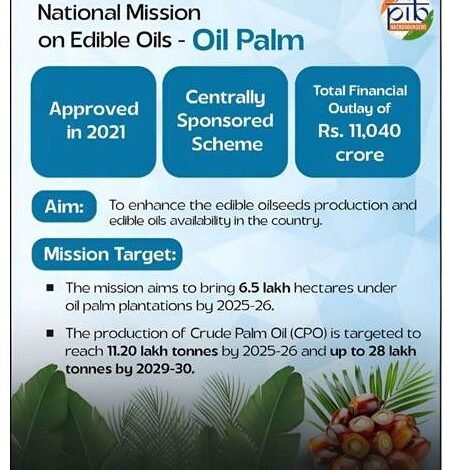
NMEO–Oil Palm (NMEO-OP) boosts crude palm oil output
The NMEO-OP targets 6.5 lakh hectares under oil palm cultivation by 2025-26 and aims to scale crude palm oil (CPO) production to 2.8 million tonnes by 2029-30.
As of November 2025, over 2.50 lakh hectares of new cultivation have already been added, taking India’s total palm oil coverage to 6.20 lakh hectares. CPO production has doubled in the past decade — from 1.91 lakh tonnes in 2014-15 to 3.80 lakh tonnes in 2024-25 — indicating the mission’s strong momentum.
NMEO–Oilseeds (NMEO-OS): Targeting productivity-led growth
The second pillar of the mission — NMEO-OS — focuses on oilseed crops through cluster-based interventions, enhanced seed systems, technology adoption, and improved market linkages. The objective is to increase oilseed production from 39 million tonnes to 69.7 million tonnes by 2030-31.
Oilseeds play a crucial role in the rural economy, serving as a major cash crop that ensures farmers’ income security while contributing to national nutritional goals. Millions of households rely on edible oils for dietary fats and essential vitamins — making production growth vital for both nutrition and livelihood stability.
Rising consumption and import burden
India’s per-capita edible oil consumption has risen sharply over the past two decades:
- Rural areas: from 5.76 kg/year (2004-05) to 10.58 kg/year (2022-23)
- Urban areas: from 7.92 kg/year (2004-05) to 11.78 kg/year (2022-23)
During 2023-24, India produced 12.18 million tonnes of edible oils — enough to meet only 44% of domestic demand. Although import dependence has declined from 63.2% in 2015-16 to 56.25% in 2023-24, the surge in consumption continues to put pressure on supply.
Why NMEO matters
In the 1990s, India achieved near self-sufficiency during the “Yellow Revolution”, driven by price support and import substitution policies. However, reductions in tariff protection and market liberalization reversed this trend, leading to an escalation in edible oil imports — reaching 15.66 million tonnes in 2023-24.
Global market fluctuations and supply chain disruptions have repeatedly highlighted the risks of heavy import reliance. NMEO, therefore, stands as a critical step toward:
- Agricultural sustainability
- Nutritional security
- Improving farmers’ income
- Reducing foreign exchange outflow
Road ahead
India contributes 15–20% of global oilseed area, yet only 6–7% of vegetable oil production, indicating vast untapped potential. The government aims to bridge this gap through:
- Better seeds and research support
- Expansion of oil palm in suitable regions
- Incentive-based support for farmers
- Modern processing and marketing systems
As the mission advances, experts believe India could not only reduce imports but also elevate millions of farmers into a more secure and profitable agricultural future.
Conclusion
The National Mission on Edible Oils is emerging as a strategic milestone for Indian agriculture. By aligning productivity growth with farmer welfare and nutritional needs, the programme has the potential to make India self-reliant in edible oils while significantly boosting rural prosperity.