


Bilaspur, India: A protest organized by the Indian National Congress and its student wing NSUI (National Students’ Union of India) against the alleged NEET examination paper leak took an unexpected turn, sparking debate about whether the event was driven more by political activism or social media visibility.
The demonstration, held outside the residence of Union Minister of State and Member of Parliament Tokhan Sahu, was intended to highlight concerns over the integrity of India’s highly competitive medical entrance examination. However, observers noted that while slogans were being raised and confrontations with police were unfolding, an equally noticeable activity was taking place—participants appeared highly focused on recording videos, taking photographs, and creating social media content.
“My Leader Asked Me to Come”
During the protest, some participants were reportedly asked about the purpose of the demonstration and the issues surrounding the NEET paper leak controversy. According to eyewitness accounts, several individuals struggled to explain the issue and responded with comments such as, “My leader asked me to come, so I came.”
The responses raised questions about how well-informed some protesters were regarding the issue they had gathered to oppose. Critics argued that the incident highlighted a disconnect between the seriousness of the controversy and the level of awareness among certain participants.
Students Missing from a Student-Centric Protest
Although the protest centered on the future of students affected by the alleged examination irregularities, many observers pointed out the apparent absence of a significant number of actual NEET aspirants, coaching institute representatives, or educators.
For an event presented as a movement for students’ rights and educational transparency, critics noted that the visible participation of those directly impacted appeared limited.
Drones Above, Reels Below
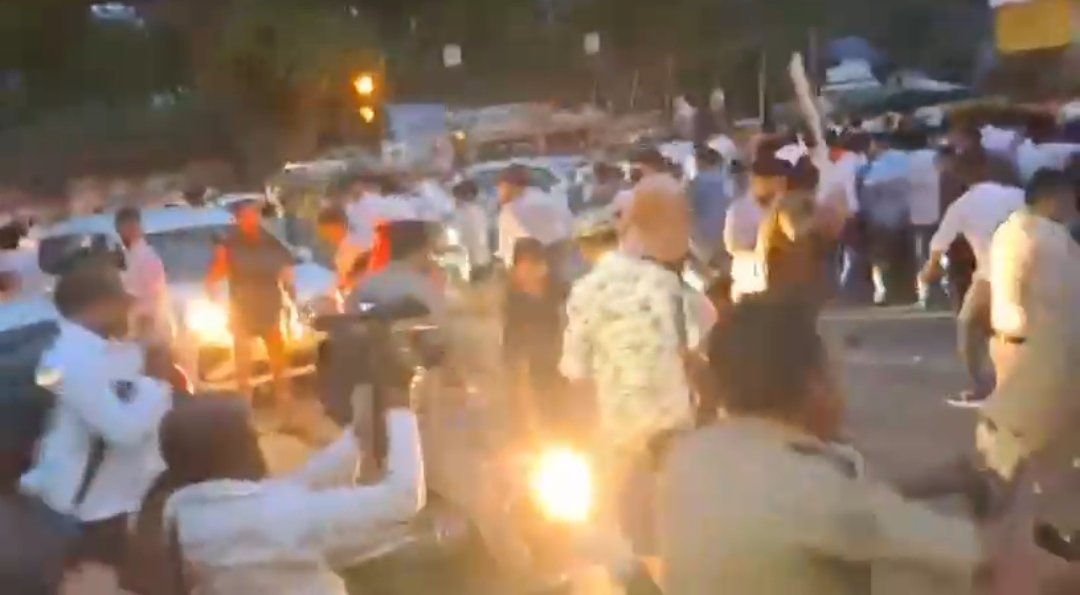
Throughout the demonstration, drones hovered overhead capturing aerial footage while dozens of smartphones remained in recording mode on the ground.
Witnesses reported that some participants appeared more concerned about securing the perfect camera angle than engaging in the protest itself. Several protesters were allegedly seen positioning themselves near police barricades and prominent locations to maximize their visibility in videos and photographs.
According to bystanders, the atmosphere occasionally resembled a large-scale content production event rather than a traditional political demonstration.
“Please Let My Video Be Recorded”
One phrase reportedly heard multiple times during the event quickly became a talking point among locals:
“Brother, please let my video be recorded.”
The comment, whether made jokingly or seriously, has since become symbolic of the criticism surrounding the protest. Many residents questioned whether some participants were motivated more by social media exposure than by the underlying issue of examination fairness.
From Police Action to Upload Action
As tensions escalated, police reportedly used water cannons and other crowd-control measures to disperse protesters. Several participants were detained, while others sustained minor injuries during clashes.
However, once the demonstration concluded, activity shifted rapidly online.
Within hours, Facebook, Instagram, and X (formerly Twitter) were flooded with videos, photographs, and short-form content from the event. The speed and volume of uploads led many observers to remark that content distribution appeared almost as organized as the protest itself.
A Growing Debate: Public Movement or Viral Project?
There is little disagreement that allegations surrounding the NEET paper leak represent a serious issue affecting the futures of millions of students across India. Calls for accountability and transparency remain significant concerns for students, parents, and educational institutions alike.
Yet the events in Bilaspur have triggered a broader discussion about the changing nature of modern political activism.
In an era dominated by social media platforms, critics and supporters alike are asking whether public demonstrations are increasingly becoming opportunities for digital visibility, personal branding, and viral content creation rather than purely vehicles for public advocacy.
As conversations continue across the city, one thing is clear: following the protest, discussions about the alleged examination leak were often overshadowed by another topic entirely—the race to appear in the next viral reel.