
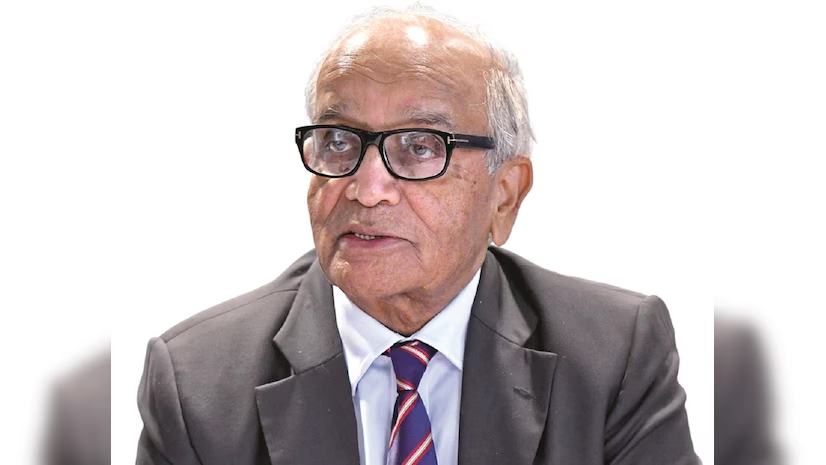
New Delhi : Maruti Suzuki India Limited Chairman R.C. Bhargava has raised concerns over the government’s proposal to make Vehicle-to-Vehicle (V2V) communication systems mandatory in all new automobiles from October 2028, arguing that such regulations may slow the growth of India’s automobile industry if implemented without considering the country’s unique driving conditions.
In an interview, Bhargava said India should adopt automotive regulations that are suited to its own transportation ecosystem rather than replicating standards designed for developed nations.
Questions Practical Benefits of Mandatory V2V Systems
Bhargava questioned the necessity of making V2V communication technology compulsory across all categories of vehicles, particularly when a large proportion of Indian motorists drive in urban traffic or rural areas, where vehicle speeds remain relatively low.
He asked what practical advantage such systems would offer to drivers traveling at 30–40 km/h in congested cities or on rural roads.
According to him, technologies designed primarily for high-speed highway driving in developed countries may not provide the same value in India’s diverse road environment.
“What would car users gain from this in rural areas or in cities where they travel at speeds of only 30–40 km an hour?” Bhargava remarked.
India’s Road Conditions Are Different
The Maruti Suzuki Chairman emphasized that India is not a homogeneous automotive market.
Unlike many developed economies, the country has a wide variety of:
- Road infrastructure
- Traffic conditions
- Vehicle categories
- Driving patterns
- Consumer affordability levels
Bhargava argued that automotive regulations should reflect these realities rather than adopting standards developed for countries where most vehicles travel long distances on high-speed expressways.
He cautioned against uniformly applying Western automotive standards without evaluating their relevance to Indian conditions.
Concerns Over Industry Growth
According to Bhargava, imposing complex and expensive technologies across all vehicles could increase manufacturing costs and create additional compliance burdens for automobile manufacturers.
He warned that excessive regulation may:
- Increase vehicle prices
- Raise development costs
- Slow product launches
- Reduce affordability for consumers
- Delay industry growth and innovation
He stressed that policy decisions should strike a balance between improving safety and maintaining the affordability that has driven India’s automobile market.
Government’s V2V Proposal
The proposed Vehicle-to-Vehicle (V2V) communication system is intended to allow vehicles to exchange real-time information such as:
- Vehicle speed
- Position
- Direction of travel
- Braking activity
- Potential collision risks
The technology is designed to enhance road safety by enabling vehicles to warn drivers of possible hazards before they become visible.
The government is reportedly considering making the technology mandatory for all new vehicles from October 2028 as part of its broader road safety and intelligent transportation initiatives.
Comments on E20 Fuel Adoption
Bhargava also addressed the rollout of E20 fuel (petrol blended with 20% ethanol), stating that widespread adoption will depend less on vehicle technology and more on the availability and quality of fuel across the country.
According to him, automobile manufacturers have already developed E20-compatible engines, but the success of the programme will depend on:
- Reliable fuel distribution infrastructure
- Consistent fuel quality
- Nationwide availability of E20 petrol
He suggested that strengthening the fuel ecosystem is just as important as ensuring vehicle compatibility.
Need for India-Centric Policies
Bhargava reiterated that India’s automotive regulations should be designed according to the country’s own economic and transportation realities rather than simply mirroring international standards.
He emphasized that while advanced safety technologies are important, policymakers should carefully evaluate their cost-benefit impact, particularly in a market where affordability remains a key purchasing factor for millions of consumers.
Looking Ahead
The remarks by R.C. Bhargava add an important industry perspective to the ongoing discussion on the future of automotive regulations in India. As the government continues to pursue higher vehicle safety standards, smart mobility, and clean transportation technologies, manufacturers are calling for a balanced approach that promotes innovation while preserving affordability and supporting the continued growth of India’s automobile sector.
The debate over mandatory V2V communication systems and the implementation of E20 fuel is expected to continue as policymakers, automakers, and industry stakeholders work together to shape the next phase of India’s mobility ecosystem.