
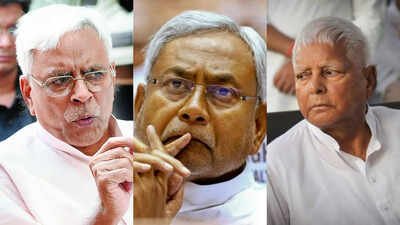
Patna — A major political transition appears to be underway in the eastern Indian state of Bihar, as the influence of two of its most dominant leaders—Nitish Kumar and Lalu Prasad Yadav—continues to wane. Veteran socialist leader Shivanand Tiwari has described the moment as “the end of an era” in Bihar’s political history.
In a detailed reflection shared publicly, Tiwari traced the political journeys of both leaders, who emerged from the transformative JP Movement led by Jayaprakash Narayan. For nearly four decades, Kumar and Yadav shaped the state’s political direction, often as rivals but also as key figures representing social justice politics.
Rise of Lalu Yadav: From Social Justice Icon to Controversial Leader
According to Tiwari, Lalu Yadav was once the more powerful of the two leaders, gaining national prominence during the implementation of the Mandal Commission recommendations, which expanded affirmative action for backward classes.
Yadav further cemented his image as a defender of secularism when he ordered the arrest of Lal Krishna Advani during the Ram Rath Yatra—a move that elevated his stature nationwide.
However, Tiwari argued that Yadav’s politics often contained an element of “dramatic symbolism” that did not always translate into consistent action. He cited the events surrounding the Babri Masjid demolition, suggesting a gap between Yadav’s strong public statements and his response during critical moments.
Shifting Social Coalitions and Political Decline
Tiwari noted that while Yadav championed “social justice,” the benefits were not evenly distributed among all marginalized communities. Over time, extremely backward classes—key electoral groups—began drifting away from him.
This shift created an opening for Nitish Kumar, who built his early political success by targeting these groups and introducing policies such as reservations for women and extremely backward classes during his first term (2005–2010), often described as his “golden phase.”
Nitish Kumar: From Reformist Leader to Political Compromises
Despite his early achievements, Kumar’s political trajectory also changed significantly over time. Once known for his strong opposition to Narendra Modi and his politics, Kumar later aligned with him for political survival.
Tiwari described Kumar’s recent political moves as a form of “surrender,” arguing that he eventually ceded power to the Bharatiya Janata Party without a significant political struggle.
A Political Vacuum in Bihar
The analysis highlights a broader concern: the absence of a strong ideological movement in Bihar’s current political landscape. Historically, major political changes in the state—from the socialist movements of the 1960s to the JP Movement of the 1970s—were driven by mass mobilization and grassroots activism.
Today, Tiwari argues, the transition in power lacks that ideological depth or public movement, creating what he calls a “political vacuum.”
What Lies Ahead?
Despite the current uncertainty, Tiwari remains optimistic that this vacuum will not last forever.
“Nature does not tolerate a vacuum. New forces will emerge to fill this space,” he suggested.
As Bihar moves into a new political phase, analysts believe emerging leaders and shifting voter dynamics—especially among youth and marginalized communities—could redefine the state’s future.
Conclusion
The simultaneous decline of Nitish Kumar and Lalu Prasad Yadav marks a significant turning point in Bihar’s political history. Their decades-long dominance, rooted in the ideals of social justice and grassroots mobilization, is now giving way to a new, yet undefined, political order—one that could reshape the state’s trajectory in the years to come.