


New Delhi: Agrivoltaics, an innovative approach that combines agriculture with solar power generation on the same land, is emerging as a potential solution to India’s agricultural and clean energy challenges. The technology allows farmers to continue growing crops while generating electricity through solar panels installed above or between cultivated areas. It can help diversify farm income, improve land-use efficiency and support India’s transition towards renewable energy.
According to a backgrounder released by the Press Information Bureau (PIB), India is exploring agrivoltaics through research, demonstration projects, policy initiatives and industry collaboration. The approach could create new opportunities for farmers while contributing to the country’s long-term clean energy and sustainable development goals.
Agriculture and Solar Energy: A Dual Opportunity
Agriculture remains a major source of livelihood in India, supporting approximately 46.1 per cent of the population. The Gross Value Added (GVA) of agriculture and allied sectors is estimated to reach ₹52.08 lakh crore in 2025–26, according to the PIB backgrounder.
Farming requires reliable and affordable electricity for irrigation, water pumping and other agricultural operations. Solar energy can help meet these needs while reducing dependence on conventional electricity and diesel-powered pumps.
India’s extensive agricultural land also offers considerable scope for combining crop cultivation with solar electricity generation.
According to land-use statistics for 2023–24 cited by the PIB, India has a total geographical area of 306.96 million hectares, of which approximately 55 per cent is agricultural land. The country’s net sown area stands at 138.99 million hectares, while the total cropped area is 217.88 million hectares.
Agrivoltaics seeks to make better use of this land by allowing agricultural production and solar power generation to take place simultaneously.
What Is Agrivoltaics and How Does It Work?
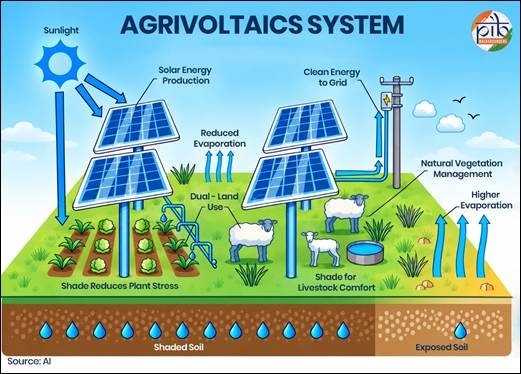
Agrivoltaics, also known as agrisolar or dual-use solar, integrates solar photovoltaic systems with agricultural activities. Instead of covering agricultural land entirely with conventional ground-mounted solar panels, the technology uses specially designed structures that allow farming to continue underneath or between the panels.
The system generally works through three key features.
1. Elevated solar panel structures
Solar panels are mounted on raised structures to leave sufficient space for crops, farm workers and agricultural machinery. The height, spacing and arrangement of the panels are designed according to local farming conditions and the requirements of the crops being cultivated.
2. Partial shade for crops
Solar panels create partial shade, which can reduce direct exposure to intense sunlight and slow moisture loss from the soil under suitable conditions. This may help moderate temperatures and reduce water stress in certain crops, particularly in hot or dry regions.
However, the benefits depend on panel spacing, sunlight availability, rainfall, soil conditions and crop type. Excessive shading can also reduce yields for crops that require more direct sunlight.
3. Dual use of agricultural land
Farmers can continue cultivating suitable crops or, in some systems, undertake livestock-related activities while generating solar electricity. The electricity can support irrigation and other farm operations. Where grid connectivity and applicable regulations permit, surplus power may also be sold to the electricity distribution network.
This combination can diversify farm income and improve the productive use of agricultural land.
Agrivoltaics Projects in India
India’s agrivoltaics sector is developing through pilot projects and demonstration systems across different agricultural and climatic regions.
According to the PIB backgrounder, as of August 2025, India had 36 operational agrivoltaic projects with a combined installed capacity of 37.54 megawatts. Another 10 pilot projects were under development.
The projects use different approaches, including elevated solar structures, layouts with spaces between crop rows and solar tracking systems.
These installations are helping researchers and stakeholders examine how solar electricity generation can be integrated with farming under varying local conditions.
India’s Estimated Agrivoltaics Potential
The PIB backgrounder cites estimates placing India’s agrivoltaic potential between 3,000 gigawatts and approximately 14,000 gigawatts. These figures represent estimated potential rather than currently installed capacity and depend on the assumptions and land-use criteria applied.
A GIS-based national screening exercise identified 47.35 million hectares of potentially suitable agricultural land after applying environmental, agricultural and technical filters.
Several factors could influence the development of agrivoltaics in India:
- Crop suitability: Fruits, vegetables, spices and medicinal plants may be suitable for selected systems, depending on their sunlight and water requirements.
- Regional conditions: Solar radiation, land availability, irrigation facilities and local farming practices will determine where projects are practical.
- Farm income: Electricity generation may provide an additional revenue stream alongside agricultural earnings.
- Water management: Partial shade may reduce evaporation in certain conditions, although actual water savings vary by crop and system design.
The backgrounder also cites estimates suggesting that annual earnings could rise from around ₹60,000 per acre to more than ₹1 lakh per acre in some cases. These are potential outcomes, not guaranteed returns; actual earnings would depend on crop yields, project costs, electricity tariffs, financing and contractual arrangements.
States with Significant Agrivoltaics Potential
The PIB backgrounder identifies several states where agricultural land availability, solar resources and agro-climatic conditions could support agrivoltaic development.
High-potential states: Maharashtra, Rajasthan, Andhra Pradesh, Madhya Pradesh, Karnataka and Uttar Pradesh.
Together, these states could account for approximately 50 per cent of India’s estimated agrivoltaic electricity-generation potential, according to the cited assessment.
Moderate-potential states: Odisha, Tamil Nadu, Kerala, Telangana, Bihar and West Bengal.
The backgrounder notes that southern, western and central India offer favourable combinations of solar radiation, land availability and horticultural activity for certain large-scale agrivoltaic applications.
Nevertheless, project suitability must be assessed locally. Soil conditions, crop selection, water availability and the economics of installation can vary substantially within a state.
Government Initiatives to Promote Solar Energy in Agriculture
The Central Government and state governments are supporting the integration of solar energy with agriculture through programmes, research initiatives and state-specific schemes.
PM-KUSUM Scheme
Launched in February 2019, the Pradhan Mantri Kisan Urja Suraksha evam Utthaan Mahabhiyan (PM-KUSUM) promotes solar energy in agriculture. Its objectives include reducing dependence on diesel, supporting solar-powered irrigation and creating opportunities for farmers to benefit from decentralised renewable energy generation.
The PIB backgrounder cites a provision of approximately ₹34,422 crore in central financial assistance for the scheme.
Although PM-KUSUM is not exclusively an agrivoltaics programme, its support for decentralised solar generation and solarisation of agricultural pumps can complement the wider development of agriculture-linked solar energy systems.
Agrivoltaics Centre of Excellence
The National Institute of Solar Energy (NISE), in collaboration with the Indian Agricultural Research Institute (IARI) under the Indian Council of Agricultural Research (ICAR), has established an Agrivoltaics Centre of Excellence.
The centre supports research, demonstrations and capacity building in the field. Its activities include pilot installations, including a 100-kilowatt agrivoltaic system at IARI.
Research of this kind can help establish suitable panel heights, spacing arrangements and crop combinations for Indian farming conditions.
India Agrivoltaics Alliance
The India Agrivoltaics Alliance (IAA), operated by the National Solar Energy Federation of India (NSEFI), is a multi-stakeholder platform working to promote the dual use of land for agriculture and solar power.
Launched in 2023, the alliance had grown to more than 40 members, according to the PIB backgrounder.
Its activities include policy engagement, research, knowledge development, pilot projects and support for commercial models that can improve land productivity, diversify farmers’ incomes and strengthen rural energy access.
State-Level Initiatives Supporting Solar Agriculture
Several states have introduced programmes to expand solar power generation and improve access to electricity for agricultural consumers.
Maharashtra: Mukhyamantri Saur Krushi Vahini Yojana 2.0
The scheme promotes decentralised solar power projects to help supply electricity to agricultural consumers. The backgrounder cites plans involving approximately 35,000 acres of government and private land and a proposed solar capacity of 16,000 MW.
Gujarat: Kisan Suryoday Yojana
The scheme aims to improve electricity availability for agricultural activities by expanding access to daytime power supplies. It is intended to help farmers meet irrigation and other agricultural electricity requirements.
Karnataka: Surya Raitha Scheme
The scheme promotes solar-powered irrigation pumps and provides opportunities for farmers to earn additional income by selling surplus electricity, subject to applicable arrangements. Solar pumps can also reduce dependence on diesel-powered irrigation.
These initiatives illustrate how state-level programmes can complement national renewable energy objectives. Their specific benefits and implementation arrangements differ, and they should not be confused with agrivoltaic installations unless crop cultivation and solar generation are integrated on the same land.
Seventh World Agrivoltaics Conference Held in New Delhi
New Delhi hosted the seventh World Agrivoltaics Conference from October 21 to 23, 2026, according to the PIB backgrounder.
The conference theme, “Powering the Global South,” brought attention to opportunities for combining agricultural production with solar electricity generation, particularly in developing economies.
The event brought together stakeholders from industry, research, policy and finance to discuss efficient land use, agricultural sustainability and the transition towards a low-carbon economy.
Such collaboration can help address practical challenges, including project financing, crop compatibility, engineering standards, farmer participation and the development of commercially viable business models.
Challenges That Will Shape Future Adoption
Despite its potential, agrivoltaics requires careful planning to ensure that solar installations complement rather than undermine agricultural production.
Panel height and spacing must be adapted to the crops being grown. Farmers also need access to suitable financing, technical advice, maintenance services and reliable electricity-purchase arrangements.
Project developers must consider installation costs, machinery access, soil conditions, irrigation requirements and the impact of shading on crop yields.
Field trials and long-term research will be essential to identify which combinations of crops and solar systems deliver the best results under different Indian conditions.
The participation of farmers in project design and decision-making will also be important to ensure that the economic benefits reach agricultural communities.
Agrivoltaics Could Link Farmers’ Prosperity with India’s Clean Energy Goals
Agrivoltaics offers India an opportu