

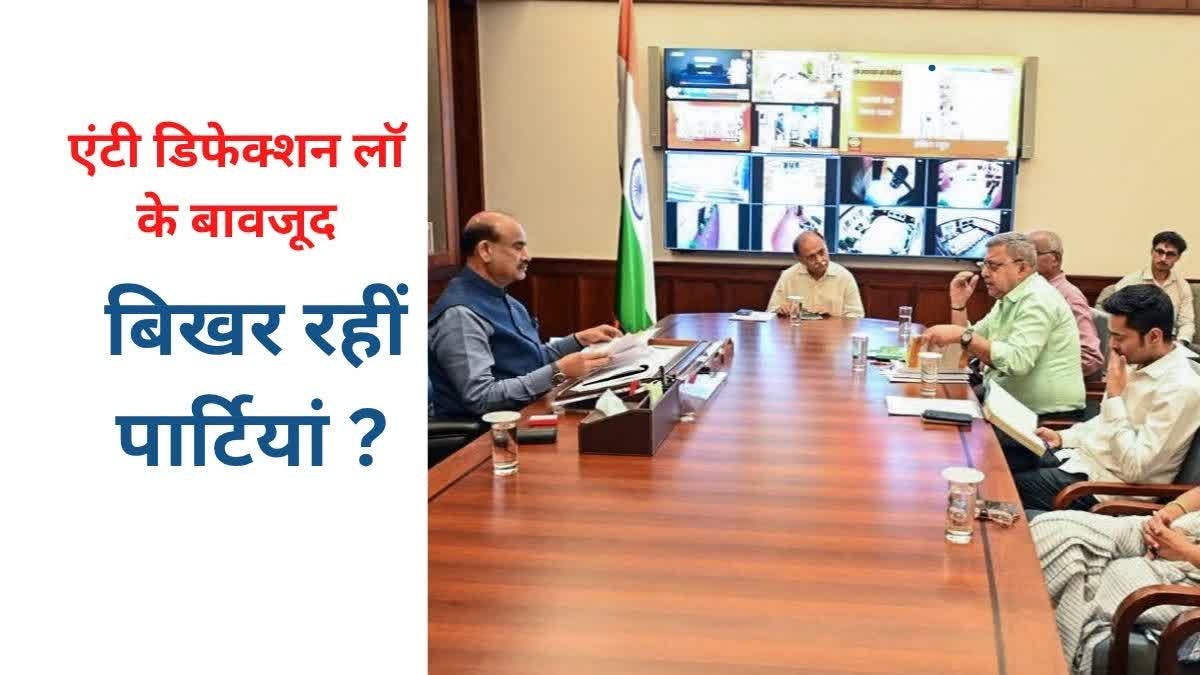

New Delhi: India’s Anti-Defection Law, enacted to prevent elected representatives from switching political parties for personal or political gain, is once again at the center of national debate. A series of recent political developments involving alleged splits within opposition parties has renewed questions about whether the law remains effective or requires comprehensive reform.
Political analysts argue that while the law was originally designed to ensure government stability and protect the electoral mandate, its loopholes have increasingly been exploited, allowing large-scale defections and political realignments.
Why the Debate Has Intensified
Several opposition parties have recently alleged that their legislators have been persuaded or pressured to switch allegiance to rival political groups. Among the most discussed cases are political developments involving the Trinamool Congress (TMC) and Shiv Sena (Uddhav Balasaheb Thackeray faction).
Opposition leaders claim lawmakers are being influenced through political incentives, strategic negotiations, or other forms of pressure. These developments have reignited debate over whether India’s Anti-Defection Law is capable of preventing political instability.
The Origins of the Anti-Defection Law
The law was introduced after decades of widespread political defections that destabilized governments across India.
Between 1951 and 1967, approximately 542 legislators switched political parties. The situation became significantly worse during 1967–68, when 438 elected representatives reportedly changed parties within a single year.
Between 1967 and 1970, more than 1,240 cases of political defections were recorded across various states, leading to repeated collapses of elected governments.
One of the most famous incidents occurred in 1967, when Haryana legislator Gaya Lal changed political parties three times in a single day, giving rise to the now-famous political phrase “Aaya Ram, Gaya Ram,” which has since become synonymous with political defections in India.
According to reports published by the Association for Democratic Reforms (ADR), nearly half of the approximately 4,000 legislators elected between 1967 and 1971 later switched political parties.
How the Law Was Introduced
In response to growing political instability, Parliament established a committee headed by Y. B. Chavan in 1968 to study the issue.
Based on the committee’s recommendations, the 52nd Constitutional Amendment Act, 1985 introduced the Anti-Defection Law, incorporating it into the Tenth Schedule of the Constitution of India.
The amendment also formally introduced the term “Political Party” into the Constitution.
How the Anti-Defection Law Works
The law applies to both Parliament and State Legislative Assemblies.
An elected representative may be disqualified if he or she:
- Voluntarily resigns from the political party on whose ticket they were elected.
- Votes against the official party directive (party whip) during legislative proceedings.
- Abstains from voting despite being instructed by the party to participate.
A petition seeking disqualification must be filed by another member of the legislative body.
The authority to decide such petitions currently rests with:
- Speaker of the Lok Sabha
- Chairman of the Rajya Sabha
- Speaker of the respective State Legislative Assembly
Role of the Party Whip
A party whip is an official instruction issued by a political party directing its legislators how to vote on specific matters before the legislature.
Failure to follow the whip can result in disqualification under the Anti-Defection Law.
Special Rule for Nominated Members
Members nominated to the Rajya Sabha may join a political party within six months of their nomination.
However, joining a party after this period can make them liable for disqualification under the Anti-Defection Law.
Major Criticism of the Law
One of the law’s biggest weaknesses is that it does not specify a fixed time limit for Speakers or Chairpersons to decide disqualification petitions.
As a result, several lawmakers accused of defection have continued serving as legislators—and in some cases even become ministers—while their cases remained pending.
Legal experts argue that delayed decisions undermine the very purpose of the legislation.
Judicial Review by the Supreme Court
Initially, the Tenth Schedule barred judicial review of decisions made by the Speaker.
However, in 1992, the Supreme Court of India ruled that decisions under the Anti-Defection Law are subject to judicial review after the Speaker issues a final order.
Courts may intervene in cases involving:
- Bad faith
- Arbitrary decision-making
- Violation of natural justice
However, courts generally do not interfere before the Speaker reaches a decision.
The 2003 Constitutional Amendment
To prevent engineered political splits, Parliament enacted the 91st Constitutional Amendment Act, 2003.
Earlier provisions allowed one-third of legislators to split from a party without facing disqualification.
The amendment abolished this rule and introduced a stricter requirement that at least two-thirds of legislators must support a merger for it to qualify as a legitimate political split.
Although intended to strengthen the law, critics argue that political parties have continued finding ways to circumvent these provisions.
Supreme Court’s Three Key Tests
The Supreme Court has identified three important principles for determining the legitimacy of rival political factions:
- Objectives and ideology of the political party
- Compliance with the party’s constitution and internal democratic structure
- Majority support in both the legislative and organizational wings of the party
These principles became particularly significant in disputes involving Shiv Sena.
Expert Recommendations for Reform
Several expert committees and constitutional bodies have proposed significant reforms.
Dinesh Goswami Committee (1990)
The committee recommended limiting disqualification primarily to cases where:
- A legislator voluntarily resigns from the party.
- A legislator violates the party whip only on critical votes such as:
- Confidence Motions
- No-Confidence Motions
- Money Bills
- Motion of Thanks to the President’s Address
Law Commission of India (2015)
The Commission proposed transferring the authority to decide disqualification cases from the Speaker to the President or Governor, acting on the advice of the Election Commission of India.
Supreme Court Recommendation (2020)
In the Keisham Meghachandra Singh v. Speaker, Manipur Legislative Assembly case, the Supreme Court recommended creating an independent tribunal headed by retired judges to decide Anti-Defection cases instead of the Speaker.
Additional Reform Proposals
Constitutional experts have also suggested:
- Legislators wishing to leave a political party should first resign from their legislative seat.
- The legal exemption for party mergers should be abolished.
- Defecting legislators should face immediate disqualification.
- Defectors should be barred from contesting elections for up to five years.
- The Election Commission should actively encourage stronger internal democracy within political parties.
A Law at a Crossroads
Nearly four decades after its introduction, India’s Anti-Defection Law remains one of the country’s most debated constitutional safeguards. While it successfully reduced frequent defections during its early years, recent political developments have exposed significant procedural and legal weaknesses.
Constitutional scholars believe that introducing time-bound decisions, independent adjudication, and stronger enforcement mechanisms could restore the law’s original objective of protecting the people’s electoral mandate, ensuring government stability, and strengthening India’s democratic institutions.