

WASHINGTON/PARIS — Although China is the world’s second-largest economy by gross domestic product (GDP), it remains outside the Group of Seven (G7), one of the most influential political and economic forums in the world. The issue has gained renewed attention as global leaders gather for G7 discussions on trade, security, technology, and economic growth.
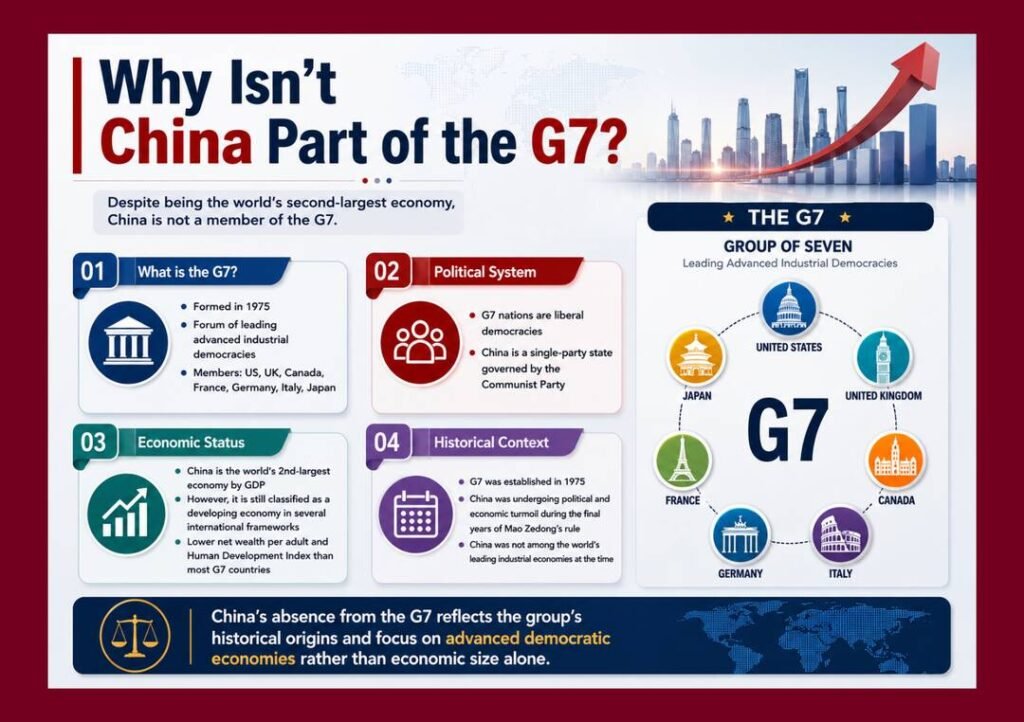
The G7 consists of seven advanced industrial democracies:
- United States
- Canada
- United Kingdom
- France
- Germany
- Italy
- Japan
The group was established in 1975 as a platform for the world’s leading industrialized nations to coordinate economic policy and address global challenges.
More Than Economic Size
While China has a significantly larger economy than several G7 members, membership has never been based solely on GDP.
The G7 is often described as a coalition of advanced liberal democracies that share common political values, including:
- Democratic governance
- Rule of law
- Free-market principles
- Political pluralism
- Protection of civil liberties
China, by contrast, is governed by the Chinese Communist Party, making it a single-party state rather than a multiparty liberal democracy. This political difference is widely viewed as one of the primary reasons China has never been invited to join the group.
China Still Classified as a Developing Country
Despite its enormous economic output, China continues to face development challenges.
Experts note that China’s:
- Per-capita income remains below that of most G7 nations.
- Net wealth per adult is considerably lower than in advanced Western economies.
- Human Development Index (HDI) rankings remain below many developed countries.
As a result, many international institutions still categorize China as a developing economy, even though it is a global economic powerhouse.
A Different Global Role
China has instead played a prominent role in broader international forums such as the G20, which includes both developed and developing economies and represents the majority of global GDP and population.
The G20 framework allows China to participate alongside major economies such as the United States, India, Japan, Germany, and others in discussions on international finance, trade, climate policy, and development.
Growing Influence Outside the G7
Over the past two decades, China has expanded its global influence through initiatives such as:
- The Belt and Road Initiative
- Increased international trade partnerships
- Investments in emerging markets
- Leadership in manufacturing and technology sectors
China is also a founding member of organizations such as BRICS, which has emerged as an alternative platform for major developing economies.
The Ongoing Debate
Some analysts argue that China’s economic size and global influence justify a greater role in international decision-making forums traditionally dominated by Western nations. Others contend that the G7’s identity is rooted not only in economic strength but also in shared democratic values and political systems.
As geopolitical competition between China and Western countries continues, the question of China’s relationship with the G7 remains a significant topic in global diplomacy.
Bottom Line
Although China’s economy is the second-largest in the world, G7 membership is based on more than economic power alone. The group’s emphasis on advanced democratic governance, combined with China’s status as a single-party state and its classification as a developing economy in several key measures, explains why Beijing remains outside the exclusive club of the world’s leading industrial democracies.