


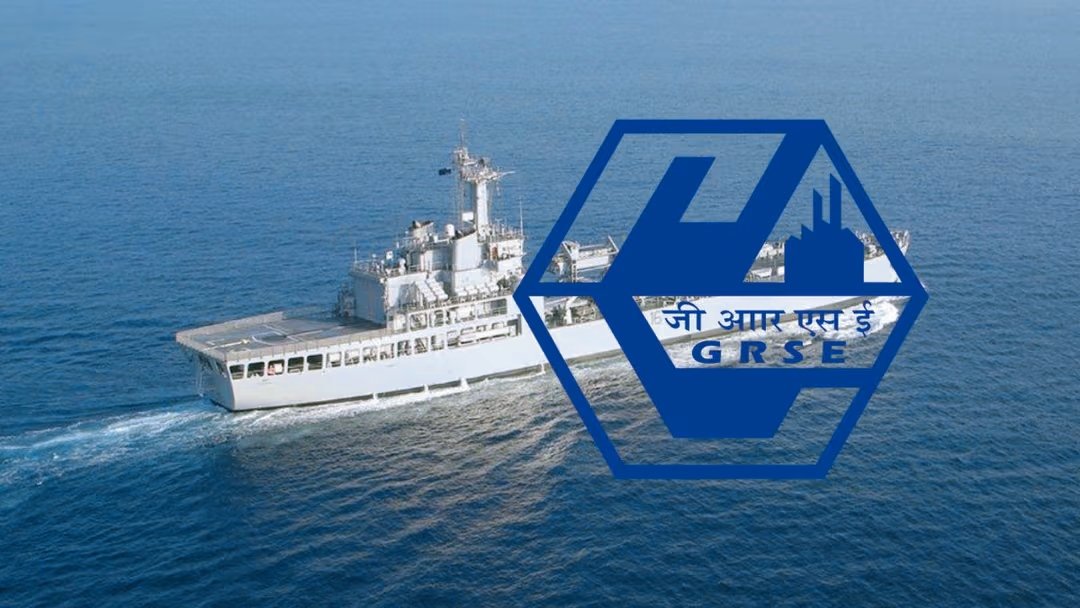

Kolkata : Garden Reach Shipbuilders & Engineers (GRSE) Limited is poised to secure one of the most significant naval shipbuilding contracts in India’s recent defense history, as the company awaits final approval from the Cabinet Committee on Security (CCS) for the ambitious Next Generation Corvettes (NGC) Project of the Indian Navy.
The project, estimated at approximately ₹40,000 crore (US$4.7 billion), involves the construction of eight state-of-the-art stealth corvettes designed to strengthen India’s maritime defense capabilities and support the nation’s ongoing naval modernization efforts.
According to industry sources, the proposal is currently in the final stages of government review, and the formal contract is expected to be signed following CCS clearance. Once approved, the project will become one of the largest indigenous warship-building programs awarded to an Indian shipyard.
Major Boost for Indigenous Defense Manufacturing
The upcoming Next Generation Corvettes are expected to feature advanced technologies, including stealth design, integrated combat management systems, modern sensors, electronic warfare suites, and a range of indigenous weapon systems. The vessels will be capable of conducting anti-surface warfare, anti-air warfare, anti-submarine warfare, and electronic warfare operations, making them highly versatile assets for the Indian Navy.
The project aligns closely with the Government of India’s Atmanirbhar Bharat (Self-Reliant India) initiative, which seeks to strengthen domestic defense manufacturing and reduce dependence on foreign military imports.
Strategic Importance for the Indian Navy
Defense experts believe the induction of eight advanced corvettes will significantly enhance the Indian Navy’s operational capabilities in the Indian Ocean Region (IOR), a strategically critical area witnessing increasing geopolitical competition and maritime activity.
The vessels are expected to replace aging naval platforms while introducing cutting-edge capabilities such as network-centric warfare systems, enhanced stealth characteristics, and improved survivability in modern combat environments. Their deployment will strengthen India’s ability to safeguard vital sea lanes, protect maritime interests, and respond effectively to emerging security challenges.
GRSE Prepared for Execution
Headquartered in Kolkata, GRSE has built a strong reputation for delivering complex naval platforms, including the Kamorta-class Anti-Submarine Warfare Corvettes, survey vessels, patrol vessels, and advanced frigates for the Indian Navy and Coast Guard.
Over the past several years, the shipyard has invested heavily in infrastructure modernization, digital shipbuilding technologies, and production capacity enhancement to support large-scale defense projects. Industry observers note that GRSE is well-positioned to commence construction immediately after the contract is awarded.
The project is also expected to generate substantial employment opportunities across India’s defense manufacturing ecosystem, benefiting numerous micro, small, and medium enterprises (MSMEs) involved in shipbuilding, engineering, electronics, and defense equipment production.
Strengthening GRSE’s Order Book
Securing the NGC contract would provide a significant boost to GRSE’s already strong order book and reinforce its status as one of India’s leading defense shipbuilders. The program is expected to ensure long-term revenue visibility while contributing to the growth of India’s indigenous naval shipbuilding industry.
Company officials have previously indicated that GRSE is “keenly awaiting” the formalization of the contract, reflecting confidence in the project’s progress through the government approval process.
Outlook
With final CCS approval anticipated in the coming months, the ₹40,000 crore Next Generation Corvettes Project represents a landmark opportunity for both GRSE and the Indian Navy. Once executed, the program will play a crucial role in enhancing India’s maritime security, advancing indigenous defense production, and strengthening the country’s position as a major naval power in the Indo-Pacific region.