
₹2.68 Lakh Crore Project to Integrate Railway Infrastructure, Housing, Public Transport, Commercial Spaces and Green Areas
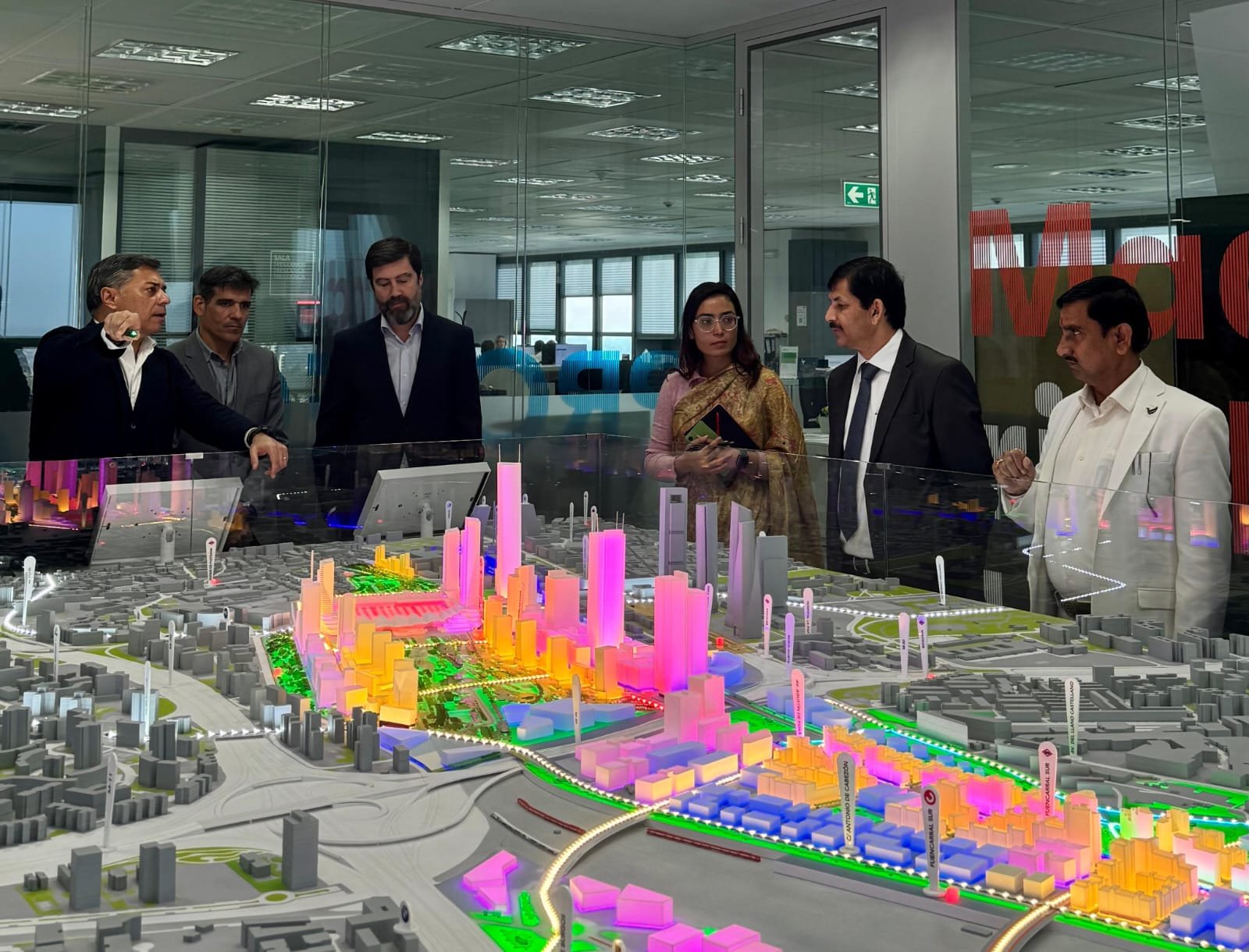
Madrid : Union Minister of State for Housing and Urban Affairs Tokhan Sahu visited Crea Madrid Nuevo Norte in Madrid as part of the first programme of his official visit to Spain. The project is regarded as one of the largest urban redevelopment initiatives in Europe and among the most ambitious urban transformation projects globally.
With an estimated investment of approximately ₹2.68 lakh crore (25.2 billion euros), the project is planned for phased implementation over the next 15 to 20 years. It aims to create a modern, well-planned, inclusive and sustainable urban development model for Madrid.
During the visit, Sahu reviewed the project’s integrated approach to urban planning, which brings together railway infrastructure, residential development, public transportation, commercial activities and green spaces.
Integrated Redevelopment of Chamartín Railway Station
A key feature of Madrid Nuevo Norte is the integrated redevelopment of Chamartín Railway Station. A new urban district is being developed over an area of approximately 2.3 million square metres above and around the railway station.
The project envisages the construction of around 10,500 new homes, including a significant number of affordable housing units. The development is intended to address residential requirements while creating a well-connected and accessible urban neighbourhood.
The integration of railway infrastructure with residential and commercial development is a central element of the project’s planning strategy.
Focus on Sustainable Mobility and Public Transport
The project places considerable emphasis on sustainable and accessible urban mobility. An integrated mobility hub is being planned to connect different modes of transportation and improve movement across the development.
Around 80 per cent of journeys are targeted to be made through walking, cycling and public transport. This approach is intended to reduce dependence on private vehicles, improve connectivity and promote environmentally sustainable travel.
In addition, the project will develop more than 1.5 million square metres of office and commercial space, creating opportunities for business activities and economic growth.
A proposed 300-metre-high building is also expected to become one of the tallest buildings in the European Union.
14.5-Hectare Central Park and Extensive Green Spaces
Environmental sustainability is another major component of Madrid Nuevo Norte. The plan includes the development of a 14.5-hectare Central Park over the railway tracks, along with more than 400,000 square metres of additional green spaces.
These green areas are expected to improve the urban environment, provide public recreational spaces and contribute to a more sustainable city structure.
The project is also expected to generate approximately 350,000 new employment opportunities, giving a significant boost to economic activity in the region.
Important Lessons for India’s Urban Development
Madrid Nuevo Norte demonstrates how railway stations, housing, public transport, commercial infrastructure and green spaces can be integrated into a comprehensive urban development framework.
The project offers important lessons for India, particularly in the areas of railway station redevelopment, transit-oriented development, affordable housing and the creation of environmentally sustainable urban infrastructure.
Its integrated planning approach provides an opportunity to understand how large railway and transport hubs can serve as catalysts for the development of modern urban centres.
India’s Focus on Modern and Sustainable Cities
Under the leadership of Prime Minister Narendra Modi, India is also prioritising modern urban infrastructure, affordable housing, accessible public transport and sustainable development.
In line with the vision of Viksit Bharat, efforts are underway to make Indian cities more modern, inclusive, convenient and better equipped to meet future urban requirements.
The visit to Madrid Nuevo Norte is significant in this context, as the project’s integrated development model offers valuable insights into combining infrastructure, mobility, housing and environmental sustainability in the planning of future cities.