

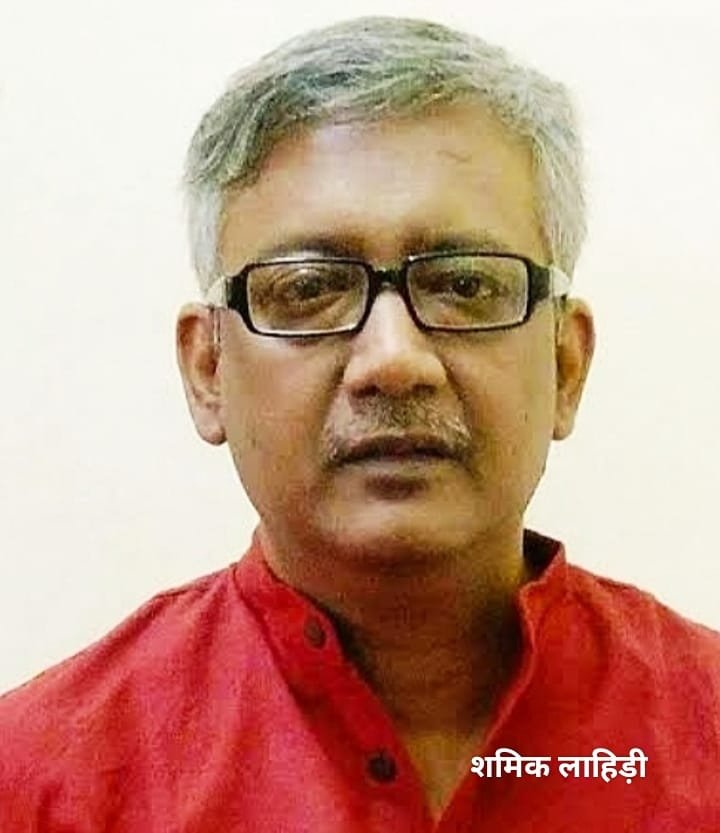

By Shamik Lahiri
Pray tell, what is the most critically urgent regional, national or international crisis facing our land today?
Ah, no—forgive me. You have asked a hopelessly foolish question!
Whether one’s stomach is empty or full, whether employment exists or not—those are terribly ancient and outdated concerns. The real question confronting civilisation today is this: tonight, will you earn a direct VIP pass to heaven by eating paneer, or will you roast in the fires of hell for eating mutton?
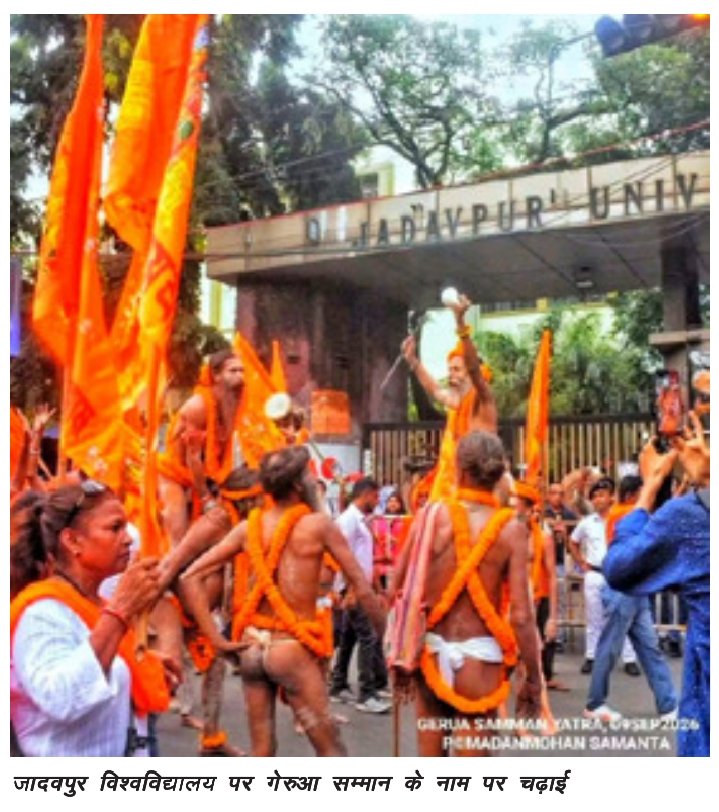
Recently, to settle this profound scientific, social and spiritual dilemma, a venerable ‘Babaji’ arrived in Bengal, reportedly with the state government’s support. He waved his arms and legs and showered us with priceless nuggets of wisdom. Television news channels watched open-mouthed, while social media revelled in the spectacle.
A dozen ministers and bureaucrats, led by the Chief Minister herself, were seen listening attentively to his words of supposed spiritual enlightenment. Thereafter, the holy ‘Babaji’ packed his bags and left the state as scheduled, leaving behind a benevolent parting glance and one particularly sharp remark: “Hypocrites!”
Whether he intended to diagnose Bengali society or had simply experienced a sudden moment of intense self-realisation, however, remains unclear.
Yet one major benefit certainly emerged.
The divisive political marketplace had been suffering from an oxygen shortage for some time, and the ‘Babaji’ arrived just in time to supply it with a full week’s emergency cylinder.
Now nobody talks about such useless matters as unemployment, the price of rice and sugar, or the shortage of jobs. Bengal is blissfully engrossed in the glorious World War of ‘Meat vs Vegetarianism’.
The whole spectacle is rather like offering solemn advice to a homeless man: “Brother, should we paint your non-existent ceiling saffron or white?”
The Great Debate Over Durga’s Hands
Hot on the heels of this cosmic event came an even more weighty, universe-altering crisis—the hands of a Durga idol.
Eleven hands.
Described as a “casual mistake”.
Let the rest of the nation’s petty troubles stand quietly in line with folded hands. First, we must count the Mother’s arms: one, two, three… eleven!
Instantly, heat waves engulfed newsrooms, a tsunami swept across social media and lightning struck the political stage. A debate of millimetre precision broke out over whose religious sentiments ran deeper.
At that very moment, somewhere in a corner, a young man was filling out a government job application.
His father’s pockets were empty, and the young man was seeing stars before his eyes. He might have thought to himself:
Eleven arms may certainly enhance the Mother’s divine power, but if only these two hands of mine could secure a job as a constable or clerk, at least the cooking pot at home would begin to boil.
What a magnificent civilisation ours has become!
A place where people can fiercely debate whether mutton or cottage cheese should be served on the plate, while asking why they are starving is considered vulgar.
Prime-time television can rage for hours over the exact number of arms on a deity, but the moment someone asks why there are not enough teachers in government schools, that person can immediately be branded a “demagi naxal”.
One Teacher for Hundreds of Students
Would you like to hear the official figures?
Government records show that during the 2025–26 academic year, 6,769 schools in West Bengal were functioning with only one teacher.
And how many students were enrolled in those single-teacher schools?
2,29,569 students.
In other words, one solitary teacher is expected to play the roles of teacher, headmaster, clerk and even school attendant responsible for ringing the dismissal bell.
If only our political demigods could somehow graft eight additional arms onto the shoulders of those lone teachers—just like the goddess—perhaps our education system could be saved!
Now comes the mirror image of this spiritual spectacle.
There are 4,133 government schools in the state with zero students.
Yet 19,502 teachers are reportedly employed there and continue to draw monthly salaries.
This is true Indian spiritual philosophy!
Where more than two lakh children are waiting with their mouths open, the guru is absent. And where nearly twenty thousand gurus reside in peaceful meditation, the students have mysteriously disappeared.
Naturally, our government-blessed Babaji did not waste a single sentence discussing this extraordinary educational arrangement.
Why would he?
There are no TRP ratings in it.
Unemployment: The Question Nobody Wants to Hear
Talk about meat and one faction loses its mind.
Preach vegetarianism and another becomes outraged.
Comment on Durga’s hands and everyone explodes.
But the moment you raise the issue of unemployment, the entire nation collectively falls into a sleep so deep that even Kumbhakarna might feel embarrassed.
What do the official PLFS figures for 2025 say?
In West Bengal, the unemployment rate among young people aged 15 to 29 stood at 10.6% under the Usual Status measure. Under the Current Weekly Status measure, it rose to 12.6%.
That means that, under the latter measure, roughly 12 to 13 out of every 100 young people in this age group were unemployed.
Their pockets are empty, yet the holy man lovingly asks:
“First tell me, child, did you eat jackfruit seeds for breakfast or mutton?”
Poverty Is More Than an Empty Wallet
NITI Aayog’s figures indicate that multidimensional poverty in India has declined.
According to the figures cited by NITI Aayog, multidimensional poverty fell from 24.85% in 2015–16 to 14.96% in 2019–21, with an estimated further decline to 11.28% in 2022–23.
These are official figures, of course, and figures are always capable of telling us something important.
But does a reduction in poverty mean that poverty has disappeared?
Poverty is not merely an empty wallet, my friend.
NITI Aayog’s own multidimensional poverty framework recognises several dimensions, including nutrition, schooling, drinking water, sanitation, electricity and housing.
A person can therefore suffer from more than hunger of the stomach.
There can be hunger for information, hunger for education, hunger for employment and hunger for dignity.
Yet no self-proclaimed Babaji ever preaches about these forms of hunger:
“Lo, my devotees, on the day every young person in this nation gets a job, I shall break my fast!”
Why would they?
Creating employment requires budgets, investment, factories, infrastructure and accountability.
But provoking an argument over vegetarian versus non-vegetarian food, or ten hands versus eleven, requires little more than a microphone and two cameras.
Add Facebook and WhatsApp propaganda to the mix, and you can create an inferno that spreads faster than fire in a nearby factory.
Where Are the Industries?
And speaking of factories and industry, someone might ask:
Where are the new industries in the state?
Ugh, what a hopelessly old-fashioned question!
Talking about industry means opening files, examining investments and calculating the availability of land, water and electricity.
How much easier it is to ask:
“Are you a mutton-eater or a vegetarian?”
Or:
“How many hands does Mother Durga have?”
Neither question requires anyone to open an economics textbook.
And here lies the greatest advantage.
Food and religion can divide people effortlessly into two opposing camps.
But unemployment cannot.
The pain of an unemployed Hindu youth and an unemployed Muslim youth is fundamentally the same.
Both need jobs.
Both need rice and dal on the table.
Both may need medicines for ageing parents.
And this commonality can be deeply inconvenient for those who profit politically from division.
So the clever operators throw a marble down the middle and encourage the two sides to fight.
What do you eat?
What does your goddess look like?
Meanwhile, the questions that actually determine everyday life quietly disappear:
Where is my job?
Why are there no teachers in my school?
Why is there no factory in my area?
Why is there no drinking water in my home?
All these questions dissolve into the cosmic void.
The Politics of Attention
The truth is that petrol and data are not necessarily the most expensive commodities in this country.
The most valuable asset is human attention.
Where your attention is directed—and where it remains trapped—is a crucial part of politics.
If you spend your entire day watching a holy man’s sermons on television and debating the contents of your dinner plate, where will you find the time to question your child’s future?
So there is little point in blaming the godmen alone.
They will arrive, distract us, collect their money and leave.
The real question is for us:
Will we walk into the same trap every single time?
If someone stands before a starving person today and asks:
“Brother, will you eat meat or vegetarian food?”
The starving man might well respond:
“Give me rice first, you rascal, or I’ll devour the map!”
Let some grain enter the stomach first.
Philosophy can be discussed afterwards.
That is an undeniable truth.
For a human being, the first religion is survival.
And the first condition of survival is putting food into the stomach.
All other quarrels can wait.
The goddess’s arms can be counted later.
The holy man’s sermons can be heard eventually.
But before all that, come, brother—let us count:
- Does the average person in this country have food in their hands?
- Do our young people have work in their hands?
- Do the 2,29,569 children in those 6,769 schools have enough teachers before them?
- And do the 19,502 teachers in those 4,133 schools have students sitting before them?
Ah, no!
This arithmetic is far too difficult and complicated.
That is probably why, to this day, no holy Babaji has ever appeared to solve this particular mathematical problem.
Yours,
Shamik Lahiri
The author is a Central Committee member of the Communist Party of India (Marxist), editor of the Bengali daily Ganashakti and a former Member of Parliament.