


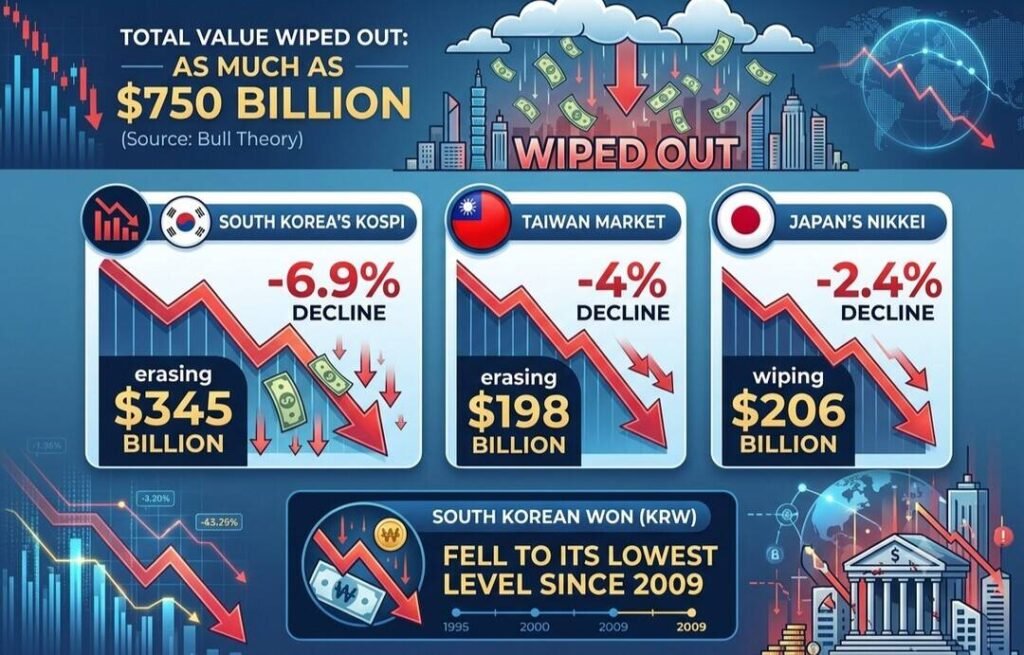
Seoul/Tokyo/Taipei — Asian financial markets suffered a dramatic downturn on Friday, with an estimated $750 billion in market value erased across the region amid a broad-based investor sell-off. The sharp decline hit major stock exchanges in South Korea, Taiwan, and Japan, raising concerns about growing uncertainty in global financial markets.
According to market data cited by Bull Theory, investors witnessed one of the most significant single-day losses in recent months as fears over economic growth, geopolitical tensions, and market volatility triggered widespread selling across Asian equities.
South Korea Leads Regional Losses
The biggest blow was felt in South Korea, where the benchmark KOSPI Index plunged 6.9%, wiping out approximately $345 billion in market capitalization.
The sell-off reflected heavy pressure on major South Korean companies, particularly in the technology, semiconductor, and manufacturing sectors. The decline also weighed heavily on investor sentiment, pushing the country’s currency lower.
Adding to concerns, the South Korean won fell to its lowest level since 2009, highlighting increasing pressure on the nation’s financial markets and raising fears of potential capital outflows.
Taiwan Stocks Suffer Heavy Damage
Taiwan’s stock market also experienced substantial losses, with the benchmark index declining 4% during the trading session.
The drop resulted in approximately $198 billion being erased from the market’s overall value. Technology stocks, which play a dominant role in Taiwan’s economy, were among the hardest hit as investors reduced exposure to risk-sensitive assets.
Analysts noted that weakness in global demand expectations and concerns surrounding the technology sector contributed to the sharp decline.
Japan’s Nikkei Extends Regional Sell-Off
In Japan, the Nikkei 225 Index fell 2.4%, resulting in an estimated $206 billion loss in market capitalization.
While Japan’s losses were less severe than those seen in South Korea and Taiwan, the decline underscored the widespread nature of the regional market downturn. Investors continued moving away from equities amid concerns over global economic conditions and potential disruptions to international trade.
Factors Behind the Market Decline
Market analysts pointed to several factors contributing to the sharp sell-off:
- Global economic uncertainty
- Concerns over slowing growth
- Investor risk aversion
- Geopolitical tensions
- Currency market volatility
- Weakness in technology and export-driven sectors
The broad decline reflects growing investor caution as markets attempt to assess the outlook for economic growth across major economies.
Impact on Investors
The combined $750 billion loss represents a significant destruction of shareholder value in a single trading session. Institutional investors, pension funds, retail traders, and foreign investors all felt the impact of the market correction.
Financial experts noted that such large declines can affect:
- Investment portfolios
- Retirement funds
- Corporate valuations
- Consumer confidence
- Foreign investment flows
What Investors Are Watching Next
Market participants will closely monitor upcoming economic data, central bank decisions, currency movements, and geopolitical developments for clues about the direction of global markets.
While short-term volatility remains elevated, analysts say investors will be looking for signs of stabilization before confidence returns to regional equities.
Key Market Losses at a Glance
Market Index Decline Market Value Lost South Korea (KOSPI)-6.9%$345 BillionTaiwan-4.0%$198 BillionJapan (Nikkei 225)-2.4%$206 BillionTotal Asian Market Losses — Approximately $750 Billion
Bottom Line
Asian markets experienced a severe shock on Friday as approximately $750 billion was wiped from regional stock exchanges. South Korea suffered the largest losses, followed by Taiwan and Japan, while the South Korean won’s fall to its weakest level since 2009 added to concerns about financial stability. Investors are now closely watching whether the sell-off represents a temporary correction or the beginning of a broader period of market turbulence.